

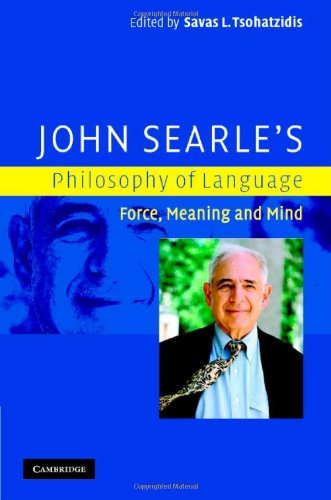
John Searle s Philosophy of Language Force Meaning and Mind 1st Edition by Savas Tsohatzidis 0511363924 9780511363924

Original price was: $50.00.$35.00Current price is: $35.00.
John Searle s Philosophy of Language Force Meaning and Mind 1st Edition by Savas L. Tsohatzidis – Ebook PDF Instant Download/Delivery: 0511363924, 9780511363924
Full download John Searle s Philosophy of Language Force Meaning and Mind 1st Edition after payment
Product details:
ISBN 10: 0511363924
ISBN 13: 9780511363924
Author: Savas L. Tsohatzidis
This is a volume of original essays on key aspects of John Searle’s philosophy of language. It examines Searle’s work in relation to current issues of central significance, including internalism versus externalism about mental and linguistic content, truth-conditional versus non-truth-conditional conceptions of content, the relative priorities of thought and language in the explanation of intentionality, the status of the distinction between force and sense in the theory of meaning, the issue of meaning scepticism in relation to rule-following, and the proper characterization of ‘what is said’ in relation to the semantics/pragmatics distinction. Written by a distinguished team of contemporary philosophers, and prefaced by an illuminating essay by Searle, the volume aims to contribute to a deeper understanding of Searle’s work in philosophy of language, and to suggest innovative approaches to fundamental questions in that area.
John Searle s Philosophy of Language Force Meaning and Mind 1st Table of contents:
Chapter 1 What is language: some preliminary remarks
1 Naturalizing language
2 Language as phonology, syntax, and semantics
3 Society and language
4 What does language add to prelinguistic cognition?
5 Features common to prelinguistic intentionality and language
The categories
6 Features of language that consciousness lacks
Structure and segmentation
Declarations
7 Some special features of consciousness. The unity of the proposition and the salience of objects w
8 The functions of language: Representation versus expression
9 Speaker meaning as the imposition of conditions of satisfaction on conditions of satisfaction
10 A further step: Syntactical compositionality
11 The next step: Deontology
12 The extension of deontology to social reality: How language enables us to create social instituti
13 Summary of the argument so far
14 Why standard semantic theories fail to account for these features
15 Why language is essentially conventional and why there are so many different languages
Notes
PART I From mind to meaning
Chapter 2 Content, mode, and self-reference
1 Illocutionary force, psychological mode, and the fallacy of misplaced information
2 The content of perceptual experience: Searle’s analysis
3 What is wrong with Searle’s analysis
4 Reflexive truth conditions without reflexive content
5 Time and memory
Notes
Chapter 3 Searle against the world: How can experiences find their objects?
1 The puzzle of experience and the problem of particularity
2 Searle’s inherently descriptivist solution
3 Why content cannot determine conditions of satisfaction
4 The indexicality of experience: Why the relation between object and experience is not part of cont
5 Afterthoughts
Note
Chapter 4 Seeing what is there
The particularity objection
The intentional content of visual experience
The richness objections: Reference to visual experience and perception of causes
The poverty objection: The representation of spatial location
Empirical considerations
Notes
Chapter 5 Intentionalism, descriptivism, and proper names
1 Sense, reference, and intentional content
2 Advantages of intentionalist theories
3 Names and descriptive content
4 The explanation argument
5 The disjunctive and second–order definite description theories
6 The variable definite description theory
Notes
Chapter 6 On the alleged priority of thought over language
Intrinsic intentionality
Speech acts
Animals and babies
Computationalism
Meaning and communication
How we can think in language
Notes
Chapter 7 Rule skepticism: Searle’s criticism of Kripke’s Wittgenstein
1 Introduction
2 Kripke’s Wittgenstein
3 Searle’s interpretation of Kripke’s Wittgenstein
4 Searle’s criticism of WRPL
5 An alternative reading of the skeptical challenge and argument
6 Are there two forms of skepticism in WRPL?
7 An alternative reading of the skeptical solution
8 Why the skeptical solution does not beg the skeptical challenge
9 Conclusion
Note
PART II From meaning to force
Chapter 8 How to say things with words
1 Introduction
2 Locutionary content versus “What is said”
3 Locutionary acts and locutionary content
4 ‘Locuted’ but not said: some examples
(4.1) He is a fine friend
(4.2) John is turning red
(4.3) Flying planes can be dangerous
(4.4) Aristotle enjoyed philosophy
(4.5) You are late
(4.6) I am Joana
5 Locutionary vs. propositional content
6 Conclusion
Appendix: The reflexive-referential theory
Notes
Chapter 9 Semantics without the distinction between sense and force
Introduction
1 Assertion and belief – R1
1.1 Reason and normative expressivism
1.2 A plurality of Π-properties
2 Compositionality: jumping to R3
3 Proto-asserting and sentential embedding – R4
4 Back to assertion and saying – R2
5 Mood – R5
Conclusions
Notes
Chapter 10 Dynamic discourse semantics for embedded speech acts
1 Introduction
2 Embeddings of various speech acts
3 A discourse-based semantics for interrogatives and imperatives
3.1 Interrogatives
3.2 Imperatives: propositional dynamic logic+dynamic semantics
3.3 Extending the semantics
3.4 Compositional semantics for imperativals
4 Pragmatics and discourse
5 Results and Predictions
5.1 Conjunction revisited
5.2 Disjunction Revisited
5.3 Negation revisited
5.4 What does this semantics not claim to be consistent?
Conclusions
Notes
Chapter 11 Yes–no questions and the myth of content invariance
1 Two kinds of force-content distinction
2 Yes–no questions and the analysis of illocutionary acts
3 Yes–no questions and the classification of illocutionary acts
Note
Chapter 12 How do speech acts express psychological states?
1 Introduction
2 Expression and Moorean absurdity
3 Expression as designed showing
4 Conventions, norms, and handicaps
5 Expressive speech acts as handicaps
People also search for John Searle s Philosophy of Language Force Meaning and Mind 1st:
chinese philosophy meaning the way
what is the philosophy of john locke
tim maudlin philosophy of physics quantum theory
john locke philosophy example
john searle philosophy of language
Tags: John Searle, Philosophy, Language, Force Meaning, Mind, Savas Tsohatzidis