

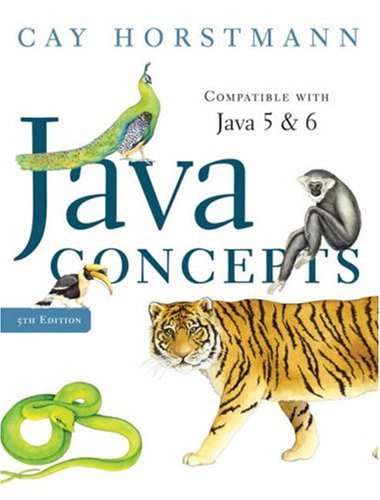
Java concepts 5th Edition by Cay S Horstmann ISBN 0470105550 9780470105559
Original price was: $50.00.$35.00Current price is: $35.00.
Java concepts 5th Edition by Cay S Horstmann – Ebook PDF Instant Download/Delivery: 0470105550, 9780470105559
Full download Java concepts 5th Edition after payment
Product details:
ISBN 10: 0470105550
ISBN 13: 9780470105559
Author: Cay S Horstmann
Let Cay Horstmann teach you to think like a programmer!
If you really want to master Java, it’s not enough to know the code. You must begin to think like a programmer, and in this newest edition of his bestselling guide, Java Concepts, programming guru Cay Horstmann shows you how.
Updated to integrate Java 6, Java Concepts, Fifth Edition introduces you to fundamental programming techniques and design skills that are crucial to learning how to program. Drawing on his many years of experience as an expert programmer and teacher, Horstmann brings out the most important elements of computing, problem solving, and program design.
Thanks to Horstmann’s proven formula, you’ll complete this book with a thorough grounding in programming concepts and problem-solving and get quickly up to speed writing efficient and successful programs.
Features of the new Fifth Edition:
* The ‘Objects Gradual’ approach leads you into object-oriented thinking step-by-step, from using classes, implementing simple methods, all the way to designing your own object-oriented programs.
* A strong emphasis on test-driven development encourages you to consider outcomes as you write programming code so you design better, more usable programs
* Unique approach goes beyond language syntax to focus on computer science concepts and problem solving, encouraging you to think as a problem solver
* New teaching and learning tools in WileyPLUS–including a unique assignment checker that enables you to test your programming problems online before you submit them for a grade
* Helpful “Testing Track” introduces techniques and tools step by step, ensuring that you master one before moving on to the next
* Graphics topics are developed gradually throughout the text, conveniently highlighted in separate color-coded sections
* Updated coverage is fully compatible with Java 5 and includes a discussion of the latest Java 6 feature
Java concepts 5th Table of contents:
1. Introduction
1.1 What is Advanced Placement?
1.1.1 Computer Science as an AP Subject
1.2 Who Takes AP Courses?
1.2.1 Who Takes AP Computer Science?
1.3 What is the Difference Between AP Computer Science A and AB?
1.3.1 AP CS Course Organization
1.4 Which Elements of Computer Science Are on the AP Exam?
1.4.1 Format of the AP CS Exam
1.5 Strategies for Taking the AP CS Exam
1.5.1 Strategies for Part 1
1.5.2 Strategies for Part 2
1.5.3 Materials You Should Bring
1.5.4 Last Minute Reminders
1.6 How Are the Exams Graded?
1.6.1 Special Recognition for Doing Well
1.6.2 College Credit or Placement
1.7 How Should This Guide be Used to Prepare for the AP CS Exam?
1.8 Where Can I Get More Information?
1.8.1 Where Can I Get the Text Ancillaries?
1.9 Are There Other Suggestions for Success in AP CS?
2. Introduction to Hardware and Software
2.1 What Is Programming?
2.2 The Anatomy of a Computer
2.3 Translating Human-Readable Programs to Machine Code
2.4 The Java Programming Language
2.5 Becoming Familiar with Your Computer
2.6 Compiling a Simple Program
2.6.1 Java Comments
2.7 Errors
2.8 The Compilation Process
3. Using Objects
3.1 Types and Variables
3.2 The Assignment Operator
3.3 Objects, Classes, and Methods
3.4 Method Parameters and Return Values
3.5 Number Types
3.6 Constructing Objects
3.7 Accessor and Mutator Methods
3.8 Implementing a Test Program
3.9 The API Documentation
3.10 Object References
4. Implementing Classes
4.1 Levels of Abstraction
4.1.1 Black Boxes
4.1.2 Object-Oriented Design
4.1.3 Crawl, Walk, Run
4.2 Specifying the Public Interface of a Class
4.3 Commenting the Public Interface
4.4 Instance Fields
4.5 Implementing Constructors and Methods
4.5.1 Implementing Constructors
4.5.2 Implementing Methods
4.5.3 Designing and Implementing a Class
4.6 Unit Testing
4.7 Categories of Variables
4.8 Implicit and Explicit Method Parameters
5. Fundamental Data Types
5.1 Number Types
5.1.1 Numbers in Other Bases
5.2 Constants
5.3 Assignment, Increment, and Decrement
5.4 Arithmetic Operations and Mathematical Functions
5.5 Calling Static Methods
5.5.1 More on Type Conversion
5.5.2 Random Numbers
5.6 Strings
5.6.1 Escape Sequences
6. Decisions
6.1 The if Statement
6.2 Comparing Values
6.2.1 Relational Operators
6.2.2 Comparing Floating-Point Numbers
6.2.3 Comparing Strings
6.2.4 Comparing Objects
6.2.5 Testing for null
6.3 Multiple Alternatives
6.3.1 Dangling else
6.4 Using Boolean Expressions
6.4.1 Short Circuit Evaluation
6.4.2 Using Boolean Variables
6.5 Test Coverage
7. Iteration
7.1 while Loops
7.2 for Loops
7.3 Nested Loops
7.4 Processing Sentinel Values
7.5 Loop Invariants (AB only)
7.6 Using a Debugger
Cumulative Review 1: Chapters 2–7
8. Arrays and Array Lists
8.1 Arrays
8.1.1 A Word about Efficiency
8.1.2 A Formal Analysis of Array Efficiency (AB only)
8.2 Array Lists
8.2.1 Another Word about Efficiency
8.2.2 A Formal Analysis of Array List Efficiency (AB only)
8.3 Wrappers and Auto-boxing
8.4 The Enhanced for Loop
8.5 Simple Array Algorithms
8.6 Two-Dimensional Arrays (AB only)
9. Designing Classes
9.1 Choosing Classes
9.2 Cohesion and Coupling
9.3 Accessors, Mutators, and Immutable Classes
9.3.1 Parameter Passing
9.4 Side Effects
9.5 Preconditions and Postconditions
9.5.1 Class Invariants (AB only)
9.6 Static Methods
9.7 Static Fields
9.8 Scope
9.8.1 Scope of Local Variables
9.8.2 Scope of Class Members
9.8.3 Initializing Variables
9.9 Packages
10. Interfaces and Polymorphism
10.1 Using Interfaces for Code Reuse
10.1.1 Constants in Interfaces
10.2 Converting Between Class and Interface Types
10.3 Polymorphism
11. Inheritance
11.1 Introduction to Inheritance
11.2 Inheritance Hierarchies
11.3 Inheriting Instance Fields and Methods
11.4 Subclass Construction
11.5 Converting Between Subclass and Superclass Types
11.6 Abstract Classes
11.7 Access Control
11.8 Object: The Cosmic Superclass
11.8.1 Inheritance and the toString Method
11.8.2 Inheritance and the equals Method
12. Exception Handling
12.1 Introduction to Exceptions
12.1.1 Understanding Exceptions
12.2 Throwing Exceptions (AB only)
12.3 Checked and Unchecked Exceptions
13. Object-Oriented Design
13.1 The Software Life Cycle
13.2 Discovering Classes
13.3 Relationships Between Classes
Cumulative Review 2: Chapters 8–13
14. Recursion
14.1 Thinking Recursively
14.2 Permutations
14.3 Tracing Through Recursive Methods
14.4 The Efficiency of Recursion
15. Sorting and Searching
15.1 Selection Sort
15.1.1 Analyzing the Performance of the Selection Sort Algorithm
15.2 Insertion Sort
15.2.1 Analyzing the Performance of the Insertion Sort Algorithm
15.3 Merge Sort
15.3.1 Analyzing the Performance of the Merge Sort Algorithm
15.4 Quicksort (AB only)
15.4.1 Analyzing the Performance of the Quicksort Algorithm (AB only)
15.5 Comparing O(n²) and O(n log(n)) (AB only)
15.6 Sequential Search
**15.6.1 Analyzing the Performance of
People also search for Java concepts 5th:
java concepts 5th edition
java concepts with examples
java basic concepts with examples
java all basic concepts
java concepts early objects pdf
Tags: Cay S Horstmann, Java concepts