

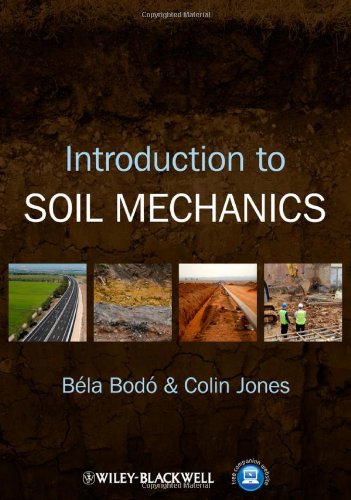
Introduction to soil mechanics 1st Edition by Béla Bodó ,Colin Jones ISBN 0470659432 978-0070407695

Original price was: $50.00.$35.00Current price is: $35.00.
Introduction to soil mechanics 1st Edition by Béla Bodó ,Colin Jones – Ebook PDF Instant Download/Delivery:0470659432 ,978-0070407695
Full download Introduction to soil mechanics 1st Edition after payment
Product details:
ISBN 10:0470659432
ISBN 13:978-0070407695
Author:Béla Bodó ,Colin Jones
INTRODUCTION TO SOIL MECHANICS
Introduction to Soil Mechanics covers the basic principles of soil mechanics, illustrating why the properties of soil are important, the techniques used to understand and characterise soil behaviour and how that knowledge is then applied in construction. The authors have endeavoured to define and discuss the principles and concepts concisely, providing clear, detailed explanations, and a wellillustrated text with diagrams, charts, graphs and tables. With many practical, worked examples and end-of-chapter problems (with fully worked solutions available at www.wiley.com/go/bodo/soilmechanics) and coverage of Eurocode 7, Introduction to Soil Mechanics will be an ideal starting point for the study of soil mechanics and geotechnical engineering.
This book’s companion website is at
www.wiley.com/go/bodo/soilmechanics and offers invaluable resources for both students and lecturers:
- Supplementary problems
- Solutions to supplementary problems
Table of contents:
- Soil Structure
Volume relationships
Voids ratio (e)
Porosity (n)
Degree of saturation (Sr)
Weight−volume relationships
Bulk densities
Dry densities
Saturated densities
Submerged densities (γ′)
Density of solids (γs)
Specific gravity (Gs)
Moisture content (m)
Partially saturated soil
Relative density (Dr)
Alteration of soil structure by compaction
Laboratory compaction tests
Practical considerations
Relative compaction (Cr)
Compactive effort
Under- and overcompaction
Site tests of compaction
California bearing ratio (CBR) test
The pycnometer
Supplementary problems - Classification of Cohesive Soils
Atterberg Limits
Liquid Limit (LL)
Plastic Limit
Shrinkage Limit
Swelling of cohesive soils
Saturation Limit (Z%)
Relationship between the limits
Linear shrinkage and swelling
Consistency indices
Plasticity index (PI)
Relative consistency index (RI)
Liquidity index (LI)
Classification of soils by particle size
Sieve analysis
Uniformity coefficient (U)
Filter design
Typical problems
Combination of materials
Sedimentation tests
Supplementary problems - Permeability and Seepage
Coefficient of permeability (k)
Seepage velocity (us)
Determination of the value of k
Constant head test
Falling head test
Field pumping tests
Unconfined layer
Radius of influence (R)
Confined layer under artesian pressure (σA)
Permeability of stratified soil
Flow nets
Flow lines (FL)
Head loss in a flow channel
Equipotential lines (EPL)
Flow net construction
Application of flow nets
Seepage flowrate (Q)
Seepage pressure
Seepage force (S)
Erosion due to seepage
Prevention of piping
Flow net for earth dams
Supplementary problems - Pressure at Depth Due to Surface Loading
Concentrated point load
Concentrated line load
Uniform strip loading (Michell’s solution)
Bulb of pressure diagrams
Vertical pressure under triangular strip load
Vertical pressure under circular area
Rectangular footing
Footings of irregular shape
Pressure distribution under footings
Influence of footing
Influence of loading
Linear dispersion of pressure
Supplementary problems - Effective Pressure (σ′)
Unloaded state
Loaded state
Flooded state
Types of problem
Effect of seepage on shallow footings
Ground water lowering (at atmospheric pressure)
Reduction of artesian pressure
Capillary movement of water
Equilibrium moisture content (mE)
Soil suction (Ss)
Supplementary problems - Shear Strength of Soils
Coulomb–Mohr Theory
Stresses on the plane of failure
Friction and cohesion
Apparent cohesion
Stress path
Stress path failure envelope
Variation of stress path
Effect of saturation
Effective Mohr’s circle
Effective stress path (ESP)
Measurement of shear strength
Triaxial tests
Variation of pore pressure
Total excess pore pressure
Unconsolidated–undrained tests
Quick-undrained test
Consolidated–undrained (CU) test
Consolidated–drained (CD) test
Unconfined compression strength of clays
Standard shear box test
The Vane shear test
Residual shear strength
Thixotropy of clay
Undrained cohesion and overburden pressure
Supplementary problems - Consolidation and Settlement
Consolidation
The pressure–voids ratio curve
Analytical solution
Equation of the σ′−e curve
Alternative conventional procedure
Graphical solution
Forms of the σ′−e curve
Normally consolidated clay
Overconsolidated clays
Coefficient of Compressibility (av)
Coefficient of Volume Change (mv)
Voids ratio method
Direct method
Estimation of settlement
Voids ratio method
Method Using mv
Direct method
Rate of consolidation
Variation of excess pore pressure with time
Typical pore pressure distributions
Estimation of time
Coefficient of Consolidation (cv)
Pore pressure isochrones
Average percentage consolidation
Coefficient of permeability (k)
Time from similarity
Total settlement
Initial compression
Primary consolidation
Secondary consolidation
Supplementary problems for - Lateral Earth Pressure
Resistance to active expansion
The value of K0
Stress path representation
Rankine’s theory of cohesionless soil
Stress path representation (Lambe)
Rankine-Bell theory for c − φ soil
Tension cracks
Effect of surcharge (q kN/m) on z0
Water in the cracks only
Rankine−Bell theory for c–soil
Pressure−force and its line of action
Triangular diagram for uniform soil
Triangular diagram for water
Rectangular diagram for surcharge only
Wall supporting sloping surface
General formulae for c − φ soil
Active case
Passive case (with surcharge)
Formulae for pure clay (φ = 0)
Height of unsupported clay
Wedge theories
Procedure for cohesionless soil
Procedure for cohesive soil
Point of application of Pa(x)
Effect of static water table
Stability of retaining walls
Gravity walls
Cantilever walls
Buttress and counterfort walls
Stability check
Sheet piles
Cantilever sheet pile walls
Factor of safety
Bending of sheet piles
Sheet pile in cohesive soils
Anchored sheet pile walls
Free-earth support method
Fixed-earth support method
Anchorage
Length of tie rod (L)
Stability of anchors
Effect of ground water
Stability of deep trenches
Horizontal bracing
Bentonite slurry support
Trench in clay
Trench in sand
Supplementary problems - Bearing Capacity of Soils
Terminology
Foundation pressure (σ)
Net foundation pressure (σn)
Effective overburden pressure (σ′0)
Ultimate bearing capacity (qu)
Net ultimate bearing capacity (qn)
Safe net bearing capacity (qsn)
Safe bearing capacity (qs)
Allowable foundation pressure (σa)
Presumed bearing values
Shallow strip footing
Terzaghi’s equation for qu
Effect of static water table
Influence of footing shape
Shallow rectangular footing
Method of Fellenius
Deep foundations
Moderately deep foundations
Standard penetration test (SPT)
Pile foundations
Types of pile
Some reasons for choosing piles
Some reasons for not choosing piles
Effects necessitating caution
Negative skin friction
Stress distribution around piles
Load-carrying capacity of piles
Static formulae
End-bearing resistance (Qe)
Shaft resistance (Qs)
Ultimate carrying capacity of pile
Allowable carrying capacity of piles (Qa)
Negative skin friction (Qf)
End bearing resistance and SPT
Influence of pile section on Qu
Group of piles
Eccentrically loaded pile group
Settlement of pile groups
Raking piles
Supplementary problems - Stability of Slopes
Short-term and long-term stability
Total stress analysis (cohesive soils)
Homogeneous, pure clay (φu = 0)
Increasing the value of Fs
Minimum value of Fs
Potential slip surface
Determination of the factor of safety
Homogeneous c − φ soil (total stress analysis)
Stratified slopes
Slopes under water
Taylor’s stability numbers
Effective stress analysis (cohesive soils)
Method of slices (radial procedure)
Bishop’s conventional method
Bishop’s rigorous iterative method
Stability of infinite slopes
Supplementary problems - Eurocode 7
Introduction
Recommended units
Limit states
Design procedures
Verification procedures
Application of partial factors
People also search for:
introduction to soils notes
what is c’ in soil mechanics
an introduction to geotechnical engineering
introductory soil mechanics and foundations geotechnical engineering
soil mechanics 1 lecture notes
Tags: Béla Bodó, Colin Jones, Introduction, mechanics