

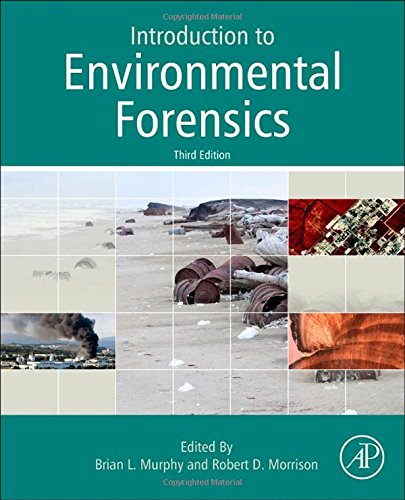
Introduction to Environmental Forensics 3rd Edition by Brian L Murphy, Robert D Morrison ISBN 0124046967 9780124046962

Original price was: $50.00.$35.00Current price is: $35.00.
Introduction to Environmental Forensics 3rd Edition by Brian L Murphy, Robert D Morrison – Ebook PDF Instant Download/Delivery: 0124046967, 9780124046962
Full download Introduction to Environmental Forensics 3rd Edition after payment
Product details:
ISBN 10: 0124046967
ISBN 13: 9780124046962
Author: Brian L Murphy, Robert D Morrison
Environmental forensics deals with questions such as: Whose hazardous waste is it? When was it placed in its present location? How did it happen? How much have people and the environment been exposed? How should liabilaty be allocated? The third edition of INTRODUCTION TO ENVIRONMENTAL FORENSICS will provide the most current coverage of issues and techniques crucial to forensic investigations of environmental disasters. It will show the evolution of the field, including topics such as chemical fingerprinting of hydrocarbons and PCBs, forensic air dispersion modeling analysis, and soil and groundwater modeling. Written by an international group of scientific specialists in order to cover this broad and important field most fully, the new volume will rely on reader feedback to focus on the most important areas for environmental professionals. INTRODUCTION TO ENVIRONMENTAL FORENSICS, third edition will be of interest to consultants, regulators, attorneys, or others whose practice involves identifying sources of pollution and allocating responsibility among multiple parties.
Introduction to Environmental Forensics 3rd Table of contents:
Section I. Basic Information
Chapter 1. Applications of Environmental Forensics
1.1. Introduction
1.2. Chemical Characterization and/or Delineation of Contamination
1.3. Reconstructing Historical Releases and Establishing Background
1.4. Determination of Responsibility and Allocation of Liability
1.5. Insurance Litigation
1.6. Toxic Torts
Chapter 2. Essential Historical Research Methods and Their Application to Environmental Forensics
2.1. Introduction
2.2. Historical Research for Site Assessment or Responsibility Assignment
2.3. Historical Research and Analysis for Apportionment and Cost Allocation
2.4. The Historian’s Contribution to Liability Determinations
2.5. The Historian’s Contribution to Cost Allocation
2.6. Historical Research and Analysis for Matters of “Intentionality”
2.7. Conclusion
Chapter 3. Photogrammetry, Photointerpretation, and Digital Imaging and Mapping in Environmental Forensics
3.1. The Aerial Photographic Record
3.2. Principles of Photogrammetry
3.3. Photointerpretation
3.4. Analytical Products and Preparation of Exhibits
3.5. Case Studies
3.6. Conclusion
Chapter 4. The Measurement Process
4.1. Introduction
4.2. Sampling and Analytical Errors in the Measurement Process
4.3. Planning
4.4. Sampling Different Media
4.5. Data Assessment
4.6. Conclusion
Chapter 5. Statistical Methods
5.1. Introduction
5.2. Background
5.3. Applications in Environmental Forensics
5.4. Conclusion
Chapter 6. Identification of Forensic Information from Existing Conventional Site-Investigation Data
6.1. Introduction
6.2. Site History
6.3. Geological Data
6.4. Hydrogeological Data
6.5. Contaminant Chemistry Data
6.6. High Resolution Site Characterization (HRSC) Data
6.7. Data Reflecting Postrelease Contaminant Concentration Pattern Changes
6.8. Conclusion
Chapter 7. Chemical Partitioning and Transport in the Environment
7.1. Introduction
7.2. Chemical Parameters
7.3. Fugacity Description of Partitioning
7.4. Mass-Transfer Models
7.5. The Advection–Dispersion Equation
7.6. Conclusion
List of Symbols and Abbreviations
Section II. Chemical, Biological, And Isotopic Pattern-Recognition Methods
Chapter 8. Hydrocarbon Fingerprinting Methods
8.1. Introduction
8.2. Overview of Chemical Fingerprinting Methodology
8.3. Quality Assurance and Quality Control
8.4. Volatile Hydrocarbon Fingerprinting Methods
8.5. Semivolatile Hydrocarbon Fingerprinting Methods
Chapter 9. Source Identification and Age Dating of Chlorinated Solvents
9.1. Introduction
9.2. Product Formulations and Diagnostic Stabilizers
9.3. Manufacturing Impurities
9.4. Manufacturing Impurities to Distinguish New and Used Vapor Degreasing Chlorinated Solvents
9.5. Symmetric Tetrachloroethane for Age Dating PCE and TCE
9.6. Compound-Specific Isotope Analysis (CSIA)
9.7. Reconstructed Chlorinated Hydrocarbon Plume Technique
9.8. Conclusion
Chapter 10. Congeners: A Forensics Analysis
10.1. Introduction
10.2. Polycyclic Aromatic Hydrocarbons (PAHs)
10.3. Polychlorinated Biphenyls (PCBs)
10.4. Dioxins and Furans
10.5. Other Chemical Families
10.6. Developing Analytical Tools for Forensic Studies of Congeners
10.7. Conclusion
Chapter 11. Application of Stable Isotopes and Radioisotopes in Environmental Forensics
11.1. Introduction
11.2. Radioisotope Age Dating of Contaminants in Sediments and Groundwater
11.3. Use of Stable Isotopes to Identify Contaminant Sources
11.4. Biodegradation
11.5. Vocs and Vapor Intrusion
11.6. Sources and Sink of Atmospheric Gases
11.7. Combining Isotope Methods with Other Methods
11.8. Inorganic Isotopes
11.9. Shale Gas, Shale Oil, and Hydrofracking
11.10. Developments in LC/IRMS
Chapter 12. Criminal and Environmental Soil Forensics: Soil as Physical Evidence in Forensic Investigations
12.1. Introduction
12.2. Soil and Forensic Context
12.3. Classic Methods of Characterizing Soil for Forensic Investigations
12.4. The Practice of Forensic Investigations Relating to Soil
12.5. Developments in Analysis of Soil Samples
12.6. Characterization of Soil Organic Matter
12.7. Maximization of Soil Evidence by Integration and Use of Databases
Chapter 13. Environmental Forensic Microscopy
13.1. Introduction
13.2. Sampling and Analysis Equipment
13.3. Determining the Nature of Contaminants
13.4. Measuring the Extent of a Specific Contaminant
13.5. Case Studies: Examples of Environmental Forensic Microscopy Investigations
13.6. Conclusion
Chapter 14. Hydraulic Fracturing: Data Analysis Methods to Identify Sources of Dissolved Gas and Chemical Compounds in Drinking Water Wells
14.1. Introduction
14.2. Chemical Characterization of Potential Sources for The Drinking Water Well in Question
14.3. Sampling of Drinking Water Wells
14.4. Laboratory Analysis
14.5. Data Analysis Methods to Investigate The Source(s) of Gases in Drinking Water Wells
14.6. Conclusion
Chapter 15. Forensic Applications of Dendroecology
15.1. Introduction
15.2. Terminology
15.3. Principles
15.4. Dendroecology/Phytoscreening Sampling
15.5. Sample Preparation and Analysis
15.6. Forensic Opportunities
15.7. Interpretation of Dendroecology/Phytoscreening Data
15.8. Conclusion
Section III. Forensic Modeling
Chapter 16. Forensic Applications of Subsurface Contaminant Transport Models
16.1. Introduction
16.2. Contaminant Releases on a Paved and Unpaved Surface
16.3. Contaminant Transport Through a Paved Surface
16.4. Contaminant Transport Through an Unpaved Surface
16.5. Contaminant Transport Through Soil
16.6. Groundwater Models
16.7. Conclusion
Chapter 17. Forensic Investigation of Underground Storage Tanks and Subsurface Piping
17.1. Introduction
17.2. Forensic Sampling During Tank Excavation
17.3. Historical UST Standards
17.4. Corrosion
17.5. Conclusion
Chapter 18. Principal Components Analysis and Receptor Models in Environmental Forensics
18.1. Introduction
18.2. Principal Components Analysis
18.3. Self-Training Receptor-Modeling Methods
18.4. The Influence of Alteration Processes on Mixing Models
18.5. Conclusion
Chapter 19. Multivariate Statistical Methods and Source Identification in Environmental Forensics
19.1. Introduction
19.2. Multivariate Methods
Chapter 20. Receptor Models and Measurements for Identifying and Quantifying Air Pollution Sources
20.1. Introduction
20.2. The General Air Quality Model
20.3. The Chemical Mass Balance Receptor Model
20.4. Chemical Components (i)
20.5. Source Profiles (j)
20.6. Sampling Periods (k)
20.7. Particle Size (m)
20.8. Receptor Locations (l)
20.9. Estimating Uncertainties (σCikl, σFij, and σSjkl)
20.10. Receptor-Model Application and Validation Protocol
People also search for Introduction to Environmental Forensics 3rd:
an introduction to forensic science
an introduction to forensics webquest
an introduction to environmental science
an introduction to forensics webquest answers
an introduction to forensics webquest answer key
Tags: Brian L Murphy, Robert D Morrison, Environmental Forensics