

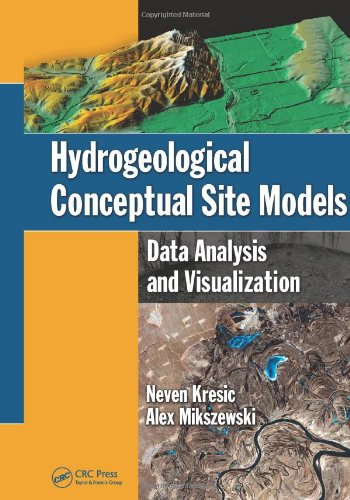
Hydrogeological Conceptual Site Models Data Analysis and Visualization 1st Edition by Neven Kresic, Alex Mikszewski ISBN 1439852227 9781439852224


Original price was: $50.00.$35.00Current price is: $35.00.
Hydrogeological Conceptual Site Models Data Analysis and Visualization 1st Edition by Neven Kresic, Alex Mikszewski – Ebook PDF Instant Download/Delivery: 1439852227, 9781439852224
Full download Hydrogeological Conceptual Site Models Data Analysis and Visualization 1st Edition after payment
Product details:
ISBN 10: 1439852227
ISBN 13: 9781439852224
Author: Neven Kresic, Alex Mikszewski
Hydrogeological Conceptual Site Models Data Analysis and Visualization 1st Table of contents:
1. Introduction
1.1 Historical Example
1.2 Example Uses of This Book
References
2. Conceptual Site Models
2.1 Definition
2.2 Physical Profile
2.2.1 Geomorphology (Topography)
2.2.2 Hydrology
2.2.3 Climate (Hydrometeorology)
2.2.4 Land Use and Land Cover
2.2.5 Water Budget
2.3 Hydrogeology
2.3.1 Aquifers in Unconsolidated Sediments
2.3.1.1 Alluvial Aquifers
2.3.1.2 Basin-Fill Aquifers
2.3.1.3 Blanket Sand-and-Gravel Aquifers
2.3.1.4 Aquifers in Semiconsolidated Sediments
2.3.1.5 Glacial-Deposit Aquifers
2.3.2 Sandstone Aquifers
2.3.3 Fractured-Bedrock Aquifers
2.3.4 Karst Aquifers
2.3.5 Basaltic and Other Volcanic Rock Aquifers
2.3.6 Aquitards
References
3. Data Management, GIS, and GIS Modules
3.1 Introduction
3.2 Data Management for GIS
3.2.1 Data Management Failures
3.2.1.1 Working with the Wrong Units
3.2.1.2 Working with Unknown or Mixed Coordinate Systems
3.2.1.3 Erroneous Query Results
3.2.1.4 Data Entry Inefficiency
3.2.2 Data Management Systems
3.2.2.1 Define the Project Objective
3.2.2.2 Determine the Quantity and Type of Field and Laboratory Data to Be Collected
3.2.2.3 Perform Required Data Collection and Analysis
3.2.2.4 Present Study Conclusions
3.3 Introducing the Geodatabase
3.3.1 Tables
3.3.2 Feature Classes
3.3.3 Rasters
3.4 Basics of Geodatabase Design
3.4.1 Table Format and Querying
3.4.1.1 Select Query
3.4.1.2 Cross-Tab Query
3.4.1.3 Forms
3.4.2 Data Linkage with GIS
3.4.3 Errors in Geodatabase Design
3.4.3.1 Fields with Wrong Data Type
3.4.3.2 Spaces in Data Field Names
3.4.3.3 Misspellings and Format Discrepancies
3.4.3.4 Cross-Tab Query Difficulties
3.4.3.5 Inconsistent or Unknown Coordinate Systems
3.5 Working with Coordinate Systems
3.6 Data Visualization and Processing with ArcGIS
3.6.1 Why Visualize Data?
3.6.2 Analog versus Digital Data
3.6.3 Data Visualization in ArcMap
3.6.3.1 Data View
3.6.3.2 Layout View
3.6.4 Geoprocessing in ArcMap
3.6.4.1 Querying Tools
3.6.4.2 Labeling Tools
3.6.4.3 Editing Tools
3.6.4.4 Georeferencing Tools
3.6.4.5 Analysis Tools
3.6.4.6 Measurement Tools
3.6.4.7 Data Management Tools
3.7 GIS Modules for Hydrogeological Data Analysis
3.7.1 Statistical Analyses
3.7.1.1 Visual Sample Plan
3.7.1.2 FIELDS Rapid Assessment Tool Software
3.7.1.3 Spatial Analysis and Decision Assistance
3.7.1.4 ArcToolbox
3.7.1.5 ProUCL
3.7.1.6 Monitoring and Remediation Optimization System
3.7.1.7 Other Tools
3.7.2 Geostatistics and Contouring
3.7.3 Boring Logs and Cross Sections
3.7.4 Proprietary Environmental Database Systems
3.7.5 General Notes on Computer Modules
References
4. Contouring
4.1 Introduction
4.2 Contouring Methods
4.2.1 Manual Contouring
4.2.2 Contouring with Computer Programs
4.2.3 Spatial Interpolation Models
4.2.3.1 Deterministic Models
Triangulation with Linear Interpolation
Minimum Curvature
Inverse Distance to Power
Natural Neighbor Method
Modified Shepard’s Method
Global and Local Polynomial Interpolation
Radial Basis Functions (Splines)
4.2.3.2 Geostatistical Models
4.2.3.3 Trend and Anisotropy
4.2.3.4 Error and Uncertainty Analysis
4.3 Kriging
4.3.1 Variography
4.3.1.1 Semivariogram Curve-Fitting
4.3.1.2 Search Neighborhood
4.3.1.3 Modeling Techniques
4.3.2 Kriging Prediction Standard Error
4.3.2.1 Nugget Effect and Prediction Standard Error
4.3.3 Types of Kriging
4.3.3.1 Ordinary, Simple, and Universal Kriging
4.3.3.2 Cokriging
4.3.3.3 Indicator Kriging
4.3.3.4 Point and Block Kriging
4.4 Contouring Potentiometric Surfaces
4.4.1 Importance of Conceptual Site Model
4.4.2 Heterogeneity and Anisotropy
4.4.3 Influence of Hydraulic Boundaries
4.5 Contouring Contaminant Concentrations
4.5.1 Importance of Conceptual Site Model
4.5.2 Example Application
4.5.2.1 Default Parameters
4.5.2.2 Data Exploration
4.5.2.3 Lognormal Kriging with Anisotropy
4.5.2.4 Lognormal Kriging with Trend Removal
4.5.2.5 Model Comparison
4.5.2.6 Advanced Detrending and Cokriging
4.5.2.7 Advanced Uncertainty Analysis
4.5.3 Summary
4.6 Grid and Contour Conversion Tools
4.6.1 Converting Contour Maps to Grid Files
4.6.2 Converting Grid File Types
4.6.3 Extracting Grid Values to Points
4.6.4 Appropriate Use of Spatial Analyst
References
5. Groundwater Modeling
5.1 Introduction
5.2 Misuse of Groundwater Models
5.3 Types of Groundwater Models
5.3.1 Analytical Models
5.3.1.1 BIOCHLOR Case Study
5.3.2 Numerical Models
5.4 Numerical Modeling Concepts
5.4.1 Initial Conditions, Boundary Conditions, and Water Fluxes
5.4.2 Dispersion and Diffusion
5.5 Model Calibration, Sensitivity Analysis, and Error
5.6 Modeling Documentation and Standards
5.7 MODFLOW-USG
5.7.1 Description of Method
5.7.2 Input and Output
5.7.3 Benchmarking and Testing
5.8 Variably Saturated Models
5.9 GIS and Numerical Modeling Software
References
6. Three-Dimensional Visualizations
6.1 Introduction
6.2 3D Conceptual Site Model Visualizations
6.2.1 3D Views of Geologic Model
6.2.2 4D Views of Groundwater Chemistry
6.2.3 Views of 3D Plumes and Soil Plumes
6.2.4 Specialty 3D Visualizations
Citations
7. Site Investigation
7.1 Data and Products in Public Domain
7.1.1 USGS Data and Publications
7.1.2 State GIS Data
7.2 Database Coordination
7.3 Georeferencing
7.3.1 Georeferencing AutoCAD Data
7.3.2 Georeferencing Raster Data
7.4 Developing a Site Basemap
7.5 Developing and Implementing Sampling Plans
7.5.1 Developing Sampling Plans
7.5.1.1 Systematic Planning to Balance Cost and Risk
7.5.1.2 Example Application of Visual Sample Plan
7.5.2 Implementing Sampling Plans
7.5.2.1 Data Collection
7.5.2.2 Real-Time Data Management, Analysis, and Visualization
7.6 Example Visualizations for Site Investigation Data
7.6.1 Plan-View Maps
7.6.2 Boring Logs and Cross Sections
7.6.3 Graphs and Charts
7.7 Toxic Gingerbread Men and Other Confounders
References
8. Groundwater Remediation
8.1 Introduction
8.2 Pump and Treat
8.2.1 Introduction
8.2.2 Design Concepts
8.2.3 System Optimization
8.3 In Situ Remediation
8.3.1 Introduction
8.3.2 In Situ Thermal Treatment
8.3.2.1 Design Concepts
Electrical Resistivity Heating
Steam-Enhanced Extraction
Conductive Heating
Performance Expectations
8.3.2.2 Case Study
8.3.3 In Situ Chemical Oxidation
8.3.3.1 Design Concepts
Permanganate
Catalyzed Hydrogen Peroxide
Activated Sodium Persulfate
8.3.3.2 Case Study
8.3.4 Bioremediation and Monitored Natural Attenuation
8.3.4.1 In Situ Bioremediation
8.3.4.2 Monitored Natural Attenuation
Plume Stability
Remedial Time Frame
MNA Sustainability
8.4 Alternative Remedial Endpoints and Metrics
8.4.1 Motivation
8.4.2 Technical Impracticability
Case Study: Use of Field Methods to Demonstrate Technical Impracticability
Case Study: Use of Modeling to Demonstrate Technical Impracticability
8.4.3 Risk-Based Cleanup Goals
8.4.4 Mass Flux
8.5 The Way Forward: Sustainable Remediation
References
9. Groundwater Supply
9.1 Integrated Water Resources Management
9.2 Groundwater Supply
9.2.1 Groundwater Quantity
9.2.2 Groundwater Quality
9.2.2.1 Protection of Groundwater
9.2.3 Groundwater Extraction
9.3 Groundwater Sustainability
9.3.1 Sustainable Groundwater Use Case Study: Plant Washington
9.3.2 Sustainable Groundwater Use: Conclusion
People also search for Hydrogeological Conceptual Site Models Data Analysis and Visualization 1st:
conceptual modeling examples
what is a conceptual site model
what does a conceptual model look like
conceptual site models
what are conceptual data models
Tags: Neven Kresic, Alex Mikszewski, Hydrogeological Conceptual, Data Analysis, Visualization