

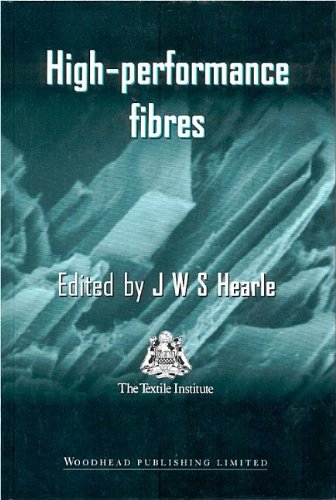
High Performance Fibres 1st Edition by JWS Hearle ISBN 1855735393 9781855735392

Original price was: $50.00.$35.00Current price is: $35.00.
High Performance Fibres 1st Edition by JWS Hearle – Ebook PDF Instant Download/Delivery: 1855735393, 9781855735392
Full download High Performance Fibres 1st Edition after payment
Product details:
ISBN 10: 1855735393
ISBN 13: 9781855735392
Author: JWS Hearle
This important new handbook provides comprehensive coverage of how high performance fibres are designed and manufactured and covers their capabilities and applications. The high-modulus, high-tenacity (HM-HT) fibres fall naturally into three groups – polymer fibres such as aramids and polyethylene fibres; carbon fibres such as Kevlar; and inorganic fibres based on glass and ceramic fibres.
The books shows how high performance fibres are being increasingly used for a wide range of applications including goetextiles and geomembranes and for construction and civil engineering projects as well as in specialist fibres within composite materials where their ability to fulfil demanding roles makes them an effective choice for the engineer and materials scientist.
Provides a comprehensive overview of how high performance fibres are designed and manufactured and covers their capabilities and applications
Explains how high performance fibres are being increasingly used for a wide range of applications, including geotextiles and geomembranes and construction and civil engineering projects
High Performance Fibres 1st Table of contents:
Chapter 1. Introduction
1.1 A New Generation of Fibres
1.2 Molecular Dimensionality
1.3 Contrasting Mechanical Properties
1.4 Economics
References
Chapter 2. Aramids
2.1 Introduction
2.2 Polymer Preparation
2.3 Spinning
2.4 Structure and Properties
2.5 Applications
2.6 Acknowledgements
References
Chapter 3. Gel-Spun High-Performance Polyethylene Fibres
3.1 Introduction
3.2 Manufacture
3.3 Fibre Characteristics
3.4 Properties
3.5 Yarn and Fabric Processing
3.6 Applications
References
Chapter 4. Other High Modulus-High Tenacity (HM-HT) Fibres from Linear Polymers
4.1 Melt-Spun Wholly Aromatic Polyester (DB)
4.2 PBO and Related Polymers (RTY and CLS)
4.3 PIPD or ‘M5’ Rigid-Rod Polymer (DJS)
4.4 Russian Aromatic Fibres (KEP)
4.5 Solid-State Extrusion High-Molecular Weight Polyethylene Fibres (GW)
References
Chapter 5. Carbon Fibres
5.1 Introduction
5.2 Physical Properties
5.3 PAN-Based Carbon Fibres
5.4 Pitch-Based Carbon Fibres
5.5 Vapour-Grown Carbon Fibres
5.6 Carbon Nanotubes
5.7 Applications
References
Chapter 6. Glass Fibres
6.1 Introduction
6.2 Glass for Fibres
6.3 Fibre Manufacture
6.4 Fibre Finish
6.5 Glass Fibre Properties
6.6 Fibre Assemblies
6.7 Composites
6.8 Design of Fibre Glass Composites
6.9 Conclusions
6.10 Acknowledgements
References
Chapter 7. Ceramic Fibres
7.1 Introduction
7.2 Silicon Carbide-Based Fibres
7.3 Other Non-Oxide Fibres
7.4 Alumina-Based Fibres
7.5 Other Polycrystalline Oxide Fibres
7.6 Single-Crystal Oxide Fibres
7.7 Conclusions
References
Chapter 8. Chemically Resistant Fibres
8.1 Introduction (ARH)
8.2 Chlorinated Fibres: PVDC (ARH)
8.3 Fluorinated Fibres: PTFE, PVF, PVDF, and FEP (ARH)
8.4 Poly(etheretherketones): PEEK (BM)
8.5 Poly(phenylene sulphide), PPS (ARH)
8.6 Poly(ether imide), PEI (ARH)
8.7 Others (ARH)
References
Chapter 9. Thermally Resistant Fibres
9.1 Introduction (ARH)
9.2 Thermosets (HE and HS)
9.3 Aromatic Polyamides and Polyarimids (ARH)
9.4 Semi-Carbon Fibres: Oxidised Acrylics (NS)
9.5 Polybenzimidazole, PBI (CT)
9.6 Polybenzoxazoles, PBO (ARH)
9.7 Final Comments (ARH)
People also search for High Performance Fibres 1st:
name three high performance fibres
high performance fibres nptel
high performance fibres ppt
high-performance fibers examples
high performance fiber
Tags: JWS Hearle, Fibres