

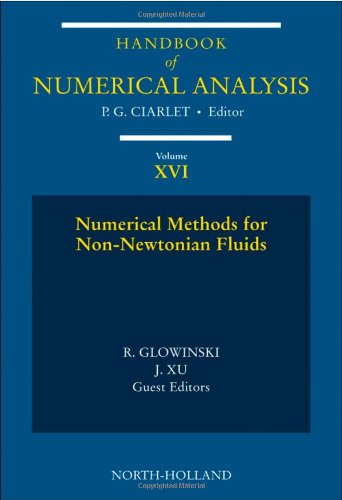
Handbook of Numerical Analysis Volume XVI Special Volume Numerical Methods for Non Newtonian Fluids 1st Edition by R Glowinski, Jinchao Xu, Philippe G Ciarlet ISBN 0444530479 9780444530479

Original price was: $50.00.$35.00Current price is: $35.00.
Handbook of Numerical Analysis Volume XVI Special Volume Numerical Methods for Non Newtonian Fluids 1st Edition by R Glowinski, Jinchao Xu, Philippe G Ciarlet – Ebook PDF Instant Download/Delivery: 0444530479, 9780444530479
Full download Handbook of Numerical Analysis Volume XVI Special Volume Numerical Methods for Non Newtonian Fluids 1st Edition after payment
Product details:
ISBN 10: 0444530479
ISBN 13: 9780444530479
Author: R Glowinski, Jinchao Xu, Philippe G Ciarlet
Non-Newtonian flows and their numerical simulations have generated an abundant literature, as well as many publications and references to which can be found in this volume’s articles. This abundance of publications can be explained by the fact that non-Newtonian fluids occur in many real life situations: the food industry, oil & gas industry, chemical, civil and mechanical engineering, the bio-Sciences, to name just a few. Mathematical and numerical analysis of non-Newtonian fluid flow models provide challenging problems to partial differential equations specialists and applied computational mathematicians alike.
This volume offers investigations. Results and conclusions that will no doubt be useful to engineers and computational and applied mathematicians who are focused on various aspects of non-Newtonian Fluid Mechanics.
New review of well-known computational methods for the simulation viscoelastic and viscoplastic types.; Discusses new numerical methods that have proven to be more efficient and more accurate than traditional methods.; Articles that discuss the numerical simulation of particulate flow for viscoelastic fluids.;
Handbook of Numerical Analysis Volume XVI Special Volume Numerical Methods for Non Newtonian Fluids 1st Table of contents:
Chapter 1. Theoretical Results
1.0. Foreword
1.1. Introduction and preliminaries
1.2. Constitutive and momentum equations
1.3. A brief survey of theoretical results
1.4. Splitting the two-dimensional problem
Chapter 2. Discretizing the Steady Split No-Slip Problem
2.1. General centered schemes
2.2. Centered schemes: Examples
2.3. Centered schemes: Successive approximations
2.4. Upwind schemes
Chapter 3. Discretizing the Time-Dependent No-Slip Problem
3.1. Introduction
3.2. Splitting the problem
3.3. Fully discrete centered schemes
3.4. Fully discrete upwind scheme with discontinuous Galerkin
Chapter 4. A Least-Squares Approach for the No-Slip Problem
4.1. Least-squares schemes for the steady no-slip problem
4.2. An approximate gradient algorithm
4.3. Application to the time-dependent problem
Chapter 5. The Steady Problem with Tangential Boundary Conditions
5.1. Some theoretical results
5.2. Centered schemes for the nonhomogeneous problem
5.3. Upwind schemes for the nonhomogeneous problem
Chapter 6. Numerical Experiments
6.1. The steady problem
6.2. The time-dependent case
References
List of Notation
The Langevin and Fokker–Planck Equations in Polymer Rheology
Chapter 1. Introduction
1.1. The Langevin and Fokker–Planck equations
1.2. Recent progress in the mathematical analysis and numerical simulation of flows of polymeric fluids
1.3. Article summary
Chapter 2. Stochastic Simulation Techniques
2.1. Introduction to stochastic differential equations
2.2. First-generation micro–macro techniques
2.3. Second-generation micro–macro techniques
2.4. Implicit micro–macro schemes
2.5. Stochastic methods for reptation models
Chapter 3. Fokker–Planck-Based Numerical Methods
3.1. Dilute solutions, locally homogeneous flows
3.2. Numerical methods for flows without the local homogeneity assumption
3.3. Numerical methods for concentrated solutions
3.4. Models with high-dimensional configuration spaces
Chapter 4. Numerical Results
4.1. Second-generation micro–macro techniques
4.2. Fokker–Planck-based numerical methods for locally homogeneous flows of dilute polymeric solutions
4.3. Fokker–Planck-based numerical methods for nonhomogeneous flows of dilute polymeric solutions
4.4. Fokker–Planck-based numerical methods for melts and concentrated polymeric solutions: Couette flow
4.5. Fokker–Planck-based numerical methods for high-dimensional configuration spaces
Acknowledgments
Bibliography
Viscoelastic Flows with Complex Free Surfaces: Numerical Analysis and Simulation
Chapter 1. Modeling of Viscoelastic Flows with Complex Free Surfaces
1.1. Macroscopic models
1.2. Mesoscopic models
1.3. Initial and boundary conditions
1.4. Summary
Chapter 2. Numerical Analysis of Simplified Problems
2.1. Numerical models for viscoelastic flows: a chronological review
2.2. Time discretization: an operator splitting scheme
2.3. The three fields Stokes problem
2.4. A simplified Oldroyd-B problem
2.5. A simplified Hookean dumbbells problem
Chapter 3. Numerical Simulation of Viscoelastic Flows with Complex Free Surfaces
3.1. Space discretization: structured cells and finite elements
3.2. Extension to mesoscopic models
3.3. Numerical results
Acknowledgment
Bibliography
Stable Finite Element Discretizations for Viscoelastic Flow Models
-
Introduction
-
Flow maps, generalized Lie derivatives, and Riccati equations
-
General macroscopic viscoelastic models
-
Basic mathematical and physical properties of the models
-
Existing numerical methods for viscoelastic fluid models
-
A family of Eulerian–Lagrangian finite element methods
-
Fast and robust solvers for Stokes-type systems
-
Stability analysis and existence of discrete solutions
-
Implementation details and numerical experiments
-
Concluding remarks
Acknowledgments
References
Positive Definiteness Preserving Approaches for Viscoelastic Flow of Oldroyd-B Fluids: Applications
-
Introduction
-
Particulate flow
-
Cavity flow
Acknowledgments
Bibliography
On the Numerical Simulation of Viscoplastic Fluid Flow
Chapter 1. Viscoplastic Fluid Flow: A Review
-
Introduction
-
Applications
-
Constitutive laws
-
Numerical methods
-
A brief history of computational viscoplasticity
-
Conclusion
Chapter 2. Bingham Flow In Cylinders and Cavities
7. Introduction and Synopsis
8. On the modeling of Bingham viscoplastic flow
9. Bingham flow in cylinders: (I) Formulation
10. Bingham flow in cylinders: (II) the regularization approach
11. Bingham flow in cylinders: (III) variational inequality formulation. The multiplier approach
12. Bingham flow in cylinders: (IV) time-discretization of problem (11.1)
13. Bingham flow in cylinders: (V) steady flow
14. Bingham flow in cylinders: (VI) an augmented Lagrangian approach to the solution of problem (13.1)
15. Bingham flow in cylinders: (VII) finite-element approximation
16. Bingham flow in cylinders: (VIII) numerical experiments
17. Bingham flow in cavities
Chapter 3. Numerical Simulation of Nonisothermal, Compressible and Thixotropic Viscoplastic Flow: An Overview
18. Generalities: synopsis
19. Governing equations
20. Augmented Lagrangian-based solution algorithms
21. A finite-volume scheme
22. Solution of the linear systems
23. Numerical experiments: wall-driven cavity creeping flow
24. Study of nonisothermal incompressible flow in pipelines
25. Transient isothermal compressible viscoplastic flow in a pipeline
26. Transient isothermal compressible and thixotropic flow in a pipeline: the isothermal restart of flow
27. Additional comments on the augmented Lagrangian/finite-volume methodology: new challenges for wall-driven flows
Chapter 4. Application of Fictitious Domain Methods to the Numerical Simulation of Viscoplastic Flow
28. Introduction. Synopsis
29. Steady flow of a Bingham fluid through an eccentric annular cross-section
30. Dynamical simulation of particle sedimentation in a Bingham fluid
31. Further comments on distributed Lagrange multiplier/fictitious domain methods for Bingham fluids
People also search for Handbook of Numerical Analysis Volume XVI Special Volume Numerical Methods for Non Newtonian Fluids 1st:
handbook of numerical analysis
handbook of optical constants of solids volume 3
handbook of optics volume 1
handbook of numerical analysis pdf
handbook of optics volume 2
Tags: R Glowinski, Jinchao Xu, Philippe G Ciarlet, Numerical Analysis