

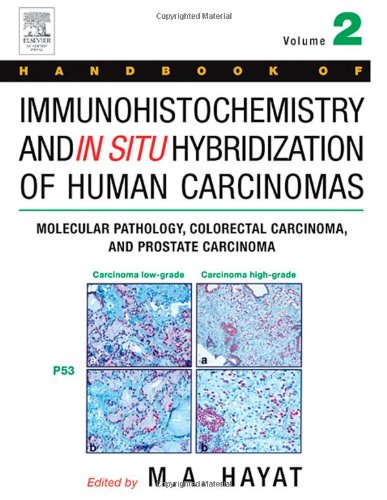
Handbook of Immunohistochemistry and in Situ Hybridization of Human Carcinomas Volume 2 1st Edition by MA Hayat ISBN 9780123339423 0123339421


Original price was: $50.00.$35.00Current price is: $35.00.
Handbook of Immunohistochemistry and in Situ Hybridization of Human Carcinomas Volume 2 1st Edition by MA Hayat – Ebook PDF Instant Download/Delivery: 9780123339423 ,0123339421
Full download Handbook of Immunohistochemistry and in Situ Hybridization of Human Carcinomas Volume 2 1st Edition after payment
Product details:
ISBN 10: 0123339421
ISBN 13: 9780123339423
Author: MA Hayat
Immunohistochemistry is the use of specific antibodies to stain particular molecular species in situ. This technique has allowed the identification of many more cell types than could be visualized by classical histology, particularly in the immune system and among the scattered hormone-secreting cells of the endocrine system, and has the potential to improve diagnosis, prognosis and therapeutic options of cancer.
This book discusses all aspects of immunohistochemistry and in situ hybridization technologies and the important role they play in reaching a cancer diagnosis. It provides step-by-step instructions on the methods of additional molecular technologies such as DNA microarrays, and microdissection, along with the benefits and limitations of each method. The topics of region-specific gene expression, its role in cancer development and the techniques that assist in the understanding of the molecular basis of disease are relevant and necessary in science today.
This book is the second volume of three planned, individually-sold volumes on this topic. Like Volume 1, this book fully explains the principles and applications of modern techniques used in the field of molecular genetics. It will be of particular interest to pathologists and molecular pathologists conducting both academic and/or clinical research.
* The only book available that translates molecular genetics into cancer diagnosis
* The results of each Immunohistochemical and in situ hybridization method are presented in the form of color illustrations
* Methods discussed were either developed or refined by expert contributors in their own laboratories
Handbook of Immunohistochemistry and in Situ Hybridization of Human Carcinomas Volume 2 1st Edition Table of contents:
Part I: Molecular Pathology
Chapter 1.1. Laser Capture Microdissection- Microarray Technology. Global mRNA Amplification for Exp
Chapter 1.2. Comparative Genomic Hybridization Analysis Using Metaphase or Microarray Slides
Chapter 1.3. Microarray Immunoassay of Complex Specimens: Problems and Technologic Challenges
Chapter 1.4. Comparative Genomic Hybridization
Chapter 1.5. Microsatellite Instability in Cancer: Assessment by High Resolution Fluorescent Microsa
Chapter 1.6. The Role of Extreme Phenotype Selection in Cancer Research
Chapter 1.7. Rolling Circle Amplification
Chapter 1.8. Direct, in situ Assessment of Telomere Length Variation in Human Cancers and Preneoplas
Chapter 1.9. Clinical Flow Cytometry of Solid Tumors
Chapter 1.10. Suppression Subtractive Hybridization Technology
Part II. Colorectal Carcinoma
Chapter 2.1. Colorectal Carcinoma: An Introduction
Chapter 2.2. Role of Immunohistochemical Expression of p53 in Colorectal Carcinoma
Chapter 2.3. Applying Tissue Microarray in Rectal Cancer: Immunostaining of Ki-67 and p53
Chapter 2.4. Role of Immunohistochemical Expression of p21 in Rectal Carcinoma
Chapter 2.5. Role of p107 Expression in Colorectal Carcinoma
Chapter 2.6. Expression of Gastric MUC5AC Mucin During Colon Carcinogenesis
Chapter 2.7. Role of Cyclooxygenase2 Expression in Colorectal Cancer
Chapter 2.8. Role of Immunohistochemical Expression of Bcl-2 in Colorectal Carcinoma
Chapter 2.9. Immunohistochemical Detection of CD97 Protein in Colorectal Carcinoma
Chapter 2.10. Roles of Immunohistochemical Expression of Cyclin A and Cyclin-Dependent Kinase 2 in C
Chapter 2.11. Role of Mismatch Repair Proteins and Microsatellite Instability in Colon Carcinoma
Chapter 2.12. Role of CD-61 (Beta-3 Integrin) Glycoprotein in Colon Carcinoma
Chapter 2.13. Immunohistochemical and in situ Hybridization Analysis of Lumican in Colorectal Carcin
Chapter 2.14. Role of Immunohistochemical Expression and in situ Hybridization Expression of Endothe
Chapter 2.15. Role of Fibroblastic Stroma in Colon Carcinoma
Chapter 2.16. Role of Immunohistochemical Expression of p53, Rb, and p16 Proteins in Anal Squamous C
Part III: Prostate Carcinoma
Chapter 3.1. Prostate Carcinoma: An Introduction
Chapter 3.2. Genetic Alterations in Prostate Cancer
Chapter 3.3. Alterations of Genes and Their Expression in Prostate Carcinoma
Chapter 3.4. In situ Hybridization of Human Telomerase Reverse Transcriptase mRNA in Prostate Carcin
Chapter 3.5. Detection of Genetic Abnormalities Using Comparative Genomic Hybridization in Prostate
Chapter 3.6. Markers for the Development of Early Prostate Cancer
Chapter 3.7. The Role of MUC18 in Prostate Carcinoma
Chapter 3.8. Role of Immunohistochemical Expression of PCNA and p53 in Prostate Carcinoma
Chapter 3.9. Role of the p14ARFand p16INK4aGenes in Prostate Cancer
Chapter 3.10. P504S/α-Methylacyl CoA Racemase. A New Cancer Marker for the Detection of Prostate C
Chapter 3.11. Role of Somatostatin Receptors in Prostate Carcinoma
Chapter 3.12. Role of Immunohistochemical Expression of Retinoid X Receptors in Prostate Carcinoma
Chapter 3.13. Role of Androgen Receptor Cofactors in Prostate Cancer
Chapter 3.14. Role of Androgen Receptor Gene Amplification and Protein Expression in Hormone Refract
Chapter 3.15. Role of Immunohistochemical Loss of Bin1/Amphiphysin2 in Prostatic Carcinoma
Chapter 3.16. Role of Prostate-Specific Glandular Kallikrein 2 in Prostate Carcinoma
Chapter 3.17. Expression and Gene Copy Number Alterations of HER-2/neu (ERBB2) Gene in Prostate Canc
Chapter 3.18. Combined Detection of Low Level HER-2/neu Expression and Gene Amplification in Prostat
Chapter 3.19. Calpain Proteases in Prostate Carcinoma
Chapter 3.20. Immunohistochemical Expression of Raf Kinase Inhibitor Protein in Prostate Carcinoma
Index
People also search for Handbook of Immunohistochemistry and in Situ Hybridization of Human Carcinomas Volume 2 1st Edition:
what is the purpose of in situ hybridization
in situ hybridization vs ihc
immunohistochemistry and immunofluorescence
in situ hybridization vs immunohistochemistry
in situ hybridization advantages and disadvantages
Tags: MA Hayat, Immunohistochemistry, Situ Hybridization, Human Carcinomas