

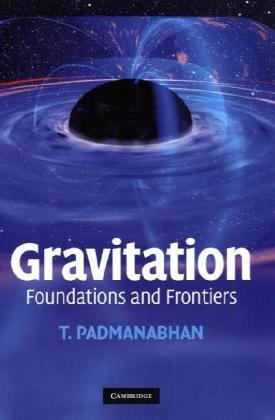
Gravitation Foundations and Frontiers 1st Edition by T Padmanabhan ISBN 0521882230 9780521882231

Original price was: $50.00.$35.00Current price is: $35.00.
Gravitation Foundations and Frontiers 1st Edition by T Padmanabhan – Ebook PDF Instant Download/Delivery: 0521882230, 9780521882231
Full download Gravitation Foundations and Frontiers 1st Edition after payment
Product details:
ISBN 10: 0521882230
ISBN 13: 9780521882231
Author: T Padmanabhan
Gravitation Foundations and Frontiers 1st Table of contents:
1. Special relativity
1.1 Introduction
1.2 The principles of special relativity
1.3 Transformation of coordinates and velocities
1.3.1 Lorentz transformation
1.3.2 Transformation of velocities
1.3.3 Lorentz boost in an arbitrary direction
1.4 Four-vectors
1.4.1 Four-velocity and acceleration
1.5 Tensors
1.6 Tensors as geometrical objects
1.7 Volume and surface integrals in four dimensions
1.8 Particle dynamics
1.9 The distribution function and its moments
1.10 The Lorentz group and Pauli matrices
2. Scalar and electromagnetic fields in special relativity
2.1 Introduction
2.2 External fields of force
2.3 Classical scalar field
2.3.1 Dynamics of a particle interacting with a scalar field
2.3.2 Action and dynamics of the scalar field
2.3.3 Energy-momentum tensor for the scalar field
2.3.4 Free field and the wave solutions
2.3.5 Why does the scalar field lead to an attractive force?
2.4 Electromagnetic field
2.4.1 Charged particle in an electromagnetic field
2.4.2 Lorentz transformation of electric and magnetic fields
2.4.3 Current vector
2.5 Motion in the Coulomb field
2.6 Motion in a constant electric field
2.7 Action principle for the vector field
2.8 Maxwell’s equations
2.9 Energy and momentum of the electromagnetic field
2.10 Radiation from an accelerated charge
2.11 Larmor formula and radiation reaction
3. Gravity and spacetime geometry: the inescapable connection
3.1 Introduction
3.2 Field theoretic approaches to gravity
3.3 Gravity as a scalar field
3.4 Second rank tensor theory of gravity
3.5 The principle of equivalence and the geometrical description of gravity
3.5.1 Uniformly accelerated observer
3.5.2 Gravity and the flow of time
4. Metric tensor, geodesics and covariant derivative
4.1 Introduction
4.2 Metric tensor and gravity
4.3 Tensor algebra in curved spacetime
4.4 Volume and surface integrals
4.5 Geodesic curves
4.5.1 Properties of geodesic curves
4.5.2 Affine parameter and null geodesics
4.6 Covariant derivative
4.6.1 Geometrical interpretation of the covariant derivative
4.6.2 Manipulation of covariant derivatives
4.7 Parallel transport
4.8 Lie transport and Killing vectors
4.9 Fermi–Walker transport
5. Curvature of spacetime
5.1 Introduction
5.2 Three perspectives on the spacetime curvature
5.2.1 Parallel transport around a closed curve
5.2.2 Non-commutativity of covariant derivatives
5.2.3 Tidal acceleration produced by gravity
5.3 Properties of the curvature tensor
5.3.1 Algebraic properties
5.3.2 Bianchi identity
5.3.3 Ricci tensor, Weyl tensor and conformal transformations
5.4 Physics in curved spacetime
5.4.1 Particles and photons in curved spacetime
5.4.2 Ideal fluid in curved spacetime
5.4.3 Classical field theory in curved spacetime
5.4.4 Geometrical optics in curved spacetime
5.5 Geodesic congruence and Raychaudhuri’s equation
5.5.1 Timelike congruence
5.5.2 Null congruence
5.5.3 Integration on null surfaces
5.6 Classification of spacetime curvature
5.6.1 Curvature in two dimensions
5.6.2 Curvature in three dimensions
5.6.3 Curvature in four dimensions
6. Einstein’s field equations and gravitational dynamics
6.1 Introduction
6.2 Action and gravitational field equations
6.2.1 Properties of the gravitational action
6.2.2 Variation of the gravitational action
6.2.3 A digression on an alternative form of action functional
6.2.4 Variation of the matter action
6.2.5 Gravitational field equations
6.3 General properties of gravitational field equations
6.4 The weak field limit of gravity
6.4.1 Metric of a stationary source in linearized theory
6.4.2 Metric of a light beam in linearized theory
6.5 Gravitational energy-momentum pseudo-tensor
7. Spherically symmetric geometry
7.1 Introduction
7.2 Metric of a spherically symmetric spacetime
7.2.1 Static geometry and Birkoff’s theorem
7.2.2 Interior solution to the Schwarzschild metric
7.2.3 Embedding diagrams to visualize geometry
7.3 Vaidya metric of a radiating source
7.4 Orbits in the Schwarzschild metric
7.4.1 Precession of the perihelion
7.4.2 Deflection of an ultra-relativistic particle
7.4.3 Precession of a gyroscope
7.5 Effective potential for orbits in the Schwarzschild metric
7.6 Gravitational collapse of a dust sphere
8. Black holes
8.1 Introduction
8.2 Horizons in spherically symmetric metrics
8.3 Kruskal–Szekeres coordinates
8.3.1 Radial infall in different coordinates
8.3.2 General properties of maximal extension
8.4 Penrose–Carter diagrams
8.5 Rotating black holes and the Kerr metric
8.5.1 Event horizon and infinite redshift surface
8.5.2 Static limit
8.5.3 Penrose process and the area of the event horizon
8.5.4 Particle orbits in the Kerr metric
8.6 Super-radiance in Kerr geometry
8.7 Horizons as null surfaces
9. Gravitational waves
9.1 Introduction
9.2 Propagating modes of gravity
9.3 Gravitational waves in a flat spacetime background
9.3.1 Effect of the gravitational wave on a system of particles
9.4 Propagation of gravitational waves in the curved spacetime
9.5 Energy and momentum of the gravitational wave
9.6 Generation of gravitational waves
9.6.1 Quadrupole formula for the gravitational radiation
9.6.2 Back reaction due to the emission of gravitational waves
9.7 General relativistic effects in binary systems
9.7.1 Gravitational radiation from binary pulsars
9.7.2 Observational aspects of binary pulsars
9.7.3 Gravitational radiation from coalescing binaries
10. Relativistic cosmology
10.1 Introduction
10.2 The Friedmann spacetime
10.3 Kinematics of the Friedmann model
10.3.1 The redshifting of the momentum
10.3.2 Distribution functions for particles and photons
10.3.3 Measures of distance
10.4 Dynamics of the Friedmann model
10.5 The de Sitter spacetime
10.6 Brief thermal history of the universe
10.6.1 Decoupling of matter and radiation
10.7 Gravitational lensing
10.8 Killing vectors and the symmetries of the space
10.8.1 Maximally symmetric spaces
10.8.2 Homogeneous spaces
11. Differential forms and exterior calculus
11.1 Introduction
11.2 Vectors and 1-forms
11.3 Differential forms
11.4 Integration of forms
11.5 The Hodge duality
11.6 Spin connection and the curvature 2-forms
11.6.1 Einstein–Hilbert action and curvature 2-forms
11.6.2 Gauge theories in the language of forms
12. Hamiltonian structure of general relativity
12.1 Introduction
12.2 Einstein’s equations in (1+3)-form
12.3 Gauss–Codazzi equations
12.4 Gravitational action in (1+3)-form
12.4.1 The Hamiltonian for general relativity
12.4.2 The surface term and the extrinsic curvature
12.4.3 Variation of the action and canonical momenta
12.5 Junction conditions
12.5.1 Collapse of a dust sphere and thin-shell
13. Evolution of cosmological perturbations
13.1 Introduction
13.2 Structure formation and linear perturbation theory
13.3 Perturbation equations and gauge transformations
People also search for Gravitation Foundations and Frontiers 1st:
gravitation the four fundamental forces of physics
zg foundation
gravity foundation essay
x foundation gerchow
x4 foundations gravimetric studies