

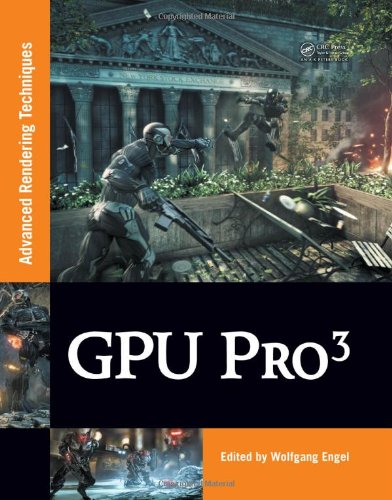
GPU Pro3 Advanced Rendering Techniques 1st Edition by Wolfgang Engel ISBN 1439887829 9781439887820


Original price was: $50.00.$35.00Current price is: $35.00.
GPU Pro3 Advanced Rendering Techniques 1st Edition by Wolfgang Engel – Ebook PDF Instant Download/Delivery: 1439887829, 9781439887820
Full download GPU Pro3 Advanced Rendering Techniques 1st Edition after payment
Product details:
ISBN 10: 1439887829
ISBN 13: 9781439887820
Author: Wolfgang Engel
GPU Pro3 Advanced Rendering Techniques 1st Table of contents:
I Mathematics
1 GPU Color Quantization
1.1 Introduction
1.2 The Self-Organizing Map
1.3 Color Quantization with SOM
1.4 Implementation
1.5 Results and Discussion
1.6 Conclusion
Acknowledgments
Bibliography
2 Visualize Your Shadow Map Techniques
2.1 Introduction
2.2 Article Overview
2.3 Scope of Analysi
2.4 Aliasing Revisited
2.5 A Representation of Aliasing Errors
2.6 Visualization
2.6.1 Measurement 1: How the Warping Strength Varies as the Light Direction Changes
2.6.2 Measurement 2: How Aliasing Errors are Distributed Within the View Frustum
2.6.3 Measurement 3: How Aliasing Errors are Distributed along the View Direction
2.7 Mismatch of View Direction and Warping Direction
2.8 Conclusion
2.9 Supplementary Materials
2.10 Acknowledgments
Bibliography
II Geometry Manipulation
1 As Simple as Possible Tessellation for Interactive Applications
1.1 Basic Phong Tessellation Operator
1.2 Extension to Quads
1.3 Results and Discussion
Bibliography
2 Rule-Based Geometry Synthesis in Real-Time
2.1 Introduction
2.2 Building Up the Scene with Procedures
2.3 L-systems and the PGI
2.4 Model Details and Implementation
2.4.1 Symbols
2.4.2 Algorithm Overview
2.4.3 Iteration and Termination
2.4.4 Culling
2.4.5 Rule Selection
2.4.6 Rule Application
2.4.7 Expressiveness of the Model: Selection Strategies and Operators
2.4.8 Sorting
2.4.9 Instancing
2.5 Interaction with the Procedural Scene
2.6 Results
2.6.1 Performance of the Generation Step
2.6.2 Performance of the Sorting Step
2.6.3 Examples
2.7 Conclusion
Bibliography
3 GPU-Based NURBS Geometry Evaluation and Rendering
3.1 A Bit of NURBS Background
3.2 Related Work
3.3 NURBS Surface and Curve Evaluation
3.4 Trimmed NURBS Surface Evaluation
3.4.1 NURBS Surface and Curve Evaluation
3.4.2 Trimming Profile Projection
3.4.3 Trim Texture Generation
3.4.4 Rendering Trimmed Surfaces
3.5 Results and Conclusion
Bibliography
4 Polygonal-Functional Hybrids for Computer Animation and Games
4.1 Introduction
4.2 Background
4.2.1 Implicit Surfaces and Function Representation (FRep)
4.2.2 Convolution Surfaces
4.2.3 Rendering FRep Models
4.3 Working with FRep Models Using the GPU
4.3.1 Function Evaluation
4.3.2 Isosurface Extraction
4.3.3 Rendering
4.4 Applications
4.4.1 Approach Outline
4.4.2 Embedding an FRep Object inside a Mesh Object
4.4.3 Attaching an FRep Object to the Mesh
4.4.4 Attaching a Polygonal Object to the FRep Object
4.5 Tools
4.6 Limitations
4.7 Conclusion
4.8 Source Code
Bibliography
III Rendering Techniques
1 Quadtree Displacement Mapping with Height Blending
1.1 Overview
1.2 Introduction
1.3 Overview of Ray-Tracing Algorithms
1.3.1 Online Algorithms
1.3.2 Algorithms Using Precomputed Data
1.4 Quadtree Displacement Mapping
1.4.1 Quadtree Construction
1.4.2 Quadtree Traversal
1.4.3 Optimizations
1.5 Self-Shadowing
1.5.1 General Self-Shadowing
1.5.2 Quadtree Soft Shadowing
1.6 Ambient Occlusion
1.6.1 QDM Ambient Occlusion
1.6.2 Performance
1.7 Surface Blending
1.7.1 Alpha Blending
1.7.2 Raytracing Blended Surfaces
1.7.3 Height Blending
1.7.4 QDM with Height Blending
1.7.5 Self-Shadowing and Ambient Occlusion for Blended Surfaces
1.8 General Advice
1.8.1 Case Study
1.8.2 Surface Rendering Pipeline
1.9 Conclusion
Bibliography
2 NPR Effects Using the Geometry Shader
2.1 Introduction
2.2 Previous Work
2.3 Silhouette Rendering
2.3.1 Algorithm Overview
2.3.2 Silhouette Detection and Geometry Generation
2.3.3 Silhouette Texturing
2.3.4 Single Pass Geometry and Silhouette Rendering
2.3.5 Results
2.4 Pencil Rendering
2.4.1 Algorithm Overview
2.4.2 Geometry Shader Optimization
2.4.3 Pixel Texturing
2.4.4 Results
2.5 Acknowledgments
Bibliography
3 Alpha Blending as a Post-Process
3.1 Introduction
3.2 The Alternatives
3.3 The Source Artwork
3.4 Initial Attempts
3.5 The Screen-Space Alpha Mask
3.5.1 The Opaque Pass
3.5.2 The Mask Generation Pass
3.5.3 The Color Pass
3.5.4 The Final Composition Pass
3.6 Alpha Reference Issues
3.6.1 The Clear-Screen Color Fix
3.6.2 The Squared Alpha Trick
3.7 Rendering Pipeline Integration
3.8 Conclusion
3.9 Demo
3.10 Acknowledgments
3.11 Source Code
Bibliography
4 Virtual Texture Mapping 101
4.1 Introduction
4.2 Virtual Texture Mapping
4.2.1 Page Fault Generation
4.2.2 Page Handler
4.2.3 Rendering
4.3 Implementation Details
4.3.1 Page Fault Generation
4.3.2 Page Handler
4.3.3 Rendering
4.4 Conclusion
4.5 Shader Code
4.5.1 MIP Map Calculation
4.5.2 Tile ID Shader
4.5.3 Virtual Texture Lookup
4.6 Acknowledgments
Bibliography
IV Global Illumination
1 Fast, Stencil-Based Multiresolution Splatting for Indirect Illumination
1.1 Quick Review: Instant Radiosity
1.2 Quick Review: Reflective Shadow Maps
1.3 Multiresolution Splatting
1.3.1 Implementing Multiresolution Splatting
1.3.2 Iterative Splat Refinement
1.3.3 Upsampling Multiresolution Illumination Buffers
1.4 Fast Stencil-Based Multiresolution Splatting
1.4.1 Parallel Splat Refinement into a Stencil Buffer
1.4.2 Discontinuity Detection
1.4.3 Rendering with Stenciled Multiresolution Splatting
1.5 Results and Analysis
1.6 Conclusion
1.7 Demo and Source
Bibliography
2 Screen-Space Directional Occlusion
2.1 Introduction
2.2 Screen-Space Ambient Occlusion
2.2.1 SSAO Problems
2.3 Screen-Space Directional Occlusion
2.3.1 Direct Illumination
2.3.2 Indirect Bounces of Light
2.4 Interleaved Sampling
2.5 Discussion
2.6 Conclusion
Bibliography
3 Real-Time Multi-Bounce Ray-Tracing with Geometry Impostors
3.1 Geometry Impostors
3.1.1 Distance Impostors
3.1.2 Height Maps
3.1.3 Geometry Images
3.2 Intersection Computation with an Environment Distance Impostor
3.3 Ray-Object Intersection Using Distance Impostors
3.4 Ray-Object Intersection Using Height Maps
3.5 Tracing Multiple Refractions within a Single Object
3.6 Multiple Ray Bounces with Object Impostors Only
3.7 Multiple Ray Bounces with Environment Distance Impostors Only
3.8 Combination of Environment and Object Impostors
3.9 Caustics and Shadows
3.10 Example Application: Glass Chess
3.11 Example Application: Alien Pool
3.12 Conclusion
Bibliography
V Image Space
1 Anisotropic Kuwahara Filtering on the GPU
1.1 Introduction
1.2 Kuwahara Filtering
1.3 Generalized Kuwahara Filtering
1.4 Anisotropic Kuwahara Filtering
1.4.1 Orientation and Anisotropy Estimation
1.4.2 Filtering Process
1.5 Conclusion
Acknowledgments
Bibliography
2 Edge Anti-aliasing by Post-Processing
2.1 Introduction
2.1.1 Problems
2.1.2 Related Work
2.2 Finding the Nearest Silhouette Edge
2.3 The Post-Process
2.4 Refinements
2.5 GPU Implementation and Results
2.5.1 Offset Vertices
2.5.2 Sample Offset and Blend Values
2.5.3 Blend Edge Pixels
2.5.4 Implementation Costs
2.6 Results
2.6.1 Performance
2.7 Other Applications
2.7.1 Shadow Mapping
2.7.2 Upscaling
2.8 Conclusion
Bibliography
3 Environment Mapping with Floyd-Steinberg Halftoning
3.1 Parametrization of the Environment Map
3.2 Importance Sampling
3.3 Proposed Solution
3.3.1 Floyd-Steinberg Sampler
3.3.2 Application to Light-Source Sampling
3.3.3 Application to Product Sampling
3.4 Conclusion
Bibliography
4 Hierarchical Item Buffers for Granular Occlusion Culling
4.1 Introduction
4.2 Hierarchical Item Buffers
4.2.1 ID Assignment
4.2.2 Direct3D 10 Implementation
4.2.3 Direct3D 11 Implementation
4.3 Application
4.4 Results
4.5 Conclusion
Bibliography
5 Realistic Depth of Field in Postproduction
5.1 Depth-of-Field Equations
5.2 Camera Lens Simulation
5.3 Exposure Simulation
5.3.1 Improvements by Local Neighborhood Blending
5.4 CUDA-Accelerated Computation
5.5 Results
5.6 Conclusion
Bibliography
6 Real-Time Screen Space Cloud Lighting
6.1 Introduction
6.2 Implementation
6.2.1 Lighting
6.2.2 Distance to the Sky and Clouds
6.2.3 Scattering
6.3 Results
6.4 Extensions
6.5 Conclusion
Bibliography
7 Screen-Space Subsurface Scattering
7.1 Introduction
7.2 The Texture-Space Approach
7.2.1 Subsurface Scattering and Diffusion Profiles
7.2.2 Irradiance Texture
7.2.3 Gaussians and the Jittered Kernel
7.2.4 Texture-Space Diffusion Problems
7.3 The Screen-Space Approach
7.3.1 The Big Picture
7.3.2 Depth-Based Gaussians Level of Detail
7.3.3 Alpha Blending Workflow
7.3.4 Anti-aliasing and Depth-Stencil
7.4 Model Preparation
7.5 Discussion of Results
7.6 Conclusion
7.7 Acknowledgments
Bibliography
VI Handheld Devices
1 Migration to OpenGL ES 2.0
1.1 Introduction
1.2 Key API Differences
1.2.1 Programmable Pipeline
1.2.2 Vertex Attributes
1.2.3 Other New Features
1.3 The Shader Language
1.3.1 Vertex Programs
1.3.2 Fragment Programs
1.3.3 Precision Modifiers
1.4 Initialization
1.5 Basic Shaders: Implementing the Fixed-Function Pipeline
1.5.1 Implementing Matrix Transforms
1.5.2 Example 1: Simple Transform
1.5.3 Example 2: Basic Diffuse Lighting
1.5.4 Example 3: Basic Texturing
1.5.5 Shader Tools
1.6 Advanced Effects Made Easy
1.6.1 Multi-texturing
1.6.2 Reflections with Cubemaps
1.6.3 Proper Bump Mapping
1.6.4 Vertex Texturing and Displacement Mapping
1.6.5 Post-Processing
1.7 Conclusion
1.8 Acknowledgments
2 Touchscreen-Based User Interaction
2.1 Introduction
2.2 Motion Estimation
2.3 Position Predictio
2.4 Application: Controlling a Camera in a Spherical Coordinate System
2.4.1 Adding Inertia
2.5 Algorithm Overview
2.6 Conclusion
2.7 Acknowledgments
3 iPhone 3GS Graphics Development and Optimization Strategies
3.1 Software Development Kits
3.1.1 iPhone SDK
3.1.2 POWERVR SDK
3.1.3 Tools and Utilities
3.2 General Optimization Strategies
3.2.1 Managing Vertex Data Efficiently
3.2.2 Textures
3.2.3 Shaders
3.3 Conclusion
Bibliography
4 Optimizing a 3D UI Engine for Mobile Devices
4.1 Overview
4.2 Optimization Methods
4.2.1 Rendering Pipeline Optimization
4.2.2 TrueType Font Rendering
4.2.3 Widget Caches with Partial Update
4.2.4 Resource Management
4.3 Conclusion
Bibliography
VII Shadows
1 Fast Conventional Shadow Filtering
1.1 Overview
1.2 Introduction
1.3 Uniform Shadow Filtering
1.4 Separable Shadow Filters
1.5 Nonseparable Unique Weights per PCF Result
1.6 Advanced Shadow Filtering Techniques
1.6.1 Light Shape-Dependent Shadows for Directional Lights
1.6.2 Contact Hardening Shadows
Bibliography
2 Hybrid Min/Max Plane-Based Shadow Maps
2.1 Overview
2.2 Introduction
2.3 Construction of an HPSM
2.4 Using an HPSM
2.5 Other Uses for the HPSM
Bibliography
3 Shadow Mapping for Omnidirectional Light Using Tetrahedron Mapping
3.1 Shadow Mapping
3.2 Tetrahedron Shadow Mapping
3.2.1 Step One: Generating Tetrahedron Shadow Map
3.2.2 Step Two: Render the Scene
3.3 Optimization
3.4 Lookup Map
3.5 Conclusion
Bibliography
4 Screen Space Soft Shadows
4.1 Introduction
4.2 Previous Work
4.3 Screen Space Soft Shadows
4.3.1 Calculating the Shadow Maps
4.3.2 Calculating the Distances Map
4.3.3 Applying the Gaussian Filter
4.3.4 Using Average Instead of Minimum Depth
4.4 Results
4.4.1 Quality Tests
4.4.2 Performance Tests
4.5 Conclusion
Acknowledgments
Bibliography
VIII 3D Engine Design
1 Multi-Fragment Effects on the GPU Using Bucket Sort
1.1 Introduction
1.2 Design of Bucket Array
1.3 The Algorithm
1.4 Multi-pass Approach
1.5 The Adaptive Scheme
1.6 Applications
1.6.1 Transparent Effect
1.6.2 Translucent Effect
1.6.3 Fresnel’s Effect
1.7 Conclusions
Bibliography
2 Parallelized Light Pre-Pass Rendering with the Cell Broadband Engine
2.1 Introduction
2.2 Light Pre-Pass Rendering
2.3 The PLAYSTATION3 and the CBE
2.4 GPU/SPE Synchronization
2.5 The Pre-pass
2.6 The Lighting SPE Program
2.6.1 The Atomic Tile Arbiter
2.6.2 Multi-Buffering
2.6.3 Light Gathering and Culling
2.6.4 Point Lights
2.6.5 Spot Lights
2.7 The Main Pass
2.8 Conclusion
2.9 Further Work
2.10 Acknowledgments
Bibliography
3 Porting Code between Direct3D9 and OpenGL 2.0
3.1 Introduction
3.2 General Issues
3.2.1 Object-Oriented API vs. C-styled API
3.2.2 Avoid Unnecessary Functions Calls
3.2.3 Lost Device
3.2.4 Memory Pools
3.2.5 Unit-Cube Constraints
3.3 Resources Management
3.3.1 Textures
3.3.2 Off-Screen Surfaces and Framebuffers
3.3.3 Vertex Declarations
3.3.4 Vertex and Index Buffers
3.3.5 Shaders
3.4 Notes on Debugging
3.5 A Word on Sample Application
3.6 Conclusion
Bibliography
4 Practical Thread Rendering for DirectX 9
4.1 Abstract
4.2 Introduction
4.3 Solution
4.3.1 Why is it Faster?
4.3.2 Command Buffer
4.3.3 Immediate Commands
4.4 Conclusion
4.5 Future Work
IX Game Postmortems
1 Stylized Rendering in Spore
1.1 Filter Chain System
1.1.1 Design Considerations
1.1.2 Implementation
1.1.3 Performance
1.2 Fun with Filters
1.2.1 Oil Paint Filter
1.2.2 Watercolor Filter
1.2.3 8-Bit Filter
1.2.4 Film Noir Filter
1.2.5 Old Film Filter
1.3 Cheats
2 Rendering Techniques in Call of Juarez: Bound in Blood
2.1 Introduction
2.2 Deferred Shading
2.3 Single Frame of CoJ:BiB, The Black Magic
2.4 What Else Do We Have?
2.4.1 Terrain
2.4.2 Geometry
2.4.3 Materials
2.5 Conclusion
2.6 Acknowledgments
Bibliography
3 Making it Large, Beautiful, Fast, and Consistent: Lessons Learned Developing Just Cause 2
3.1 Introduction
3.2 Making it Large and Beautiful
3.2.1 Dynamic Lights
3.2.2 The Shadowing System
3.2.3 Character Shadows
3.2.4 Soft Particles
3.2.5 Ambient Occlusion
3.2.6 The Jitter Bug: Dealing with Floating-Point Precision
3.3 Making it Consistent
3.3.1 Same-Same, but Different
3.3.2 Gamma
3.4 Making it Fast
3.4.1 Cloud Rendering Optimization
3.4.2 Particle Trimming
3.4.3 Memory Optimizations
3.5 Conclusion and Future Work
3.6 Acknowledgments
Bibliography
4 Destructible Volumetric Terrain
4.1 Introduction
4.1.1 Challenges
4.1.2 Engine Structure
4.2 Converting Custom 3D Models into Voxel Representations
4.3 Memory Requirements for Large Voxel Maps
4.4 Polygonization from Voxels to Triangles
4.5 Seamless Texture-Mapping for Free-Form Surfaces
4.6 Reducing Repeated Texture Patterns
4.7 Tangent Space Calculation in the Pixel Shader
4.8 Multi-material Voxel Maps
4.8.1 Multiple Dynamic Lights
4.9 Level of Detail
4.10 Ambient Light
4.11 Conclusion
Bibliography
X Beyond Pixels and Triangles
1 Parallelized Implementation of Universal Visual Computer
1.1 Introduction
1.2 Background
1.3 CNN Implementation
1.3.1 Overview
1.3.2 Using the Four-Channel Textures
1.3.3 Shader Implementation
1.4 Results
1.5 Conclusion
1.6 Acknowledgments
Bibliography
2 Accelerating Virtual Texturing Using CUDA
2.1 Introduction
2.1.1 Virtual Texturing
2.1.2 GPU Computing and CUDA
2.2 Implementing Virtual Texturing
2.3 Rendering with Virtual Texturing
2.3.1 Translating Virtual into Physical Addresses
2.3.2 Sampling the Cache Texture
2.3.3 Anisotropic Filtering
2.3.4 Generating the PageId Buffer for the Resolver
2.4 GPU-Based Acceleration
2.4.1 Accelerating the Resolver
2.4.2 Asynchronous Uploading and Compression
2.4.3 Updating the Page Table
2.5 Results
2.6 Conclusion
2.7 Acknowledgments
Bibliography
3 Efficient Rendering of Highly Detailed Volumetric Scenes with GigaVoxels
3.1 Introduction
3.2 Voxel Representations
3.3 The GigaVoxels Approach
3.4 Data Structure
3.4.1 Structure Storage: The Pools
3.4.2 Octree Implementation
3.5 Rendering
3.5.1 Hierarchical Volume Ray Casting
3.5.2 Octree and Node Traversal
3.5.3 Descending in the Octree
3.5.4 Tracing Cones: LOD and Volume MipMapping
3.6 Out-of-Core Data Management
3.6.1 Global Scheme
3.6.2 GPU Cache Mechanism
3.6.3 Structure Update Requests Management
3.6.4 Per-ray Requests
3.6.5 Requests Type Sorting
3.6.6 Dealing with Data Requests
3.6.7 Separating Constant from Brick Nodes
3.6.8 Dealing with Subdivision Requests
3.6.9 Implementation Summary
3.7 Octree-Based Synthesis
3.8 Voxel Object Instancing
3.9 MipMap-Based Blur Effects
3.9.1 Soft Shadows
3.9.2 Depth of Field
3.10 Conclusion
Bibliography
4 Spatial Binning on the GPU
4.1 Introduction
4.2 Binning
4.2.1 Queries
4.2.2 Building the Data Structure
4.2.3 Handling Overflow
4.2.4 Item Distribution
4.3 Applications
4.3.1 Particle Systems
4.3.2 Agent Avoidance
4.3.3 Bucket Sort
4.4 Results
4.4.1 Binning Performance
4.4.2 Comparison to Stencil Routing
4.5 Conclusion
4.6 Acknowledgments
Bibliography
5 Real-Time Interaction between Particles and the Dynamic Mesh on the GPU
5.1 Introduction
5.2 Process Overview
5.3 Sorting the Triangles
5.4 Building the Buffer Map
5.5 Addressing the Buffer
5.6 Performance
5.7 Conclusion
People also search for GPU Pro3 Advanced Rendering Techniques 1st:
gpu pro advanced rendering techniques
amd gpu rendering
advanced graphics processor settings photoshop
gpu pro 4 advanced rendering techniques
gpu rendering benchmarks
Tags:
Wolfgang Engel,GPU Pro3,Rendering Techniques