

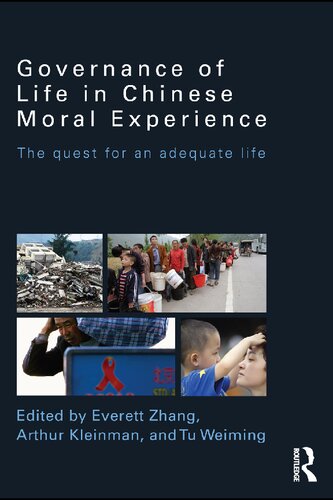
Governance of Life in Chinese Moral Experience The Quest for an Adequate Life 1st Edition by Everett Zhang, Arthur Kleinman, Weiming Tu ISBN 0203834399 9780203834398

Original price was: $50.00.$35.00Current price is: $35.00.
Governance of Life in Chinese Moral Experience The Quest for an Adequate Life 1st Edition by Everett Zhang, Arthur Kleinman, Weiming Tu – Ebook PDF Instant Download/Delivery: 0203834399, 9780203834398
Full download Governance of Life in Chinese Moral Experience The Quest for an Adequate Life 1st Edition after payment
Product details:
ISBN 10: 0203834399
ISBN 13: 9780203834398
Author: Everett Zhang, Arthur Kleinman, Weiming Tu
Governance of Life in Chinese Moral Experience The Quest for an Adequate Life 1st Table of contents:
CHANGES AND CONTRADICTIONS
The truth of min yi shi wei tian (people regard food as top priority)
The politics and morality of death
The contradictory power
Disparity in the state and differences in citizenship
“GOVERNMENTALITY” IN CHINA: A FRAMEWORK
Defining governmentality
Governmentality without liberal democracy?
Governmentality in China
CHINESE GOVERNMENTALITY: THE DEVELOPMENT AND THE OBSTACLES
The harm of communist revolution to governmentality
From ideological security to pragmatic security
Coming to terms with the social
Behind the central–local disparity
Chinese governmentality: Western influence and Chinese roots
Notes
References
Part I Min yi shi wei tian
1 Feeding the revolution
Commensality and social engineering
Political background: the Great Leap Forward
Public mess hall campaign: the collectivization of eating
Women’s labor and communist consciousness
To attack the family, destroy the kitchen
Communist utopia: all you can eat, three meals a day
Time, leisure, and the regimentation of daily life
Aftermath: the post-Leap famine
Conclusions: coercive commensality and the limits of social engineering
Notes
References
2 Recalling the Great Leap Famine and recourse to irony
The moral discourse of the Party’s relation to the People
Shame and enthusiasm
How is this recalled?
Sardonic recall
Self-sacrifice turned into ritual sacrifice
The generation gap
Aggravated indifference now
Conclusion: irony
Notes
References
3 The truth about the death toll of the Great Leap Famine in Sichuan
The price for telling the truth
The system of “uninformation” and the culture of deception
Stifling truth and engulfing life
Conclusion
Notes
References
Part II The politics and morality of death
4 The death of a detainee
Introduction
The Sun Zhigang event
Becoming vagrants and beggars
The construction of “peasant” in the status politics
The modern nature of status politics
Conclusion
Notes
References
5 Depoliticizing tobacco’s exceptionality
Tobacco death in broader perspective
Theorizing mass death
Tobacco as a state of exception
Seeing past authoritarian smoke and mirrors
Dynamics, differentiations, and dividends
Good life: cigarettes and masculinity in an era of revolution
A sociality of smoke
Remembrance and demobilization
Conclusion
Notes
References
Part III Governing life
6 Memories of the barefoot doctor system
Mao’s outrage
“Barefoot doctor” Liu Mingzhu
“Mixing sands in”
The revival of herbalists
Identity and qualification
Are barefoot doctors “saints”?
The twilight of barefoot doctors
Acknowledgment
Notes
References
7 Governing Chinese life
Biopolitics, governmentality, governmentalization
Logic of science, logic of life: the birth of biopolitics
Reducing population quantity: Leninist biopolitics, with elements of sovereignty
Creating revolutionary-socialist subjects in the cities: Leninist biopolitics at its most humane
Crude subjection in the countryside: Leninist biopolitics at its most vicious
Creating market-socialist reproductive subjects in the villages
Producing the “quality child”: the emergence of neoliberal biopolitics
The quality child: the neoliberal subject par excellence
A kind of regulated freedom
The one-child generation grows up: the emergence of the self-governing subject
Vital politics today
A distinctive configuration of modern power: China in comparative perspective
References
8 Turning points in China’s fight against AIDS since 1985
Introduction
The beginning of the epidemic
Homophobia, homosexuality, and HIV
Prostitution and HIV
Domestic advocacy and events
Innocent victims and the re-emergence of sympathy and charitable action
International pressure to act
The SARS epidemic and the spur to action
Role of public intellectuals
Post 2003—government policy and action
Tolerance for civil society—recognizing the need for representation and voice
Conclusion
References
9 Governing suicide
Introduction
Suicide in contemporary China and the theoretical dilemma underlying it
A social organization concerning the soul
Into the local political structure
Between love and conflict
A program for the harmonious family
Eight-Mile-Inn of Qianxi County
Yihe Village of Xinle
South Shuangjing of Xinle
The end of the Rural Women’s suicide intervention program
Conclusion
References
Part IV From living being to well-being
10 Citizens’ perceptions ofadequate governance
General attitudes about government performance
Public attitudes about the provision of public goods and services
Conclusions
Appendix 1: the survey14
Appendix 2: sites chosen for the survey
Notes
References
11 Debating women’s rights in Hong Kong
Creating and protecting a colonial category
Moral worlds: women, families, and property
Women’s rights and indigenous rights14
Inheritance debates: urban and village perspectives
Inheritance debates: village perspectives
Notes
References
12 Biological citizenship and its forms1
Introduction
Biological citizenship in Europe: from the quality of the population to the quality of life
Biological citizenship in China: quantity and quality
People also search for Governance of Life in Chinese Moral Experience The Quest for an Adequate Life 1st:
governance of life in chinese moral experience
what is moral governance
moral values in chinese
chinese quotes about life in chinese
what is the good life in ethics
Tags:
Everett Zhang,Arthur Kleinman,Weiming Tu,Governance,Chinese,Chinese