

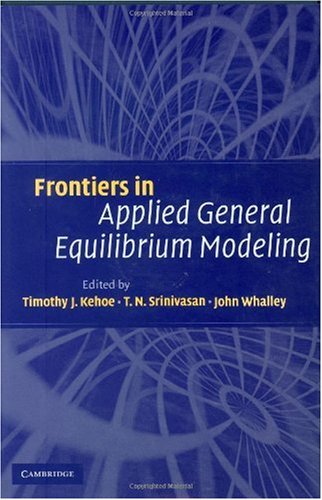
Frontiers in applied general equilibrium modeling In honor of Herbert Scarf 1st edition by Timothy Kehoe, Srinivasan, John Whalley 0511108761 9780511108761


Original price was: $50.00.$35.00Current price is: $35.00.
Frontiers in applied general equilibrium modeling In honor of Herbert Scarf 1st edition by Timothy J. Kehoe, T. N. Srinivasan, John Whalley – Ebook PDF Instant Download/DeliveryISBN: 0511108761, 9780511108761
Full download Frontiers in applied general equilibrium modeling In honor of Herbert Scarf 1st edition after payment.
Product details:
ISBN-10 : 0511108761
ISBN-13 : 9780511108761
Author: Timothy J. Kehoe, T. N. Srinivasan, John Whalley
This 2005 volume brings together twelve papers by many of the most prominent applied general equilibrium modelers honoring Herbert Scarf, the father of equilibrium computation in economics. It deals with developments in applied general equilibrium, a field which has broadened greatly since the 1980s. The contributors discuss some traditional as well as some modern topics in the field, including non-convexities in economy-wide models, tax policy, developmental modeling and energy modeling. The book also covers a range of distinct approaches, conceptual issues and computational algorithms, such as calibration and areas of application such as macroeconomics of real business cycles and finance. An introductory chapter written by the editors maps out issues and scenarios for the future evolution of applied general equilibrium.
Frontiers in applied general equilibrium modeling In honor of Herbert Scarf 1st Table of contents:
PART ONE. GENERAL EQUILIBRIUM THEORY
1 Personal Reflections on Applied General Equilibrium Models
1.1. THE DEFINIENDUM
1.1.1. “Applied”
1.1.2. “General”
1.1.3. “Equilibrium”
1.1.4. “Competitive”
1.1.5. “Model”
1.2. WHY COMPLETE SYSTEMS?
1.2.1. Tinbergen
1.2.2. Completeness for Determinateness
1.2.3. Consistency of Viewpoint
1.2.4. The Price of Completeness
1.3. THE EXTENSION INTO TIME AND UNCERTAINTY
1.3.2. Equilibrium with Uncertainty
1.3.3. The Curse of Dimensionality
1.3.4. Securities Markets
1.4. THE COMPLETE MODEL: STATISTICAL INFERENCE AND DATA SOURCES
1.4.1. Simultaneous Equations Estimation
1.4.2. Time Series and National Income Accounting
1.5. SOLUTION ALGORITHMS
1.5.1. Solving Systems of Nonlinear Equations
1.5.2. Algorithms: Need They Always Converge?
1.5.3. Convenient Function Forms
1.5.4. The Liberating Power of the Scarf Algorithm
REFERENCES
2 Uniqueness of Equilibrium in the Multicountry Ricardo Model
2.1. UNIQUENESS IN THE MODEL OF EXCHANGE
2.1.1. General Equilibrium with Production
2.1.2. Uniqueness in the Ricardo Model
2.2. INDEX THEORY
2.2.1. Exchange Economies with Two Goods
2.2.2. The Index for a Model of Exchange with n Goods
2.2.3. Uniqueness in a Model of Exchange with Gross Substitutes
2.2.4. Index Theory with Production
2.2.5. Index Theory and the Ricardo Model
REFERENCES
PART TWO. COMPUTATIONAL METHODS
3 Solving Dynamic Stochastic Competitive General Equilibrium Models
3.1. A DYNAMIC GENERAL EQUILIBRIUM MODEL AND STANDARD SOLUTION METHODS
3.2. RELIABLE AND EFFICIENT COMPUTATION OF GENERAL EQUILIBRIUM
3.3. A NEGISHI APPROACH TO STOCHASTIC, DYNAMIC GENERAL EQUILIBRIUM
3.4. DYNAMIC PROGRAMMING: CONVENTIONAL METHODS AND THEIR LIMITATIONS
3.5. SHAPE-PRESERVING APPROXIMATION METHODS
3.5.1. Schumaker’s Shape-Preserving Splines
3.5.2. Performance in a Simple Example
3.5.3. Alternative Shape-Preserving Approximation Methods
3.6. CONCLUSIONS
REFERENCES
4 Mathematical Programs with Equilibrium Constraints: Automatic Reformulation and Solution via Const
4.1. INTRODUCTION
4.2. FORMULATIONS OF THE MODEL
4.3. TOOLS FOR MPEC SOLUTION
4.3.1. Modeling Language Tools
4.3.2. The Convert Tool
4.3.3. Options and Parametric Solution
4.3.4. Nonlinear Optimization Codes
4.4. COMPUTATIONAL RESULTS
4.4.1. Feasibility Problems
4.4.2. Small Optimization Problems
4.4.3. Feasibility Tests
4.4.4. Larger Optimization Problems
4.5. CONCLUSIONS
APPENDIX A: EXAMPLE OF GAMS MPEC SYNTAX
APPENDIX B: MODEL STATISTICS FOR TEST PROBLEMS
REFERENCES
PART THREE. MACROECONOMICS AND FINANCE
5 Nonconvexities in Quantitative General Equilibrium Studies of Business Cycles
INTRODUCTION
5.1. BUSINESS CYCLES
5.2. CONVEX ECONOMIES
5.3. THE AGGREGATE PRODUCTION FUNCTION
5.4. LABOR INDIVISIBILITY
5.5. WHY A FIXED WORKWEEK LENGTH?
5.6. CAPACITY CONSTRAINTS AND NONLINEARITIES
5.6.1. Resource Constraint and the Evolution of Capital
5.6.2. Preferences
5.6.3. Computing Equilibrium Allocations
5.6.4. Computing Equilibrium Factor Shares
5.6.5. Solution Method
5.7. CONCLUDING COMMENTS
REFERENCES
6 Lotteries for Consumers versus Lotteries for Firms
6.1. INTRODUCTION
6.2. LAYOFF TAXES IN AN EMPLOYMENT LOTTERIES MODEL
6.3. LAYOFF TAXES IN AN ISLAND MODEL
6.4. CONCLUDING REMARKS
REFERENCES
7 Default and Aggregate Fluctuations in Storage Economies
7.1. INTRODUCTION
7.2. THE MODEL ECONOMY
7.2.1. The Timing
7.2.2. The Default Option and Market Arrangement
7.2.3. Households
7.2.4. Unsecured Credit Industry and Equilibrium
7.3. CALIBRATION
7.3.1. Model Extensions for Calibrating Purposes
7.3.2. Calibrating the Deterministic Version of the Model to U.S. Data
7.3.2.1. The Targets from the Data
7.3.2.2. The Targets in the Model
7.4. MODEL ECONOMIES WITH AGGREGATE SHOCKS
7.5. THE BUSINESS CYCLE BEHAVIOR OF THE BASIC MODEL ECONOMY: AGGREGATE SHOCKS TO THE LEVEL OF EARNIN
7.5.1. Business Cycle Statistics
7.5.2. Discussion of the Bankruptcy-Related Statistics
7.6. THE BUSINESS-CYCLE BEHAVIOR OF THE OTHER MODEL ECONOMIES
7.6.1. The Business-Cycle Behavior of Economies with Interest-Rate Fluctuations
7.6.2. The Business-Cycle Behavior of Economies with Asset-Destruction Shock
7.6.3. The Business-Cycle Behavior of Other Economies
7.7. CONCLUDING REMARKS
REFERENCES
8 New Applications of General Equilibrium to Finance: Default and Collateral
8.1. INTRODUCTION
8.2. DEFAULT AND BANKRUPTCY
8.2.1. Default and Penalties with a Continuum of States
8.2.2. Bankruptcy
8.2.3. Collateral and CMO Markets
8.2.3.1. The Model
8.2.3.2. Equilibria
8.2.3.3. Extensions: Arbitrage and Equilibrium without Minimum Margin Requirements
8.3. DEFAULT AND COLLATERAL IN INFINITE HORIZON
8.3.1. A General Model with Short-Lived Assets: Collateral Avoids Ponzi Schemes
8.3.2. Extensions: Markov Equilibria and Computational Algorithms, Bubbles, and International Bankru
REFERENCES
PART FOUR. PUBLIC FINANCE, DEVELOPMENT, AND CLIMATE CHANGE
9 Efficient Taxation of Income
9.1. INTRODUCTION
9.2. INCOME TAX REFORM
9.3. CONSUMPTION TAX PROPOSALS
9.3.1. Tax Reform Proposals
9.3.2. Modeling the Tax Reform Proposals
9.3.3. Welfare Impacts of Fundamental Tax Reform
9.4. CONCLUSIONS
APPENDIX: ELASTICITIES AND NONTAX PARAMETERS
A.1. Consumer Behavior
A.2. Producer Behavior
A.3. Nontax Parameters
REFERENCES
10 Representative versus Real Households in the Macroeconomic Modeling of Inequality
10.1. INTRODUCTION
10.2. THE MICROSIMULATION MODEL
10.2.1. The Household Income Generation Model
10.2.2. Estimation of the Model for the Benchmark Simulation
10.2.3. Link with the CGE Model
10.2.4. Interpretation of the Consistency System of Equations
10.2.5. Interpreting the Intercepts of Occupational Choice Criteria
10.3. THE CGE MODEL
10.3.1. Factors of Production
10.3.2. Households
10.3.3. Macro Closure Rules
10.4. SCENARIOS AND SIMULATION RESULTS
10.5. MICROSIMULATION VERSUS REPRESENTATIVE HOUSEHOLD GROUPS (RHG)
10.6. CONCLUSION
APPENDIX A: STRUCTURE OF THE SOCIAL ACCOUNTING MATRIX
REFERENCES
11 General Equilibrium Modeling for Global Climate Change
11.1. INTRODUCTION
11.2. THE FRAMEWORK CONVENTION ON CLIMATE CHANGE AND THE KYOTO PROTOCOL ON CLIMATE CHANGE
11.3. A MULTIMODEL EVALUATION BY THE ENERGY MODELING FORUM
11.4. STRUCTURE OF MERGE
11.5. DISCOUNTING IN MERGE
11.6. EQUITY AND EFFICIENCY
REFERENCES
PART FIVE. GENERAL EQUILIBRIUM RESTRICTIONS AND ESTIMATION OF HEDONIC MODELS
12 Simulation and Estimation of Hedonic Models
12.1. INTRODUCTION
12.2. GENERAL HEDONIC MODEL
12.3. TINBERGEN’S LINEAR–QUADRATIC MODEL
12.4. IDENTIFICATION
12.4.1. Identification of the Additive Model
12.4.2. Identification of the Nonadditive Model
12.5. ESTIMATION
12.5.1. Estimation of the Additive Model
12.5.2. Estimation of the Nonadditive Model
12.6. SIMULATION AND ESTIMATION RESULTS
12.6.1. Model 1: Specification and Simulation Results
12.6.2. Model 1: Estimation Results
12.6.3. Nonlinear Additively Separable Specifications, Model 2: Simulation Results
12.6.4. Model 2: Estimation Results
12.6.5. Model 3: Simulation and Estimation Results
12.7. CONCLUSIONS
APPENDIX: TABLES
REFERENCES
PART SIX. POLICY USES AND PERFORMANCE OF AGE MODELS
13 An Evaluation of the Performance of Applied General Equilibrium Models on the Impact of NAFTA
13.1. INTRODUCTION
13.2. APPLIED GENERAL EQUILIBRIUM MODELS CAN DO A GOOD JOB: SPAIN 1985–1986
13.3. MODELS OF NAFTA DID NOT DO A GOOD JOB
13.4. WHAT DO WE LEARN FROM THESE EVALUATIONS?
13.5. SECTORAL DETAIL: WHAT DRIVES INCREASES IN TRADE?
13.6. BIG QUESTION: WHAT DRIVES CHANGES IN PRODUCTIVITY?
13.7. CHALLENGE
APPENDIX
REFERENCES
14 Decompositional Analysis Using Numerical Equilibrium Models: Illustrations from Trade Literature
14.1. INTRODUCTION
14.2. BACKGROUND
14.3. A TRADE MODEL FOR DECOMPOSITION ANALYSIS
14.3.1. Production
14.3.2. Labour Markets
14.3.3. Trade
14.3.4. Equilibrium Conditions
14.4. CALIBRATING A TRADE MODEL FOR DECOMPOSITIONAL ANALYSIS
14.5. DECOMPOSITION EXPERIMENTS WITH CALIBRATED TRADE MODELS
14.6. U.K. DATA FOR TRADE DECOMPOSITION EXPERIMENTS
14.7. SOME RESULTS FROM DECOMPOSITION EXPERIMENTS
14.8. CONCLUDING REMARKS
REFERENCES
15 The Influence of Computable General Equilibrium Models on Policy
15.1. INTRODUCTION
15.2. DESIDERATA FOR POLICY MODELS
15.2.1. Model Design
15.2.2. Estimation and Validation
15.2.3. Effective Use of Policy Models
15.3. TRADE POLICY
15.3.1. NAFTA
15.3.2. CGE Models in the NAFTA Debate
15.3.3. Agriculture, Migration, and Labor Markets
15.4. PUBLIC FINANCE
15.4.1. Marginal Cost of Funds
15.4.2. Tax Reform
15.5. STRUCTURAL ADJUSTMENT
15.6. INCOME DISTRIBUTION
15.7. CONCLUSIONS
People also search for Frontiers in applied general equilibrium modeling In honor of Herbert Scarf 1st:
frontiers in finance and economics
applied general equilibrium model
a model of general economic equilibrium
applied general equilibrium models
applied general equilibrium
Tags: Frontiers, applied general, equilibrium modeling, Herbert Scarf, Timothy Kehoe, Srinivasan, John Whalley