

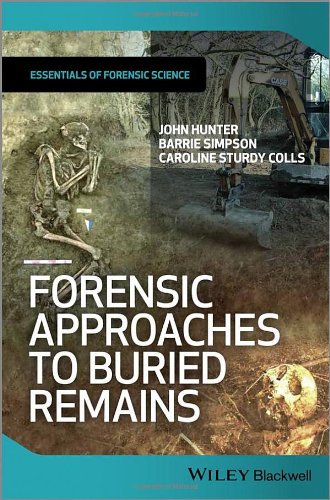
Forensic Approaches to Buried Remains 1st Edition by John Hunter ,Barrie Simpson ,Caroline Sturdy Colls ISBN 0470666293 978-0470666296

Original price was: $50.00.$35.00Current price is: $35.00.
Forensic Approaches to Buried Remains 1st Edition by John Hunter ,Barrie Simpson ,Caroline Sturdy Colls – Ebook PDF Instant Download/Delivery:0470666293 ,978-0470666296
Full download Forensic Approaches to Buried Remains 1st Edition after payment
Product details:
ISBN 10:0470666293
ISBN 13:978-0470666296
Author:John Hunter ,Barrie Simpson ,Caroline Sturdy Colls
The field of forensic archaeology has developed over recent years from being a branch of conventional archaeology into a well-established discipline in its own right. Forensic Approaches to Buried Remains takes an innovative approach to the subject by placing the role of the forensic archaeologist within the wider forensic environment; it identifies new areas of interdisciplinary research and practice, and evaluates practical difficulties.
The authors see this book as a reflection of the subject’s development, and as a knowledge base for the next generation of forensic archaeologists. Areas covered include:
- Search logistics, integration and specialist search scenarios
- Levels of confidence in site search and elimination
- Urban and rural landscape reconstruction in both short and long term cases
- The integration of cadaver dogs and earth-moving machinery
- The recovery of multiple evidence types
- Sampling strategies, spatial relevance and dating
- Multiple burial scenarios
As part of the Essential Forensic Science book series this book will provide students and practitioners alike with an invaluable resource outlining both the major developments in the discipline, as well as original approaches to the search for, and recovery of buried remains.
Table of contents:
1. An introduction to buried remains
1.1 Questions of time
1.2 Questions of interpretation
1.3 Forensic archaeology
1.4 Legal issues and procedures
1.5 Decay dynamics
1.6 Search methods and adaptations
1.7 Recovery methods and adaptation
1.8 Mass graves
2. Search theory and the landscape
2.1 The theory
2.2 Landscape mapping
2.3 Remote sensing
3. Search application
3.1 Geophysical survey
3.2 Cadaver dogs
3.3 Mechanical excavation
3.4 Bodies in aqueous environments
4. Search design
4.1 Search design
4.1.1 Definition of search boundaries
4.1.2 Recording and archiving
4.1.3 Thoroughness
4.2 Interrogating landscapes
4.3 Balancing probabilities
5. Longer-term ‘no body’ cases
5.1 Introduction
5.2 History of cold case investigation
5.3 Cultural changes to rural landscapes
5.4 Natural changes to rural landscapes
5.5 Planning controls and building controls
5.6 Current planning arrangements
5.7 Planning records
5.8 Building records
5.9 Special circumstances
5.9.1 Archaeological investigation
5.9.2 Listed buildings
5.9.3 Ecclesiastical buildings
5.9.4 Burial grounds
5.10 Landfill sites and waste disposal
6. Recovery, stratigraphy and destruction
6.1 Stratigraphy
6.1.1 Layers and contamination
6.1.2 Fire scenes
6.1.3 Formal exhumations
6.2 The destructive process
6.2.1 Documentation
6.2.2 Planning and photography
Appendix: The forensic archaeologist’s report (taken from Section 7 of the Standards and Guidance for Forensic Archaeologists)
7. Recovery, sampling and dating
7.1 Sieving
7.2 Sampling and forensic ecology
7.2.1 Entomology
7.2.2 Palynology
7.3 Essential taphonomics
7.3.1 Natural modifications
7.3.2 Anthropogenic modification
7.4 Physical anthropology, recovery and surface scatters
7.5 Dating
7.5.1 Relative dating
7.5.2 Absolute dating
8. The investigation of multiple burials
8.1 Diversity and challenges
8.2 Developments
8.3 Interrogating the evidence
8.4 The aftermath of conflict
8.5 Politics and Religion
8.6 Archives for history
People also search for:
forensic breakdown
arch forensics examples
woods solve a case forensic anthropology
techniques used in forensic anthropology
x ray in forensic science
Tags: John Hunter, Barrie Simpson, Caroline Sturdy Colls, Forensic, Approaches