

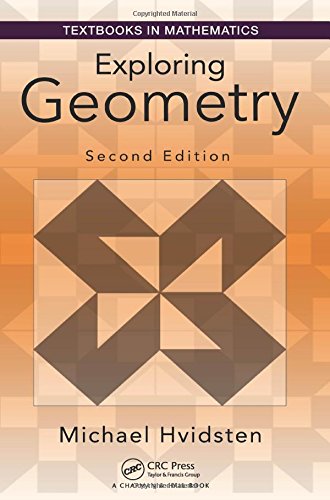
Exploring Geometry 2nd Edition by Michael Hvidsten ISBN 1498760805 9781498760805
Original price was: $50.00.$35.00Current price is: $35.00.
Exploring Geometry 2nd Edition by Michael Hvidsten – Ebook PDF Instant Download/Delivery: 1498760805, 9781498760805
Full download Exploring Geometry 2nd Edition after payment
Product details:
ISBN 10: 1498760805
ISBN 13: 9781498760805
Author: Michael Hvidsten
Exploring Geometry 2nd Table of contents:
CHAPTER 1 Geometry and the Axiomatic Method
1.1 EARLY ORIGINS OF GEOMETRY
1.2 THALES AND PYTHAGORAS
1.2.1 Thales
1.2.2 Pythagoras
1.3 PROJECT 1 — THE RATIO MADE OF GOLD
1.3.1 Golden Section
1.3.2 Golden Rectangles
1.4 THE RISE OF THE AXIOMATIC METHOD
1.5 PROPERTIES OF AXIOMATIC SYSTEMS
1.5.1 Consistency
1.5.2 Independence
1.5.3 Completeness
1.5.4 Gödel’s Incompleteness Theorem
1.6 EUCLID’S AXIOMATIC GEOMETRY
1.6.1 Euclid’s Postulates
1.7 PROJECT 2 — A CONCRETE AXIOMATIC SYSTEM
CHAPTER 2 Euclidean Geometry
2.1 ANGLES, LINES, AND PARALLELS
2.2 CONGRUENT TRIANGLES AND PASCH’S AXIOM
2.3 PROJECT 3—SPECIAL POINTS OF A TRIANGLE
2.3.1 Circumcenter
2.3.2 Orthocenter
2.3.3 Incenter
2.4 MEASUREMENT AND AREA
2.4.1 Mini-Project — Area in Euclidean Geometry
2.4.2 Cevians and Areas
2.5 SIMILAR TRIANGLES
2.5.1 Mini-Project — Finding Heights
2.6 CIRCLE GEOMETRY
2.6.1 Chords and Arcs
2.6.2 Inscribed Angles and Figures
2.6.3 Tangent Lines
2.6.4 General Intercepted Arcs
2.7 PROJECT 4 — CIRCLE INVERSION AND ORTHOGONALITY
2.7.1 Orthogonal Circles Redux
CHAPTER 3 Analytic Geometry
3.1 THE CARTESIAN COORDINATE SYSTEM
3.2 VECTOR GEOMETRY
3.3 PROJECT 5— BÉZIER CURVES
3.4 ANGLES IN COORDINATE GEOMETRY
3.5 THE COMPLEX PLANE
3.5.1 Polar Form
3.6 BIRKHOFF’S AXIOMATIC SYSTEM
CHAPTER 4 Constructions
4.1 EUCLIDEAN CONSTRUCTIONS
4.2 PROJECT 6 — EUCLIDEAN EGGS
4.3 CONSTRUCTIBILITY
4.3.1 Mini-Project — Origami Construction
CHAPTER 5 Transformational Geometry
5.1 EUCLIDEAN ISOMETRIES
5.2 REFLECTIONS
5.2.1 Mini-Project — Isometries through Reflection
5.2.2 Reflection and Symmetry
5.3 TRANSLATIONS
5.3.1 Translational Symmetry
5.4 ROTATIONS
5.4.1 Rotational Symmetry
5.5 PROJECT 7 — QUILTS AND TRANSFORMATIONS
5.6 GLIDE REFLECTIONS
5.6.1 Glide Reflection Symmetry
5.7 STRUCTURE AND REPRESENTATION OF ISOMETRIES
5.7.1 Matrix Form of Isometries
5.7.2 Compositions of Rotations and Translations
5.7.3 Compositions of Reflections and Glide Reflections
5.7.4 Isometries in Computer Graphics
5.7.5 Summary of Isometry Compositions
5.8 PROJECT 8—CONSTRUCTING COMPOSITIONS
CHAPTER 6 Symmetry
6.1 FINITE PLANE SYMMETRY GROUPS
6.2 FRIEZE GROUPS
6.3 WALLPAPER GROUPS
6.4 TILING THE PLANE
6.4.1 Escher
6.4.2 Regular Tessellations of the Plane
6.5 PROJECT 9—CONSTRUCTING TESSELLATIONS
CHAPTER 7 Hyperbolic Geometry
7.1 BACKGROUND AND HISTORY
7.2 MODELS OF HYPERBOLIC GEOMETRY
7.2.1 Poincaré Model
7.2.2 Mini-Project — The Klein Model
7.3 BASIC RESULTS IN HYPERBOLIC GEOMETRY
7.3.1 Parallels in Hyperbolic Geometry
7.3.2 Omega Points and Triangles
7.4 PROJECT 10 — THE SACCHERI QUADRILATERAL
7.5 LAMBERT QUADRILATERALS AND TRIANGLES
7.5.1 Lambert Quadrilaterals
7.5.2 Triangles in Hyperbolic Geometry
7.6 AREA IN HYPERBOLIC GEOMETRY
7.7 PROJECT 11 — TILING THE HYPERBOLIC PLANE
CHAPTER 8 Elliptic Geometry
8.1 BACKGROUND AND HISTORY
8.2 PERPENDICULARS AND POLES IN ELLIPTIC GEOMETRY
8.3 PROJECT 12 — MODELS OF ELLIPTIC GEOMETRY
8.3.1 Double Elliptic Model
8.3.2 Spherical Lunes
8.3.3 Single Elliptic Geometry
8.4 BASIC RESULTS IN ELLIPTIC GEOMETRY
8.4.1 Stereographic Projection Model
8.4.2 Segments and Triangle Congruence in Elliptic Geometry
8.5 TRIANGLES AND AREA IN ELLIPTIC GEOMETRY
8.5.1 Triangle Excess and AAA
8.5.2 Area in Elliptic Geometry
8.6 PROJECT 13 — ELLIPTIC TILING
CHAPTER 9 Projective Geometry
9.1 UNIVERSAL THEMES
9.1.1 Central Projection Model of Euclidean Geometry
9.1.2 Ideal Points at Infinity
9.2 PROJECT 14 — PERSPECTIVE AND PROJECTION
9.3 FOUNDATIONS OF PROJECTIVE GEOMETRY
9.3.1 Affine Geometry
9.3.2 Axioms of Projective Geometry
9.3.3 Duality
9.3.4 Triangles and Quadrangles
9.3.5 Desargues’ Theorem
9.4 TRANSFORMATIONS AND PAPPUS’S THEOREM
9.4.1 Perspectivities and Projectivities
9.4.2 Projectivity Constructions and Pappus’s Theorem
9.5 MODELS OF PROJECTIVE GEOMETRY
9.5.1 The Real Projective Plane
9.5.2 Transformations in the Real Projective Plane
9.5.3 Collineations
9.5.4 Homogeneous Coordinates and Perspectivities
9.5.5 Elliptic Model
9.6 PROJECT 15 — RATIOS AND HARMONICS
9.6.1 Ratios in Affine Geometry
9.6.2 Cross-Ratio
9.6.3 Harmonious Ratios
9.7 HARMONIC SETS
9.7.1 Harmonic Sets of Points
9.7.2 Harmonic Sets of Lines
9.7.3 Harmonic Sets and the Cross-Ratio
9.8 CONICS AND COORDINATES
9.8.1 Conic Sections Generated by Euclidean Transformations
9.8.2 Point Conics in Projective Geometry
9.8.3 Non-singular Conics and Pascal’s Theorem
9.8.4 Line Conics
9.8.5 Tangents
9.8.6 Conics in Real Projective Plane
CHAPTER 10 Fractal Geometry
10.1 THE SEARCH FOR A “NATURAL” GEOMETRY
10.2 SELF-SIMILARITY
10.2.1 Sierpinski’s Triangle
10.2.2 Cantor Set
10.3 SIMILARITY DIMENSION
10.4 PROJECT 16 — AN ENDLESSLY BEAUTIFUL SNOWFLAKE
10.5 CONTRACTION MAPPINGS
10.6 FRACTAL DIMENSION
10.7 PROJECT 17 — IFS FERNS
10.8 ALGORITHMIC GEOMETRY
10.8.1 Turtle Geometry
10.9 GRAMMARS AND PRODUCTIONS
10.9.1 Space-Filling Curves
10.10 PROJECT 18 — WORDS INTO PLANTS
People also search for Exploring Geometry 2nd:
exploring the fundamentals of geometry
exploring discrete geometry
exploring advanced euclidean geometry with geogebra
exploring analytic geometry with mathematica
discovering geometry answer key
Tags: Michael Hvidsten, Exploring Geometry