

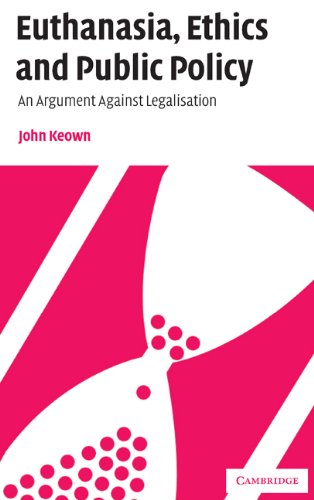
Euthanasia Ethics and Public Policy An Argument Against Legalisation 1st Edition by John Keown ISBN 0511019947 9780521804165

Original price was: $50.00.$35.00Current price is: $35.00.
Euthanasia Ethics and Public Policy An Argument Against Legalisation 1st Edition by John Keown – Ebook PDF Instant Download/Delivery: 0511019947, 9780521804165
Full download Euthanasia Ethics and Public Policy An Argument Against Legalisation 1st Edition after payment
Product details:
ISBN 10: 0511019947
ISBN 13: 9780521804165
Author: John Keown
Whether the law should permit voluntary euthanasia or physician-assisted suicide is one of the most vital questions facing all modern societies. Internationally, the main obstacle to legalisation has proved to be the objection that, even if they were morally acceptable in certain ‘hard cases’, voluntary euthanasia and physician-assisted suicide could not be effectively controlled; society would slide down a ‘slippery slope’ to the killing of patients who did not make a free and informed request, or for whom palliative care would have offered an alternative. How cogent is this objection? This book provides the general reader (who need have no expertise in philosophy, law or medicine) with a lucid introduction to this central question in the debate, not least by reviewing the Dutch euthanasia experience. It will interest all in any country whether currently for or against legalisation, who wish to ensure that their opinions are better informed.
Euthanasia Ethics and Public Policy An Argument Against Legalisation 1st Table of contents:
Part I Denitions
1 Euthanasia and Physician-Assisted Suicide
Euthanasia
Euthanasia as the Active, Intentional Termination of Life
Euthanasia as the Intentional Termination of Life by Act or by Omission
Euthanasia as Intentional or Foreseen Life-Shortening
Voluntary Active Euthanasia
Physician-Assisted Suicide
Conclusion
2 Intended versus Foreseen Life-Shortening
Distinguishing Intention from Foresight
Moral Difference
The Principle of Double Effect
Double Effect in Traditional Medical Ethics
Double Effect in the Criminal Law
Annie Lindsell
Dr David Moor
A Lingering Doubt?
Intended Ends and Intended Means
Catch-22
Conclusion
Part II The Ethical Debate: Human Life, Autonomy, Legal Hypocrisy and the Slippery Slope
3 The Value of Human Life
‘Vitalism’ versus ‘Sanctity/Inviolability of Life’ versus ‘Quality of Life’
Vitalism
Sanctity/Inviolability of Life
The Prohibition of Intentional Killing
Intention and Foresight
Acts and Omissions
The Worthwhileness of Treatment: Its Benefits and Burdens
Quality of Life
Distinguishing ‘Quality of Life’ from ‘quality of life’
Illustrating the Distinctions
Mary’s Case
Dr V(italism)
Dr Q(uality of life)
Dr I(nviolability of life)
Angela
Dr V
Dr Q
Dr I
Conclusion
4 The Value of Autonomy
The ‘Right to Choose’
Choosing What Is Right
The Purpose and Value of Autonomy
The Right to Refuse Futile or Excessively Burdensome Treatments
How Autonomous?
Conclusion
5 Legal Hypocrisy?
The Current Law
VAE as Murder
Autonomy and the Law
Five Criticisms of the Current Law
Ineffective?
Palliative Care and Euthanasia
A Right to Suicide?
A Right to Commit Suicide by Refusing Treatment?
Active and Passive Euthanasia
Conclusion
6 The Slippery Slope Arguments
VAE in Principle and in Practice
The Nature of the Slippery Slope Argument
The Empirical Argument
Capacity
Depression
Vulnerability
Precise Guidelines and Strict Safeguards?
The Logical Argument
Voluntariness
Autonomy and Suffering
Conclusion
Part III The Dutch Experience: Controlling VAE? Condoning NVAE?
7 The Guidelines
The Dutch Law
Strict Safeguards?
The Guidelines
Precisely Defined and Strict?
Conclusion
8 The First Survey: The Incidence of Euthanasia
The Remmelink Report and the Van der Maas Survey
The Findings of the Survey
Methodology
The Retrospective Study
The Death Certificate Study
The Prospective Study
How Much Euthanasia?
VAE
Other Cases of Euthanasia
2,700 or 9,050?
Dances with Data?
Conclusion
9 Breach of the Guidelines
An Explicit Request
An Entirely Free and Voluntary Request That Was Well Considered, Durable and Persistent?
Life-Terminating Acts without the Patient’s Explicit Request
Other Cases Lacking an Explicit Request
Unbearable Suffering and Last Resort
Unbearable Suffering?
Last Resort?
Consultation and Reporting
Consultation
Reporting
Conclusion
10 The Slide toward NVAE
The Remmelink Report
The KNMG
Prosecutors
Courts
The Speed of the Slide
Conclusion
11 The Second Survey
The Data
VAE and PAS
Active Termination of Life without Explicit Request
Intensification of Pain and Symptom Treatment
Withholding or Withdrawing Treatment
Neonates
Assisted Suicide of Psychiatric Patients
Consultation
Reporting
Analysing the Data
Incidence of VAE and NVAE
VAE as an Alternative to Palliative Care
Widespread Failure to Report
Conclusion
12 The Dutch in Denial?
Van der Maas and Remmelink
Dutch Diplomacy
Death on Request
The Dutch Ambassador
Dr van Delden
Conclusion
13 The Euthanasia Act and the Code of Practice
The Euthanasia Act 2002
Brongersma
Van Oijen
Heringa
The Code of Practice 2015
Precision
A Voluntary and Well-Considered Request
Unbearable Suffering with No Prospect of Improvement
Informing the Patient
No Reasonable Alternative
Specific Issues
Advance Directives
Minors
Psychiatric Disorders
Dementia
Intellectual Disability and Aphasia
Coma and Reduced Consciousness
Strictness?
14 Effective Control since 2002?
Griffiths’ Defence of the Dutch Control System
Intrinsically Ineffective
Other Forms of Intentional Life-Shortening
Lax Interpretation
Lax Enforcement
The Logical Slope: Growing Acceptance of NVAE
Preventing an ‘Undignified’ Death
Infanticide
Conclusion
15 Continuing Concerns
The United Nations Human Rights Committee
Professor Cohen-Almagor
Dr Gorsuch
Dr Kimsma
Professor Boer
Dr Chabot
Conclusions
16 A Right to Physician-Assisted Suicide by Stopping Eating and Drinking?
LAS
PASSED: The KNMG Guidance
The Introduction
Characteristics and Definitions
Empirical Data
Legal and Ethical Aspects
Care and Guidance by Professionals, Volunteers and Those Close to the Patient
Dealing with Defensive Behaviour
Some Reflections on the Guidance
The Guidance’s Unconvincing Arguments
No Legal Definition
Refusal of Treatment
Omission Rather Than an Act
Intent to Palliate Suffering
Arbitrary Discrimination
Expanding Euthanasia
Conclusion
17 Assisted Suicide for the Elderly with ‘Completed Lives’
The Limits of the Brongersma Judgment
A Line in the Sand
The KNMG Position Paper
Existential Suffering: The Government’s Proposal
The Reasons for Change
The Proposed Legal Framework
Some Reflections on the Government’s Proposals
From Medical to Nonmedical
An Increase in Numbers
Effective Control?
The Worth of the Elderly
Qualifying Age
Conclusion
Part IV Belgium
18 The Belgian Legislation
The Act
The Belgian and Dutch Acts: A Brief Comparison
Strict and Precise?
Precise?
Strict?
19 Belgium’s Lack of Effective Control
The System of Control
From Serious and Incurable to Multiple Disorders
The Elasticity of Suffering
From VAE to PAS
From an Exception to a Right
Undermining of Conscientious Objection
The Act’s Extension to Minors
Support for Extension of Euthanasia by Advance Directive
Support for NVAE
Euthanasia by Nurses
Consultation
Organ Donation
Conclusions
Part V Australia
20 The Northern Territory
ROTTI
The Patient’s Request
The First Doctor’s Opinion
The Second and Third Doctors’ Opinions
Other Conditions
Palliative Care
Withdrawal of Request
Records and Reporting
Miscellaneous
Precise and Strict?
Precise?
Terminal Illness
Treatment Reasonably Available
In the Course of a Terminal Illness
Treatable Clinical Depression in Respect of the Illness
Reasonably Available Palliative Care
Strict?
Summary
The Act in Practice: Seven Deaths in Darwin
Conclusion
Part VI The United States
21 The Oregon Model
Oregon’s Death with Dignity Act
The Patient
The Physicians
The Attending Physician
The Consulting Physician
Counselling
Documentation and Reporting
Immunity and Liability
Precise and Strict?
Precise?
Strict?
The Act in Practice
Hendin and Foley
The OHA Reports
Seven Other US Jurisdictions
The Next Step(s)
Conclusions
22 The US Supreme Court: Glucksberg and Quill
Glucksberg and Quill
State Interests
Justice Souter
Professor Epstein
Judge Posner
Van der Wal
Future Challenges
Conclusion
Part VII Canada
23 The Supreme Court of Canada: Carter
The Sanctity/Inviolability of Life
Confused Terminology
Confused Thought: Misunderstanding the Sanctity of Life
Encouraging Suicide?
Misunderstanding Liberty and Security of the Person
Arbitrary Criteria
Fuzzy Criteria
The Purposes of the Prohibition
Evading the Logical Slippery Slope Argument
The Empirical Evidence
Some Other Criticisms
Alleged Changes in the ‘Legislative and Social Facts’
The Pessimistic Dichotomy
The Optimistic Assumption
Conclusion
24 Canada’s Euthanasia Legislation
Introduction
The Legal Criteria for VAE and PNAS
Exemption from Liability
Eligibility
Safeguards
Regulations
Review
Precise and Strict?
Precise?
Strict?
The Next Step(s)
Conclusion
Conclusion
Summary
The Future: Courts and Legislatures
Expert Committees
Hard Cases
Afterword
The United States
The United Kingdom
People also search for Euthanasia Ethics and Public Policy An Argument Against Legalisation 1st:
ethics of euthanasia in animals
euthanasia public policy
euthanasia ethics pdf
euthanasia ethics paper
euthanasia ethics definition
Tags:
John Keown,Euthanasia Ethics,Public Policy,Legalisation