

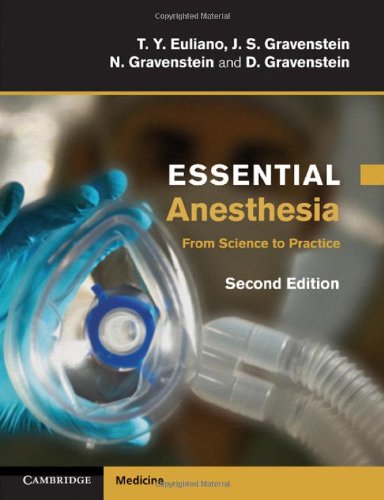
Essential Anesthesia From Science to Practice 2nd Edition by TY Euliano, JS Gravenstein, N Gravenstein, D Gravenstein ISBN 9780521149457 0521149452

Original price was: $50.00.$35.00Current price is: $35.00.
Essential Anesthesia From Science to Practice 2nd Edition by TY Euliano, JS Gravenstein, N Gravenstein, D Gravenstein – Ebook PDF Instant Download/Delivery: 9780521149457 ,0521149452
Full download Essential Anesthesia From Science to Practice 2nd Edition after payment
Product details:
ISBN 10: 0521149452
ISBN 13: 9780521149457
Author: TY Euliano, JS Gravenstein, N Gravenstein, D Gravenstein
Essential Anesthesia From Science to Practice 2nd Edition Table of contents:
Section 1: Clinical management
Chapter 1: Pre-operative evaluation
History
Medications
Allergies
Habits
Physical examination
Laboratory evaluations and studies
NPO status
Planned procedure
Anesthetic choice
Common disorders
Trauma emergency
Diabetes
Coronary artery disease
Pacemaker/AICD
Chronic hypertension
Congestive heart failure
Pulmonary disease
Asthma
Chronic renal failure
Pre-operative medication management
Peri-operative beta-blockade
Antihypertensives
Anticoagulants
Monoamine oxidase inhibitors (MAOIs)
Herbal remedies
Informed consent
Notes
Chapter 2: Airway management
Examination of the airway
Airway management techniques
Mask–ventilation
Laryngeal mask airway
Endotracheal intubation
Oral intubation by direct laryngoscopy
“Can’t intubate” situations
Awake fiberoptic intubation
Airway management plan
Notes
Chapter 3: Vascular access and fluid management
Vascular access
Peripheral venous cannulation
Central venous catheterization
Internal jugular (IJ) catheter placement technique
Pulmonary artery catheterization
Fluid management
Fluid types
Fluid requirements
Evolving fluid replacement strategy
Blood loss
Blood replacement
Risks
Notes
Chapter 4: Regional anesthesia
Neuraxial anesthesia
Hemodynamic effects
Pulmonary effects
Complications
Technique
Indications
Peripheral nerve blocks
Indications
Intravenous regional anesthesia (IVRA)
Local anesthetic toxicity
Notes
Chapter 5: General anesthesia
Pre-operative holding
Induction, maintenance, and emergence
Pre-oxygenation
Induction
The rapid sequence induction
Positioning
Depth of anesthesia and monitoring
Emergence
Problems
Notes
Chapter 6: Post-operative care
Early post-operative care
Early post-operative pain
Complications
Desaturation
Differential diagnosis
Management
Hypotension
Differential diagnosis
Management
Hypertension
Differential diagnosis
Management
PACU discharge
Outpatients
Continued post-operative care
Pain management
Chronic pain
Note
Chapter 7: Monitoring
Introduction
Focused monitoring
Inspection
Spontaneous ventilation
The eyes
Head lift test
Auscultation
Palpation
Instruments that supplement clinical monitoring
Non-invasive instruments
Blood pressure
Pulse and cerebral oximetry
The electrocardiogram
Monitoring respired gases
Capnography
Oxygen
Anesthetic gases
Temperature
Neuromuscular function
Doppler and ultrasound
The electroencephalogram and evoked responses
Invasive monitors
Arterial catheter
Central venous catheter
Pulmonary artery (PA) catheter
Notes
Chapter 8: The anesthesia machine
Systems without gas storage
Single-valve system with gas storage
Multi-valve system with gas storage
Systems with carbon dioxide absorption
Note
Section 2: Applied physiology and pharmacology
Chapter 9: Anesthesia and the cardiovascular system
Blood pressure and its determinants
Blood pressure control
Baroreceptor
Atrial stretch receptors
Chemoreceptors
Long-term control
Anesthesia in the patient with cardiovascular disease
Hypertension
Ischemic heart disease
Pacemaker/AICD
Congestive heart failure
Cardiovascular problems during anesthesia
Hypotension
Arrhythmias
Hypertension
Notes
Chapter 10: Anesthesia and the lung
Basic pulmonary physiology
Purpose of breathing
Control of breathing
Mechanics of ventilation
The work of breathing
Matching of ventilation and perfusion
Tissue oxygenation
Oxyhemoglobin dissociation curve
Alveolar air equation
Clinical relevance of the oxyhemoglobin dissociation curve
The hypoxemic patient
Conscious sedation
Studies of pulmonary function
Spirometry
Arterial blood gas analysis
Oxygen
Carbon dioxide
Bicarbonate
Anion gap
Buffers
ABG interpretation
Two clinical examples
Providing supplemental oxygen
Pre-oxygenation/denitrogenation
Mechanical ventilation
Anesthesia in the patient with pulmonary disease
Asthma
Obstructive sleep apnea
Pulmonary problems during anesthesia
Notes
Chapter 11: Anesthesia and other systems
The brain
The stomach
The liver
Liver enzymes
Liver function studies
Halothane hepatitis
The kidneys
The blood
Volume
Oxygen-carrying capacity
Clotting
Platelets
Calcium
Congenital hemorrhagic diseases
Heparin
Warfarin-type agents
Coagulation studies
Prothrombin time (PT)
Activated partial thromboplastin time (aPTT, normally 25–40 s)
Activated clotting time (ACT, normally <120 s)
The thromboelastogram (TEG)
Notes
Chapter 12: A brief pharmacology related to anesthesia
Approaching the anesthesia task with drugs
The basic approach
Drug interaction
Theories of anesthesia
Pharmacologic preparation for anesthesia
Reduce the risk of aspiration (Table 12.1)
Reduce anxiety (Table 12.2)
Benzodiazepines
Dexmedetomidine (Precedex®)
Prevent nausea and vomiting (Table 12.3)
Droperidol (Inapsine®)
Serotonin receptor blockers
Intravenous anesthetics (Table 12.4)
Barbiturates
Propofol (Diprivan®)
Etomidate (Amidate®)
Ketamine (Ketalar®)
Inhalation anesthetics (Table 12.5)
Uptake and distribution of inhaled anesthetics
The gases
Nitrous oxide
The concentration and second gas effects
Diffusion hypoxia
Xenon
The anesthetic vapors
Ethers
Halogenated aliphatic compounds
Halothane hepatitis
Comparing effects on heart, lung, and brain
Inhalation induction
Cardiovascular effects
Respiratory effects
Central nervous system effects
The opioids (Table 12.7)
Morphine
Hydromorphone (Dilaudid ®)
Meperidine (pethidine, Demerol®, Dolantin®, Pethadol®)
Fentanyls
Opioid receptor antagonism: naloxone (Narcan®)
Non-opioid analgesics in anesthesia
Clinical perspectives on the use of analgesics
Neuromuscular blockers and their antagonists (Table 12.11)
Depolarizing muscle relaxants
Non-depolarizing muscle relaxants
Muscle relaxant reversal
Dantrolene
The local anesthetics (Table 12.13)
Additives
Bicarbonate
Epinephrine
Clonidine (Catapres®)
Opioids
Bronchodilators
Cardiovascular drugs
The anticholinergic drugs
Drugs to raise blood pressure (Table 12.14)
Ephedrine
Epinephrine/norepinephrine
Dopamine
Dobutamine (Dobutrex®)
Isoproterenol (Isuprel®)
Phenylephrine (Neosynephrine®)
Vasopressin (Pitressin®)
Drugs to lower blood pressure (Table 12.15)
Beta-blockers
Direct vasodilators
Nitroglycerin
Sodium nitroprusside (Nipride®)
Clonidine (Catapres®)
Nitric oxide (INOmax®)
Antiarrhythmic drugs (Table 12.16)
Advanced cardiac life support
Notes
Section 3: Clinical cases
1 Breast lumpectomy under conscious sedation
2 Carpal tunnel release under Bier block
Note
3 Cataract removal under MAC
Note
4 Cesarean section under regional anesthesia
Note
5 Gastric bypass under general anesthesia
6 AV shunt placement under peripheral nerve block
7 Open repair of an abdominal aortic aneurysm in a patient with coronary artery disease
8 Trauma patient under general anesthesia
9 Liver resection under general anesthesia
10 Back surgery in a patient with chronic pain and an AICD
11 Pediatric inguinal hernia repair under general anesthesia
Index
People also search for Essential Anesthesia From Science to Practice 2nd Edition:
how to practice science
essential anesthesia pdf
science of anesthesia
anesthesia essentials
anesthesiology science
Tags: TY Euliano, JS Gravenstein, N Gravenstein, D Gravenstein, Essential Anesthesia, Science