

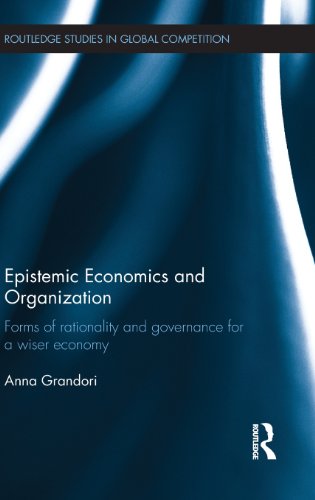
Epistemic Economics and Organization Forms of Rationality and Governance for a Wiser Economy 1st Edition by Anna Grandori ISBN 0415575656 978-0415575652


Original price was: $50.00.$35.00Current price is: $35.00.
Epistemic Economics and Organization Forms of Rationality and Governance for a Wiser Economy 1st Edition by Anna Grandori – Ebook PDF Instant Download/Delivery: 0415575656, 978-0415575652
Full download Epistemic Economics and Organization Forms of Rationality and Governance for a Wiser Economy 1st edition after payment
Product details:
ISBN 10: 0415575656
ISBN 13: 978-0415575652
Author: Anna Grandori
This book proposes a new approach to economics, management and organization that should help in making economic organization ‘wise’, ‘innovative’ and ‘robust’ in an uncertain and risky world. Although the modern economy and society is ‘knowledge intensive’, Anna Grandori argues that the dominant economic, organizational and behavioural models neglect to a large extent the problem of valid knowledge construction and effective knowledge governance.
The book integrates inputs from economics and behavioural science with insights from the philosophy of knowledge to define new micro-foundations: neither a calculative, deductive and omniscient ‘rational actor’; nor an experiential, adaptive and biased ‘behavioural actor’; but a knowledgeable and imaginative ‘epistemic actor’.
The implications for contracts and organizations, sustained also by insights from law, are shown to be far reaching, including a new view of the nature of the firm as an entity-establishing agreement under which to discover uses of resources under uncertainty, and as a democratic institution.
Epistemic Economics and Organization Forms of Rationality and Governance for a Wiser Economy 1st Table of contents:
I Micro foundations From bounded to epistemic rationality
1 ‘Models of man’ and the ‘rationality divide’
2 Savage and Simon revisited: how both ‘maximizing’ and ‘satisficing’ simplify problems
3 Endogenizing assumptions: contingent rationality
4 The ‘psychology’ versus the ‘logic’ of judgement and discovery
5 The logic of economic discovery: an epistemic decision model
5.1 Problems as conjectures
The Olive Water case
5.2 Rational heuristics with unknown a and s
5.3 Discovering and testing ‘expected utility’
5.4 The logic of improvement
The Green Move Project13
6 Conclusions
7 Summary
II Contracts and the firm beyond transactions The governance of knowledge and association
1 Contract incompleteness and the rationality divide
2 How both relational contracting and authority relations have limited capacity of governing uncertainty
3 Contracting without knowing
3.1 From contracting on actions to contracting on decision procedures and rights
3.2 From contracting on decision rights to contracting on asset ownership
3.3 From property right sharing to legal entity establishing
4 Ten theses on the nature of the firm
5 Relations with extant views of the firm
6 Summary
III Organization design beyond comparative assessment The discovery of forms, and forms for discovery
1 Organization forms and forms of rationality
2 How both markets and hierarchies decompose problems
3 Missing alternatives: non decomposable systems and panarchic governance
4 From ‘discrete institutional alternatives’ to discrete coordination mechanisms
5 Instrumentally and epistemically rational coordination mechanisms
5.1 Ad hoc coordination devices
5.2 Rule-based coordination
5.3 A model for the joint epistemic and instrumental comparative assessment of CM
6 Combining mechanisms: complementarity and the design of structural heterogeneity
7 The negotiated discovery of organizational arrangements
8 Properties of robust economic organization in uncertain worlds
8.1 Connected multiplicity and democratic governance
8.2 Flexible formalization and constitutional governance
8.3 Robustness and structural heterogeneity
9 Summary
People also search for Epistemic Economics and Organization Forms of Rationality and Governance for a Wiser Economy 1st:
epistemic rationality and epistemic normativity
epistemic rationality examples
epistemic rationality
epistemic rationality definition
an epistemic theory of democracy