

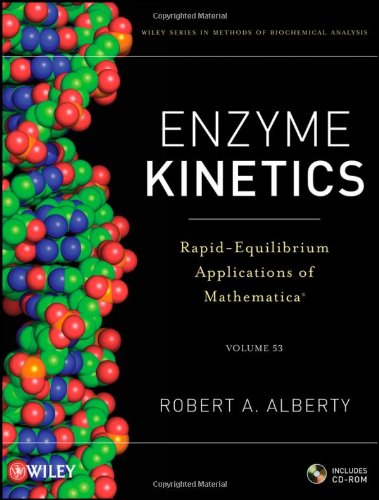
Enzyme Kinetics Rapid Equilibrium Applications of Mathematica 1st Edition by Robert A Alberty ISBN 0470639326 9780470639320


Original price was: $50.00.$35.00Current price is: $35.00.
Enzyme Kinetics Rapid Equilibrium Applications of Mathematica 1st Edition by Robert A Alberty – Ebook PDF Instant Download/Delivery: 0470639326, 9780470639320
Full download Enzyme Kinetics Rapid Equilibrium Applications of Mathematica 1st Edition after payment
Product details:
ISBN 10: 0470639326
ISBN 13: 9780470639320
Author: Robert A Alberty
Enzyme Kinetics Rapid Equilibrium Applications of Mathematica 1st Table of contents:
Chapter 1: Biochemical Thermodynamics
1.1 Introduction
1.2 Chemical Thermodynamics
1.3 Transformed Thermodynamic Properties of Biochemical Reactants at a Specified pH
1.4 Calculation of the change in binding of hydrogen ions in a biochemical reaction at a specified pH by taking the derivative of logK′ or Δr G′° with respect to pH
1.5 Calculation of the standard transformed Gibbs energies of formation of biochemical reactants
1.6 Calculation of the standard transformed Gibbs energy of hydrolysis of ATP to ADP and the apparent equilibrium constant K′
1.7 Calculation of the change in the binding of hydrogen ions Δr NH in ATP + H2O = ADP + Pi at 298.15 K
1.8 Calculation of the change in the binding of hydrogen ions in a biochemical reaction at a specified pH without information on standard Gibbs energies of formation of species
1.9 Another way to consider the pH dependence of the apparent equilibrium constant for ATP + H2O = ADP + Pi
1.10 Data on the thermodynamics of enzyme-catalyzed reactions in the literature and on the web
1.11 Discussion
Chapter 2: A = P
2.1 Introduction to enzyme kinetics
2.2 A → Products
2.3 A = P
2.4 A → P when the apparent equilibrium constant is very large
2.5 Appendix
2.6 Discussion
Chapter 3: Ordered A + B → Products
3.1 Derivation of the rapid-equilibrium rate equation for ordered A + B → products
3.2 Estimation of the kinetic parameters for ordered A + B → products
3.3 Effects of pH on the kinetics of ordered A + B → products
3.4 Effects of pH on the kinetics of ordered A + B → products when a hydrogen ion is consumed in the rate-determining reaction
3.5 Effects of pH on the kinetics of ordered A + B → products when n hydrogen ions are consumed in the rate-determining reaction
3.6 Appendix on effects of temperature on the kinetic parameters for ordered A + B → products
3.7 Discussion
Chapter 4: Random A + B → Products
4.1 Two rapid-equilibrium rate equations for random A + B → products
4.2 Use of Solve to estimate the pH-dependent kinetic parameters from the minimum number of velocity measurements for random A + B → products
4.3 Application of calckinparsrandABI to velocities for the ordered mechanism
4.4 Effects of pH on the kinetics of random A + B → products when no hydrogen ions are consumed in the rate-determining reaction
4.5 Effects of pH on the kinetics of random A + B → products when hydrogen ions are consumed in the rate-determining reaction
4.6 Discussion
Chapter 5: A + B = P + Q
5.1 Ordered A + B = ordered P + Q
5.2 Ordered A + B = random P + Q
5.3 Random A + B = random P + Q
5.4 Appendix
5.5 Discussion
Chapter 6: A + B + C → Products
6.1 Introduction
6.2 Mechanism I
6.3 Mechanism II
6.4 Mechanism III
6.5 Mechanism IV
6.6 Mechanism V
6.7 Discussion
Chapter 7: Ordered O + mR → Products
7.1 Introduction
7.2 Mechanism I for ordered O + mR → products in which mR is bound first
7.3 Effects of pH on mechanism I
7.4 Mechanism II for ordered O + 2R → products in which O is bound first
7.5 Effects of phi on mechanism II
7.6 Discussion
Chapter 8: Random O + mR → Products
8.1 Derivation of the rapid-equilibrium rate equation for random O + mR → products
8.2 Effects of pH for random O + mR → products
8.3 Estimation of kinetic parameters for random O + 3R → products
8.4 Discussion
Chapter 9: Inhibition and activation of A → products
9.1 Introduction
9.2 Competitive inhibition
9.3 Uncompetitive inhibition
9.4 Mixed inhibition
9.5 Essential activation
9.6 Essential activation when two, three, or four molecules of activator X are bound in a single reaction
9.7 Mixed activation when one X is bound
9.8 Mixed activation when two X are bound in a single reaction
9.9 Derivation of the simplest rate equation that is sigmoid in both A and X.
9.10 Derivation of the rate equation when 2A is bound in two reactions and 2X is bound in one reaction
9.11 Discussion
Chapter 10: Modification of A → products
10.1 General modifier mechanism for A → products with two paths to products
10.2 General modifier mechanism for A → products with the binding of 2X and two paths to products
10.3 General modifier mechanism for A → products when two X are bound in two reactions and there are three paths to products
10.4 Discussion
Chapter 11: Inhibition, activation, and modification of A + B → products
11.1 Introduction
11.2 Ordered A + B → products
11.3 Random A + B → products
11.4 Discussion
Chapter 12: Systems of Enzyme-Catalyzed Reactions
12.1 Simple Examples
12.2 Enzyme – catalyzed reactions
12.3 Glyoxylate cycle
People also search for Enzyme Kinetics Rapid Equilibrium Applications of Mathematica 1st:
what is vmax in enzyme kinetics
michaelis menten enzyme kinetics
what is kcat in enzyme kinetics
what does km mean in enzyme kinetics
what is ki in enzyme kinetics
Tags:
Robert A Alberty,Enzyme Kinetics,Equilibrium,Mathematica