

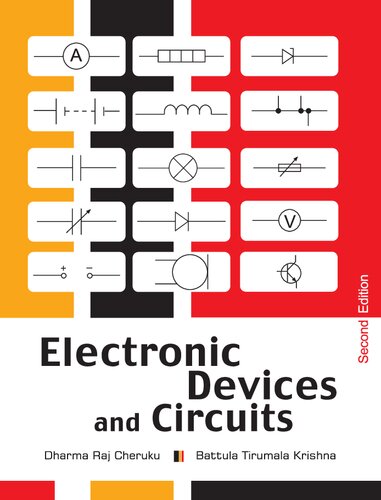
This second edition of Electronic Devices and Circuits provides a firm grounding in the fundamental concepts governing the field of electronics. The narrative style of the book, its clear illustrations, ample number of worked-out examples and review questions will aid the student in quick recapitulation and better understanding. Designed as a text book for undergraduate students, it will serve as an ideal text for students of electronics and its allied fields, besides providing a good source of reference to those in the electronics industry.
Sale!
Electronic Devices and Integrated Circuits 2nd Edition by BP Singh, Rekha Singh ISBN 8177586386 9788177586381
Original price was: $50.00.$35.00Current price is: $35.00.
Electronic Devices and Integrated Circuits 2nd Edition B. P. Singh Digital Instant Download
ISBN(s): 9788177586381, 8177586386
Edition: 2nd
File Details: PDF, 13.99 MB
Year: 2009
Language: english
Electronic Devices and Integrated Circuits 2nd Edition by BP Singh, Rekha Singh – Ebook PDF Instant Download/Delivery: 8177586386, 9788177586381
Full download Electronic Devices and Integrated Circuits 2nd Edition after payment
Product details:
ISBN 10: 8177586386
ISBN 13: 9788177586381
Author: BP Singh, Rekha Singh
Electronic Devices and Integrated Circuits 2nd Table of contents:
Chapter 1. Introduction
1.1 What is electronics?
1.2 Applications of electronics
1.3 Electronic components
Chapter 2. Semiconductors
2.1 Introduction
2.2 Potential barrier
2.3 Energy-band theory
2.4 Classification of materials
2.5 Intrinsic and extrinsic semiconductors
2.6 p- and n-type semiconductor materials
2.7 Mobility and conductivity
2.8 Properties of semiconductor materials
2.9 Hall effect and its applications
2.10 Thermistor and sensistor
2.11 Time variation of excited minority carriers
2.12 Concept of diffusion current
2.13 Continuity equation in semiconductors
2.14 Injected minority carriers
2.15 Graded semiconductor junction
Summary
Solved problems
Exercise problems
Review questions
Chapter 3. Semiconductor Diodes
3.1 p-n junction diode
3.2 Biasing the diode
3.3 The current components in a junction diode
3.4 V-I characteristics of a diode
3.5 Piecewise linear model
3.6 Transition capacitance
3.7 Diffusion capacitance
3.8 Varactor diode
3.9 Zener diode
3.10 Tunnel diode
3.11 Photodiode
3.12 Light-emitting diode
3.13 Schottky diode
3.14 Point contact diode
3.15 PIN diode
Summary
Solved problems
Exercise problems
Review questions
Chapter 4. Diode Circuits
4.1 Introduction
4.2 Rectifiers
4.3 Comparison of types of rectifiers
4.4 Filters
4.5 Voltage regulators
4.6 Performance of regulators
4.7 IC regulators
Summary
Solved problems
Exercise problems
Review questions
Chapter 5. Bipolar Junction Transistors
5.1 Introduction
5.2 Junction transistor
5.3 Transistor fabrication
5.4 Regions of operation
5.5 Transistor configurations
5.6 Current components in a transistor
5.7 Transistor as an amplifier
5.8 V-I characteristics of a transistor
5.9 Common base configuration
5.10 Common emitter configuration
5.11 Common collector configuration
5.12 Ebers-moll model of a transistor
5.13 Voltage ratings of a transistor
5.14 Typical junction voltages
5.15 Current gains
Summary
Solved problems
Exercise problems
Review questions
Chapter 6. Transistor Biasing
6.1 Introduction
6.2 Load line and operating point
6.3 Fixed-bias circuit
6.4 Stability of operating point
6.5 Self-bias circuit
6.6 Stability factors
6.7 Stability factor S
6.8 Stability factor S′
6.9 Stability factor S″
6.10 Techniques compensation
6.11 Concept of thermal runaway
6.12 Heat sink
Summary
Solved problems
Exercise problems
Review questions
Chapter 7. Transistor Amplifier Circuits
7.1 Introduction
7.2 Large signal analysis of transistor amplifier
7.3 Two-port model of a transistor
7.4 Small signal low-frequency model of a transistor
7.5 Analysis of a transistor amplifier circuit
7.6 Transistor amplifier configurations
7.7 Linear analysis of a transistor circuit
7.8 Miller’s theorem and its applications
7.9 Simplified model of a transistor
7.10 CE amplifier with emitter resistance
7.11 Multistage amplifiers
7.12 Frequency response of an amplifier
7.13 Bandwidth of a cascaded amplifier
7.14 Emitter bypass capacitor
7.15 Coupling capacitor
7.16 High-frequency model of a CE transistor
7.17 Validity of the high-frequency model
7.18 High-frequency current gain
7.19 Gain bandwidth product
Summary
Solved problems
Exercise problems
Review questions
Chapter 8. Field Effect Transistors
8.1 Introduction
8.2 Working principle of JFET
8.3 Drain and transfer characteristics of a JFET
8.4 Small signal model of a FET
8.5 MOSFET
8.6 Analysis of FET amplifier
8.7 FET biasing circuits
8.8 Voltage variable resistor
Summary
Solved problems
Exercise problems
Review questions
Chapter 9. Thyristors
9.1 Introduction
9.2 pnpn diode
9.3 Silicon-controlled rectifier
9.4 Triac
9.5 Diac
9.6 Unijunction transistor
9.7 Optoelectronic devices
Summary
Solved problems
Exercise problems
Review questions
Chapter 10. Feedback Amplifiers
10.1 Types of amplifiers
10.2 Types of distortion in amplifiers
10.3 Need for feedback
10.4 Negative feedback in amplifiers
10.5 Transfer gain with feedback
10.6 Advantages and disadvantages of negative feedback
10.7 Effect of feedback on input and output impedances
10.8 Analysis of feedback amplifiers
10.9 Voltage series feedback amplifier
10.10 Current series feedback amplifier
10.11 Current shunt feedback amplifier
10.12 Voltage shunt feedback amplifier
Summary
Solved problems
Exercise problems
Review questions
Chapter 11. Sinusoidal Oscillators
11.1 Introduction
11.2 Barkhausen criterion
11.3 Phase-shift oscillator
11.4 Resonant circuit oscillator
11.5 Hartley and Colpitt oscillators
11.6 Wien bridge oscillator
11.7 Crystal oscillator
11.8 Amplitude and frequency stability
Summary
Solved problems
Exercise problems
Review questions
Chapter 12. Power Amplifiers
12.1 Introduction
12.2 Types of power amplifiers
12.3 Harmonic distortion
12.4 Class A series-fed amplifier
12.5 Class A transformer-coupled amplifiers
12.6 Conversion efficiency
12.7 Class A push-pull amplifier
12.8 Class B amplifier
12.9 Other types of class B amplifiers
12.10 Class AB amplifiers
12.11 Tuned amplifiers
12.12 Single-tuned amplifier
12.13 Double-tuned amplifier
12.14 Stagger-tuned amplifier
12.15 Instability in tuned amplifiers
Summary
Solved problems
Exercise problems
Review questions
Chapter 13. Operational Amplifiers
13.1 Introduction
13.2 Characteristics of ideal Op-Amp
13.3 Block diagram of Op-Amp
13.4 Differential amplifier
13.5 Error voltages and currents
13.6 AC parameters of Op-Amp
13.7 Mathematical computations using Op-Amp
13.8 Converters and Comparators
Summary
Solved problems
Exercise problems
Review questions
Chapter 14. Cathode-ray Oscilloscope
14.1 Introduction
14.2 Two-dimensional motion of electron
14.3 Force and motion in magnetic field
14.4 Parallel electric and magnetic fields
14.5 Perpendicular electric and magnetic fields
14.6 Electrostatic deflection
14.7 Magnetic deflection
14.8 Electrostatic focusing
14.9 Magnetic focusing
14.10 Cathode-ray tube
14.11 Applications of Cathode-ray Oscilloscope
People also search for Electronic Devices and Integrated Circuits 2nd:
electronic devices and integrated circuits
electronic devices and integrated circuits pdf
electronic devices and circuits discrete and integrated
what is integrated circuit in electronics
what is electronic devices and circuits
Tags:
BP Singh,Rekha Singh,Electronic Devices,Integrated Circuits