

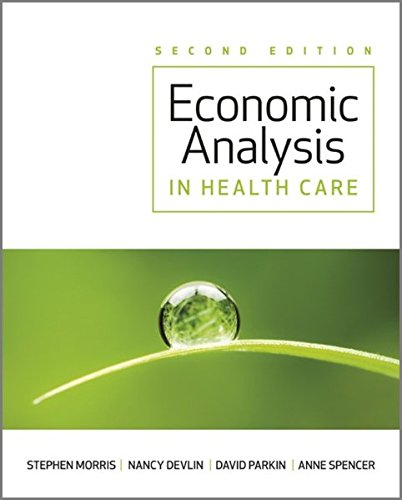
Economic Analysis in Healthcare 2nd Edition by Stephen Morris, Nancy Devlin, David Parkin, Anne Spencer 1119951496 9781119951490


Original price was: $50.00.$35.00Current price is: $35.00.
Economic Analysis in Healthcare 2nd Edition by Stephen Morris, Nancy Devlin, David Parkin, Anne Spencer – Ebook PDF Instant Download/Delivery: 1119951496, 9781119951490
Full download Economic Analysis in Healthcare 2nd Edition after payment
Product details:
ISBN 10: 1119951496
ISBN 13: 9781119951490
Author: Stephen Morris, Nancy Devlin, David Parkin, Anne Spencer
Economic Analysis in Health Care, Second Edition is intended as a core textbook for advanced undergraduate and postgraduate students of health economics. The authors provide comprehensive coverage of the field of economics in health care and the evaluation of health care technologies.
This new edition has been fully updated with up-to-date case studies from the UK, Europe and the Rest of the World. It includes a new chapter on health care labour markets and contains new material integrated throughout the text on the economics of public health.
Economic Analysis in Healthcare 2nd Table of contents:
CHAPTER 1 Introduction to economic analysis in health care
1.1 Life, death and big business: why health economics is important
TABLE 1.1 International health expenditure, 1995 and 2009
1.2 Health care as an economic good
BOX 1.1 The opportunity cost of in vitro fertilisation (IVF)
TABLE 1.2 Choice and opportunity cost in the allocation of health care resources
1.3 Health and health care
1.4 Wants, demands and needs
1.5 The production of health and health care
Figure 1.1 Production function
1.6 Deciding who gets what in health care
Figure 1.2 The demand for and supply of liposuction
Figure 1.3 The demand for and supply of health care in the NHS
1.7 Is the market for health care special?
1.8 Describing versus evaluating the use of health care resources
1.9 Judging the use of health care resources
BOX 1.2 Why not allow a market in human organs?
Summary
CHAPTER 2 The demand for health care
2.1 Why study demand? Profits, policy and improving health
2.2 Consumer choice theory
2.2.1 Preferences and utility
Figure 2.1 Indifference curves
BOX 2.1 Using utility functions to understand patients’ choice of hospital in the NHS
2.2.2 Budget constraints and maximisation
Figure 2.2 Maximising Utility
BOX 2.2 Rational addiction and price elasticity of demand
2.3 Demand functions
2.3.1 The determinants of demand
Price
Figure 2.3 Movements along and shifts in the demand curve
Income
Figure 2.4 Changes in income
Prices of other goods
Tastes and lifestyles
BOX 2.3 Why are people becoming more obese?
Population size and composition
BOX 2.4 The effect of ageing on the demand for health care
2.3.2 Estimating demand functions
2.3.3 Price and income elasticity of demand
2.4 Modelling choices about health
2.4.1 Understanding consumption of health and health care
Figure 2.5 The demand for health
2.4.2 Understanding investment in health care
2.4.3 Predictions of the Grossman model
Figure 2.6 The marginal efficiency of health capital
2.5 Needs, wants and demands
2.6 Asymmetry of information and imperfect agency
Figure 2.7 The problem of identifying supplier-induced demand
BOX 2.5 Supplier-induced demand by Irish general practitioners
2.7 Aggregate demand for health care: theory and evidence
Figure 2.8 The relationship between income per person and health care spending per person in 2009
Summary
CHAPTER 3 The production and costs of health care
3.1 Introduction
3.2 The theory of production
3.2.1 Production functions
3.2.2 Marginal products
3.2.3 Technical efficiency and isoquants
Figure 3.1 Production function and isoquant
BOX 3.1 Diminishing returns to health expenditure
3.2.4 Substitutability between inputs
BOX 3.2 The production of live births in Thailand
3.2.5 Production frontiers
Figure 3.2 Production frontier
3.3 Multi-product firms
Figure 3.3 Production transformation curve
Figure 3.4 Production frontier: two outputs
BOX 3.3 A multi-product production function for nursing-home care in the United States
3.4 Returns to scale, additivity and fixed factors
Figure 3.5 Isoquant map, returns to scale and returns to a fixed factor
Figure 3.6 Additivity in production
3.5 Costs
3.5.1 Costs and production
Figure 3.7 Equivalence of maximising output and minimising cost
Figure 3.8 Technical, allocative and scale efficiency
3.5.2 Cost functions
BOX 3.4 Factors affecting the cost of hospital services in the USA
BOX 3.5 A cost frontier for hospitals in Finland
3.5.3 Scale economies, long- and short-run cost functions and scope economies
Figure 3.9 Total, average and marginal cost curves
Figure 3.10 Short-run and long-run cost curves
Summary
CHAPTER 4 The supply of health care
4.1 Firms, markets and industries in the health care sector of the economy
BOX 4.1 Profit maximisation in the health care industry
4.2 Structure, conduct and performance in the health care industry
BOX 4.2 Market concentration in the retail market for antimalarial drugs in rural Tanzania
4.3 Profit maximisation models
TABLE 4.1 Alternative market structures
4.3.1 How firms maximise profits
Figure 4.1 Revenue, cost and profit curves for a fertility clinic with some market power in setting prices
4.3.2 Perfect competition
What happens in a perfectly competitive market?
Figure 4.2 Short-run equilibrium in the internet pharmacy sector under perfect competition
Figure 4.3 Long-run equilibrium in the internet pharmacy sector under perfect competition
BOX 4.3 Marketing and pricing of drugs sold by online pharmacies
4.3.3 Monopoly
What happens in a monopoly market?
Figure 4.4 Monopoly equilibrium for a pharmaceutical company with a medicine under patent in the short run
4.3.4 Monopolistic competition
What happens in a monopolistically competitive market?
Figure 4.5 Monopolistic competition equilibrium in the short run
Figure 4.6 Monopolistic competition equilibrium in the long run
BOX 4.4 Monopolistic competition in dental services in Norway
4.3.5 Oligopoly
4.3.6 Game theory
BOX 4.5 Oligopoly in health insurance markets in the USA
Figure 4.7 Profits under different scenarios in a non-collusive oligopoly
4.4 Goals other than profit maximisation
4.4.1 Growth maximisation
BOX 4.6 The impact of hospital ownership in the USA
4.4.2 Behavioural theories of the firm
TABLE 4.2 Some mergers and takeovers related to Pfizer and GlaxoSmithKline
4.4.3 Utility maximisation
Figure 4.8 Quantity-quality trade-off in the Newhouse model
Figure 4.9 Quantity-quality frontier derived from the Newhouse Model
4.4.4 Maximising net income per physician
Figure 4.10 Maximising net income per physician
4.5 Competition, contestability and industrial policy
Summary
CHAPTER 5 Markets, market failure and the role of government in health care
5.1 Introduction
5.2 Using perfectly competitive markets to allocate resources
5.2.1 Equilibrium in competitive markets
5.2.2 The efficiency of competitive markets
Figure 5.1 Private efficiency of the internet pharmacy market
5.3 Market failure in health care
5.3.1 Externalities
TABLE 5.1 Different types of externality arising from production and consumption
Figure 5.2 Pareto inefficiency with consumption benefit externalities
5.3.2 Caring externalities
BOX 5.1 Caring externalities in Sweden
5.3.3 Market power
Figure 5.3 Pareto inefficiency with market power
5.3.4 Public goods
Figure 5.4 Pareto inefficiency with public goods
BOX 5.2 Public goods in health care: preventing a bird and swine flu pandemic
5.3.5 Information imperfections
5.4 Government intervention in health care
BOX 5.3 Policies to reduce alcohol misuse
BOX 5.4 Policies to control utilisation in the market for pharmaceuticals
5.4.1 Direct government involvement in the finance and provision of health care
5.4.2 Taxes and subsidies
Figure 5.5 Imposing a tax to offset the external costs of consumption associated with cigarette smoking
5.4.3 Regulation
BOX 5.5 Regulation of nurse migration into the UK
5.4.4 Provision of information
BOX 5.6 The MMR vaccine
5.4.5 The theory of second best
5.5 Government failure
Summary
CHAPTER 6 Health insurance and health care financing
6.1 Uncertainty and health care financing
Figure 6.1 Health care financing relationships
6.2 Risk and the demand for health insurance
6.2.1 Risk attitudes and the diminishing marginal utility of income
Figure 6.2 Insurance and the diminishing marginal utility of income
6.2.2 The demand for insurance and indifference
Figure 6.3 Indifference curve approach to the demand for insurance
6.3 The market for health insurance and market failure
6.3.1 The supply of health insurance
BOX 6.1 Health care administration costs in the USA and Canada
6.3.2 Adverse selection
BOX 6.2 Adverse selection in health insurance in practice
BOX 6.3 Should insurance companies have access to genetic test results?
6.3.3 Moral hazard
Figure 6.4 Moral hazard, price elasticity, co-insurance and deductibles
6.3.4 Non-price competition
6.3.5 Incomplete coverage
BOX 6.4 Mind the gap: 50 million uninsured Americans
6.4 Reimbursement
6.4.1 Retrospective reimbursement
6.4.2 Prospective reimbursement
BOX 6.5 Fee-for-service versus prospective costs per case in European and Central Asian Countries
BOX 6.6 Healthcare Resource Groups (HRGs) in the NHS
6.5 Integration between third-party payers and health care providers
6.5.1 Preferred provider organisations
6.5.2 Health maintenance organisations
BOX 6.7 HMO performance in the USA
6.5.3 Point-of-service plans
6.6 Health care financing systems
TABLE 6.1 Key features of insurance-based health care financing systems
BOX 6.8 The performance of health care systems: comparing OECD and non-OECD countries
BOX 6.9 The performance of health care systems: The public’s view
TABLE 6.2 Health system financing and public satisfaction
Summary
CHAPTER 7 Equity in health care
7.1 Introduction
BOX 7.1 The equity foundations of the UK NHS
7.2 Equity in the finance of health care
7.2.1 Vertical equity
TABLE 7.1 Amount and proportion of income spent on health care, by income decile
7.2.2 Kakwani’s progressivity index
Figure 7.1 Concentration curves for income and for payments on health care
BOX 7.2 Progressivity of health care finance
7.2.3 Horizontal equity
7.3 Equity in distribution
7.3.1 Equity in the distribution of health care, of health or of utility?
7.3.2 Some concepts of equity
7.3.3 Measuring equity in distribution
7.3.4 Horizontal inequity
BOX 7.3 Inequity and inequality in the use of health care in England
Figure 7.2 Concentration curves for need and for health care
BOX 7.4 Horizontal inequity in health care use in Europe
7.3.5 Vertical equity
7.3.6 Inequalities in health
Figure 7.3 Ill health concentration curve
BOX 7.5 Differences in income-related health inequalities across European countries
Summary
CHAPTER 8 Health care labour markets
8.1 Labour as a factor of health care production
TABLE 8.1 Numbers of and spending on health workers
8.2 Supply of health care labour
Figure 8.1 A health care labour market
BOX 8.1 Empirical studies of nursing labour supply
8.3 Demand for health care labour
BOX 8.2 Measuring physician productivity
Figure 8.2 Deriving the demand curve for nursing labour
8.4 Wages and employment in perfect labour markets
8.5 Economic rent and transfer earnings
Figure 8.3 Economic rent and transfer earnings
8.6 Wage determination and employment in imperfect labour markets
8.6.1 Employers and workers with market power
Figure 8.4 Monopsony and bilateral monopoly
BOX 8.3 Monopsony in the nursing labour market
8.6.2 Labour markets slow to respond to changes in demand and supply
Figure 8.5 Cobweb model
8.6.3 Non-maximising behaviour
8.6.4 Discrimination
Figure 8.6 Labour market discrimination
BOX 8.4 Gender discrimination in doctors’ wages
8.7 Health care labour market shortages
Summary
CHAPTER 9 Welfarist and non-welfarist foundations of economic evaluation
9.1 The normative economics foundations of economic evaluation
9.2 Welfare economics
9.3 The Pareto principle
Figure 9.1 The Pareto principle demonstrated using an Edgeworth box
BOX 9.1 Using the Pareto principle to rank alternative allocations of goods
9.4 Potential Pareto improvements
Figure 9.2 Potential Pareto improvements demonstrated using a utility possibilities frontier
9.5 Social welfare functions
Figure 9.3 The social welfare function
Figure 9.4 Maximising social welfare
Figure 9.5 Utilitarian, Bernoulli-Nash and Rawlsian social welfare functions
9.6 Measurability and comparability of utility
9.7 The application of welfare economics
TABLE 9.1 Compensating and equivalent variations for gains and losses
9.8 Non-welfarism
The underlying paradigm of rational choice and utility maximising behaviour is irrelevant to health and health care behaviours
Welfarism assumes social welfare is determined only by utility from commodities
Welfare economics’ basis in individualism excludes community values
Utility is fundamentally flawed as a measure of individual well-being
TABLE 9.2 Main differences between welfarism and extra-welfarism
9.9 Is there a link between welfarism and non-welfarism?
Summary
CHAPTER 10 Principles of economic evaluation in health care
10.1 What is economic evaluation?
10.2 The economics foundations of economic evaluation
10.2.1 Cost–benefit analysis
BOX 10.1 A cost–benefit analysis of tele-endoscopy clinics for people with suspected airways cancer in Scotland
10.2.2 Cost-effectiveness analysis
BOX 10.2 A cost-effectiveness analysis of different strategies for chlamydia screening and partner notification in England
10.3 Economic evaluation applied to health care programmes
BOX 10.3 A cost-utility analysis of cervical cancer vaccination in preadolescent females in Canada
10.4 Decision rules for cost–benefit analysis
10.5 Decision rules for cost-effectiveness and cost-utility analysis
10.5.1 Ratio measures
10.5.2 The cost-effectiveness plane
Figure 10.1 The cost-effectiveness plane
10.5.3 The cost-effectiveness threshold and acceptability
Figure 10.2 Cost-effectiveness acceptability
10.5.4 The incremental cost-effectiveness ratio
BOX 10.4 Treatment of rheumatoid arthritis in Finland
10.5.5 Net benefits
Figure 10.3 Net benefit curves
10.5.6 Probabilistic approaches
Figure 10.4 Cost-effectiveness acceptability curve
10.6 Equity in economic evaluation
Summary
CHAPTER 11 Measuring and valuing health care output
11.1 Introduction
11.2 Monetary valuations of health care benefits
11.2.1 Revealed preference
11.2.2 Stated preference
BOX 11.1 Willingness to pay questions
BOX 11.2 Willingness to pay for child safety seats
11.2.3 Discrete choice experiments
BOX 11.3 Discrete choice experiment to assess patient preferences for early rehabilitation management after stroke
11.3 The measurement of health outcomes
11.4 Making health status indicators fit for purpose
11.4.1 Generic and specific measures
11.4.2 Profiles and indices
BOX 11.4 The EQ-5D health-related quality of life classification
BOX 11.5 Health state indexes and the EQ-5D
11.4.3 Measuring health-related quality of life: an indifference curve approach
Figure 11.1 Measuring health-related quality of life: profile of ill-health, relative ranking and absolute values
11.5 The measurement of health gain
Figure 11.2 Measuring the health gain from interventions
Figure 11.3 Measuring gains from different types of intervention
11.6 Non-monetary valuation of health states
11.6.1 Rating scales, category scales and visual analogue scales
11.6.2 The standard gamble
Figure 11.4 The standard gamble method for a chronic health state preferred to death
11.6.3 Time trade-off
Figure 11.5 The time trade-off method
11.6.4 How do we choose between these methods?
11.7 Multi-attribute utility measures
11.8 The valuation of health states: willingness to pay for health changes
Figure 11.6 Willingness to pay and willingness to accept
11.9 The value of life
Summary
CHAPTER 12 Economic evaluation methods
12.1 Introduction
12.2 Selecting the viewpoint
TABLE 12.1 Why does perspective matter?
12.3 Estimating costs
12.3.1 Methods and data used in estimating costs
TABLE 12.2 Categories of resource use in micro-costing
12.3.2 Which costs should we include?
12.3.3 Should future costs and cost savings be included?
12.3.4 What if cost data are from different time periods?
12.4 The measurement of health gain
12.4.1 Measuring quality-adjusted life year (QALY) gains
Figure 12.1 Estimating QALYs when HRQOL is measured at discrete points in time
BOX 12.1 Measuring QALY gains
12.4.2 Measuring healthy year equivalents (HYEs)
12.4.3 Measuring disability-adjusted life years (DALYs)
12.5 Discounting
12.5.1 The rationale for discounting monetary costs and benefits
12.5.2 The discounting formula
12.5.3 The choice of discount rate
BOX 12.2 Discounting a future stream of costs
12.5.4 Discounting health effects
TABLE 12.3 Weinstein and Stason’s consistency argument
TABLE 12.4 Keeler and Cretin’s paralysing paradox
12.6 Modelling-based economic evaluation
12.6.1 Using multiple sources of data
Figure 12.2 Economic evaluation model
12.6.2 Decision analysis
Figure 12.3 Decision tree
12.6.3 Markov models
Figure 12.4 Markov states
TABLE 12.5 Markov process
12.7 Trial-based economic evaluation
12.8 Dealing with uncertainty: sensitivity analysis
12.8.1 One-way sensitivity analysis
Figure 12.5 One-way sensitivity analysis
12.8.2 Multi-way sensitivity analysis
Figure 12.6 Two-way sensitivity analysis
12.8.3 Statistically-based sensitivity analysis
Summary
CHAPTER 13 The use of economic evaluation in decision making
13.1 The decision-making context: why is economic evaluation used?
BOX 13.1 Decision making using economic evaluation in the UK: the National Institute for Health and Clinical Excellence (NICE)
(a) To maximise the benefits from health care spending
(b) To overcome regional variations in access
BOX 13.2 The inefficiency of ‘postcode lotteries’ in health care
(c) To contain costs and manage demand
BOX 13.3 The Oregon Health Plan
(d) To regulate or negotiate prices in health care markets
13.2 Who buys economic evaluations? Does it matter?
13.3 Is economic efficiency all that matters?
13.3.1 Need
BOX 13.4 Needs and costs – and why obvious conclusions are sometimes wrong
13.3.2 Equity
13.3.3 Process-of-care considerations
13.3.4 Ethical imperatives
13.4 How is economic evaluation used to make decisions in practice?
13.5 Cost-effectiveness league tables
TABLE 13.1 Example of a cost-effectiveness league table
13.6 Programme budgeting and marginal analysis
13.6.1 Programme budgeting
BOX 13.5 Programme budgeting in the NHS in England
13.6.2 Marginal analysis
13.7 Cost-effectiveness thresholds
Figure 13.1 The cost-effectiveness threshold as a point
Figure 13.2 The cost-effectiveness threshold as a range, reflecting trade-offs against efficiency
Figure 13.3 The cost-effectiveness threshold under uncertainty
Figure 13.4 The cost-effectiveness threshold for investments and disinvestments
13.8 Evaluating economic evaluation
People also search for Economic Analysis in Healthcare 2nd:
economic analysis in healthcare morris pdf
economic analysis in healthcare pdf
economic analysis in healthcare morris
economic analysis in healthcare 2nd edition
economic and healthcare
Tags: Economic Analysis, Healthcare, Stephen Morris, Nancy Devlin, David Parkin, Anne Spencer