

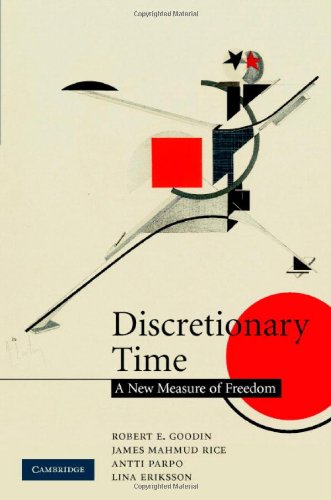
Discretionary Time A New Measure of Freedom 1st Edition by Robert E Goodin, James Mahmud Rice, Antti Parpo, Lina Eriksson ISBN 0511388322 9780521882989


Original price was: $50.00.$35.00Current price is: $35.00.
Discretionary Time A New Measure of Freedom 1st Edition by Robert E Goodin, James Mahmud Rice, Antti Parpo, Lina Eriksson – Ebook PDF Instant Download/Delivery: 0511388322, 9780521882989
Full download Discretionary Time A New Measure of Freedom 1st Edition after payment
Product details:
ISBN 10: 0511388322
ISBN 13: 9780521882989
Author: Robert E Goodin, James Mahmud Rice, Antti Parpo, Lina Eriksson
Discretionary Time A New Measure of Freedom 1st Table of contents:
Part I Introduction
1 time and money
1.1 time matters
1.2 measuring rods: time and money
1.2.1 factoring home production into the national accounts
1.2.2 custodial sentences and day fines
1.2.3 tax as ‘time working for the government’
1.2.4 poverty, time and money
1.3 two surveys, six countries
1.4 welfare and gender regimes
2 discretionary time and temporal autonomy
2.1 the value of temporal autonomy
2.1.1 the concept of autonomy
2.1.2 temporal autonomy
2.2 operationalizing discretionary time
2.2.1 necessary time: some general methodological considerations
2.2.2 necessary time in paid labour
2.2.3 necessary time in unpaid household labour
2.2.4 necessary time in personal care
2.2.5 discretionary time, pre- and post-government, and spare time
2.3 validating the measure
2.3.1 subjective time pressure
2.3.2 happiness and life satisfaction
2.3.3 discretionary time matters
3 the distribution of discretionary time
3.1 large variation
3.2 common patterns
3.3 country differences
Part II Time pressure
4 time pressure: a new problem?
4.1 time pressure in a broad historical perspective
4.2 contemporary sources of additional time stress
4.2.1 the demands of paid labour
4.2.2 the demands of unpaid household labour
4.2.3 the combined effects on people’s time
4.3 better off but busier
5 time pressure: a new measure
5.1 conceptualizing time pressure
5.2 magnitude and sources of time pressure
5.3 distribution of time pressure among subgroups of the population
5.3.1 by gender and parental status
5.3.2 by household types
5.4 the best and the worst
5.5 another example: burden-sharing in male-breadwinner families
6 is it really an illusion?
6.1 blaming the victims
6.1.1 are they victims of external forces?
6.1.2 are they badly off?
6.2 choice and the quality of options
6.3 temporal neutrality
Part III Welfare regimes matter
7 how welfare regimes differ
7.1 defining ‘welfare’
7.2 welfare policy: a potted history
7.3 three welfare regimes
7.4 standard ways of classifying countries
7.5 other dimensions of welfare: child care, for example
8 a temporal perspective on welfare regimes
8.1 welfare measures: money and time
8.2 differing state impacts on temporal welfare: the big picture
8.3 differing state impacts on parents
8.4 differing state impacts by household types
8.5 state impacts on subgroups of regime-specific concern
8.5.1 liberal regimes and lone parents
8.5.2 social-democratic regimes and parents in general
8.5.3 corporatist regimes and stay-at-home parents
9 welfare regimes and temporal autonomy
Part IV Gender regimes matter
10 how gender regimes differ
10.1 capturing gender: the challenge
10.2 two modes of maternalism
10.2.1 home-oriented pro-natalismthe french way (initially)
10.2.2 employment-oriented pro-natalism: the swedish way (ultimately)
10.2.3 pro-natalism redux
10.3 abstracting models of gender regimes
10.3.1 the male-breadwinner gender regime
10.3.2 the dual-earner (universal-breadwinner) gender regime
10.4 classifying countries: some standard indicators
10.5 taking lone mothers into account
10.5.1 a historical interlude
10.5.2 a new classificatory scheme
11 a temporal perspective on gender regimes
11.1 gender regimes: the big picture
11.2 gendered impacts on parents
11.3 gender-regime impact on mothers in different household types
11.3.1 gender-regime impact on coupled mothers
11.3.2 gender-regime impact on lone mothers
12 gender regimes and temporal autonomy
Part V Household regimes matter
13 how household regimes differ
13.1 alternative household rules: a broad overview
13.2 breadwinner rules
13.2.1 male-breadwinner rule
13.2.2 most-efficient breadwinner rule
13.3 conventional dual-earner rule
13.4 egalitarian rules
13.4.1 equal monetary contribution rule
13.4.2 equal temporal contribution rule
13.5 withdrawal (divorce) rules
13.5.1 atomistic rule
13.5.2 self-reliant divorce rule
13.5.3 breadwinner divorce rules
13.5.4 gendered divorce rule
13.5.5 financially egalitarian divorce rule
13.5.6 strictly egalitarian divorce rule
14 the difference that household rules make
14.1 preliminary methodological remarks
14.2 effects of alternative household rules: an overview
14.2.1 effects on average household discretionary time
14.2.2 effects on the distribution of discretionary time within the household
14.3 the impact of alternative household rules on gender equality
14.4 alternative household rules and the paternity penalty
14.5 alternative household rules and custodial versus non-custodial divorced parents
15 the difference that states make
15.1 how differences are made: policy instruments and social norms
15.2 temporal consequences of changing household types
15.2.1 atomistic person to conventional dual-earner
15.2.2 conventional dual-earners have children
15.2.3 conventional dual-earner to gendered divorce
15.3 temporal consequences of changing household rules
15.3.1 conventional dual-earner to male breadwinner
15.3.2 male breadwinner to most-efficient breadwinner
15.3.3 conventional dual-earner to equal temporal contribution
15.3.4 gendered divorce to financially egalitarian divorce
15.3.5 financially egalitarian divorce to strictly egalitarian divorce
15.4 the major difference states make
16 alternative household rules and temporal autonomy
16.1 private choice matters
16.2 public environment matters
16.2.1 state and society matter
16.2.2 divorce rules matter
Part VI Conclusions
17 conclusions
17.1 major findings
17.2 so what?
17.3 implications concerning public policy
17.3.1 work-time flexibility
17.3.2 equitable divorce rules
17.3.3 culture of equality
17.3.4 public transfers and subsidies
Appendix 1: methodology
a1.1 introductory notes
a1.2 actual households
a1.2.1 actual time in personal care
a1.2.2 actual time in unpaid household labour
a1.2.3 actual time in paid labour, excluding travel to/from work
a1.2.4 actual time in travel to/from work
a1.2.5 actual time in paid labour
a1.2.6 spare time
a1.2.7 necessary time in personal care
a1.2.8 necessary time in unpaid household labour
a1.2.9 necessary time in paid labour, excluding travel to/from work
a1.2.9.1 from the household’s disposable income gross of child-care costs to the household’s dis
a1.2.9.2 from the household’s disposable income net of child-care costs to the household’s neces
a1.2.2.3 from the household’s necessary income net of child-care costs to the household’s necess
a1.2.9.3.1 estimating the household’s expected alimony and child support received
a1.2.9.3.2 estimating the household’s expected ‘taxes-and-transfers’
a1.2.9.3.3 estimating the household’s necessary labour income net of child-care costs
a1.2.9.4 from the household’s necessary labour income net of child-care costs to men and women’s
a1.2.9.4.1 preliminary equations
a1.2.9.4.2 an algorithm for one-adult, one-earner households
a1.2.9.4.3 an algorithm for two-adult, one-earner households
a1.2.9.4.4 an algorithm for two-adult, two-earner households under the conventional dual-earner rule
a1.2.10 necessary time in travel to/from work
a1.2.11 necessary time in paid labour
a1.2.12 discretionary time
a1.3 alternative households
a1.3.1 male-breadwinner rule
a1.3.1.1 necessary time in unpaid household labour
a1.3.1.2 necessary time in paid labour, excluding travel to/from work
a1.3.2 most-efficient breadwinner rule
a1.3.2.1 necessary time in unpaid household labour
a1.3.2.2 necessary time in paid labour, excluding travel to/from work
a1.3.3 conventional dual-earner rule
a1.3.3.1 necessary time in unpaid household labour
a1.3.3.2 necessary time in paid labour, excluding travel to/from work
a1.3.4 equal monetary contribution rule
a1.3.4.1 necessary time in unpaid household labour
a1.3.4.2 necessary time in paid labour, excluding travel to/from work
a1.3.5 equal temporal contribution rule
a1.3.5.1 necessary time in unpaid household labour
a1.3.5.2 necessary time in paid labour, excluding travel to/from work
a1.3.6 atomistic divorce rule
a1.3.6.1 necessary time in unpaid household labour
a1.3.6.2 necessary time in paid labour, excluding travel to/from work
a1.3.7 self-reliant divorce rule
a1.3.7.1 necessary time in unpaid household labour
a1.3.7.2 necessary time in paid labour, excluding travel to/from work
a1.3.8 gendered divorce rule
a1.3.8.1 necessary time in unpaid household labour
a1.3.8.2 necessary time in paid labour, excluding travel to/from work
a1.3.9 male-breadwinner divorce rule
a1.3.9 1 necessary time in unpaid household labour
a1.3.9.2 necessary time in paid labour, excluding travel to/from work
a1.3.10 most-efficient breadwinner divorce rule
a1.3.10.1 necessary time in unpaid household labour
a1.3.10.2 necessary time in paid labour, excluding travel to/from work
a1.3.11 financially egalitarian divorce rule (money-egalitarian)
a1.3.11.1 necessary time in unpaid household labour
a1.3.11.2 necessary time in paid labour, excluding travel to/from work
a1.3.12 financially egalitarian divorce rule (time-egalitarian)
a1.3.12.1 necessary time in unpaid household labour
a1.3.12.2 necessary time in paid labour, excluding travel to/from work
a1.3.13 strictly egalitarian divorce rule (money-egalitarian)
a1.3.13.1 necessary time in unpaid household labour
a1.3.13.2 necessary time in paid labour, excluding travel to/from work
a1.3.14 strictly egalitarian divorce rule (time-egalitarian)
a1.3.14.1 necessary time in unpaid household labour
a1.3.14.2 necessary time in paid labour, excluding travel to/from work
People also search for Discretionary Time A New Measure of Freedom 1st:
Tags: Robert E Goodin, James Mahmud Rice, Antti Parpo, Lina Eriksson, Discretionary Time