

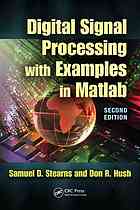
Digital signal processing with examples in MATLAB 2nd Edition by Don R Hush, Samuel D Stearns ISBN 1466500050 9781466500051

Original price was: $50.00.$35.00Current price is: $35.00.
Digital signal processing with examples in MATLAB 2nd Edition by Don R Hush, Samuel D Stearns – Ebook PDF Instant Download/Delivery: 1466500050, 9781466500051
Full download Digital signal processing with examples in MATLAB 2nd Edition after payment
Product details:
ISBN 10: 1466500050
ISBN 13: 9781466500051
Author: Don R Hush, Samuel D Stearns
Digital signal processing with examples in MATLAB 2nd Table of contents:
1. Introduction
-
1.1 Digital Signal Processing
-
1.2 How to Read This Text
-
1.3 Introduction to MATLAB®
-
1.4 Signals, Vectors, and Arrays
-
1.5 Review of Vector and Matrix Algebra Using MATLAB® Notation
-
1.6 Geometric Series and Other Formulas
-
1.7 MATLAB® Functions in DSP
-
1.8 The Chapters Ahead
-
References
-
Further Reading
2. Least Squares, Orthogonality, and the Fourier Series
-
2.1 Introduction
-
2.2 Least Squares
-
2.3 Orthogonality
-
2.4 The Discrete Fourier Series
-
Exercises
-
References
3. Correlation, Fourier Spectra, and the Sampling Theorem
-
3.1 Introduction
-
3.2 Correlation
-
3.3 The Discrete Fourier Transform (DFT)
-
3.4 Redundancy in the DFT
-
3.5 The FFT Algorithm
-
3.6 Amplitude and Phase Spectra
-
3.7 The Inverse DFT
-
3.8 Properties of the DFT
-
3.9 Continuous Transforms, Linear Systems, and Convolution
-
3.10 The Sampling Theorem
-
3.11 Waveform Reconstruction and Aliasing
-
3.12 Resampling
-
3.13 Nonuniform and Log-Spaced Sampling
-
Exercises
-
References
-
Further Reading
4. Linear Systems and Transfer Functions
-
4.1 Continuous and Discrete Linear Systems
-
4.2 Properties of Discrete Linear Systems
-
4.3 Discrete Convolution
-
4.4 The z-Transform and Linear Transfer Functions
-
4.5 The Complex z-Plane and the Chirp z-Transform
-
4.6 Poles and Zeros
-
4.7 Transient Response and Stability
-
4.8 System Response via the Inverse z-Transform
-
4.9 Cascade, Parallel, and Feedback Structures
-
4.10 Direct Algorithms
-
4.11 State-Space Algorithms
-
4.12 Lattice Algorithms and Structures
-
4.13 FFT Algorithms
-
4.14 Discrete Linear Systems and Digital Filters
-
4.15 Functions Used in This Chapter
-
Exercises
-
References
-
Further Reading
5. FIR Filter Design
-
5.1 Introduction
-
5.2 An Ideal Lowpass Filter
-
5.3 The Realizable Version
-
5.4 Improving an FIR Filter with Window Functions
-
5.5 Highpass, Bandpass, and Bandstop Filters
-
5.6 A Complete FIR Filtering Example
-
5.7 Other Types of FIR Filters
-
5.8 Digital Differentiation
-
5.9 A Hilbert Transformer
-
Exercises
-
References
-
Further Reading
6. IIR Filter Design
-
6.1 Introduction
-
6.2 Linear Phase
-
6.3 Butterworth Filters
-
6.4 Chebyshev Filters
-
6.5 Frequency Translations
-
6.6 The Bilinear Transformation
-
6.7 IIR Digital Filters
-
6.8 Digital Resonators and the Spectrogram
-
6.9 The All-Pass Filter
-
6.10 Digital Integration and Averaging
-
Exercises
-
References
-
Further Reading
7. Random Signals and Spectral Estimation
-
7.1 Introduction
-
7.2 Amplitude Distributions
-
7.3 Uniform, Gaussian, and Other Distributions
-
7.4 Power and Power Density Spectra
-
7.5 Properties of the Power Spectrum
-
7.6 Power Spectral Estimation
-
7.7 Data Windows in Spectral Estimation
-
7.8 The Cross-Power Spectrum
-
7.9 Algorithms
-
Exercises
-
References
-
Further Reading
8. Least-Squares System Design
-
8.1 Introduction
-
8.2 Applications of Least-Squares Design
-
8.3 System Design via the Mean-Squared Error
-
8.4 A Design Example
-
8.5 Least-Squares Design with Finite Signal Vectors
-
8.6 Correlation and Covariance Computation
-
8.7 Channel Equalization
-
8.8 System Identification
-
8.9 Interference Canceling
-
8.10 Linear Prediction and Recovery
-
8.11 Effects of Independent Broadband Noise
-
Exercises
-
References
-
Further Reading
9. Adaptive Signal Processing
-
9.1 Introduction
-
9.2 The Mean-Squared Error Performance Surface
-
9.3 Searching the Performance Surface
-
9.4 Steepest Descent and the LMS Algorithm
-
9.5 LMS Examples
-
9.6 Direct Descent and the RLS Algorithm
-
9.7 Measures of Adaptive System Performance
-
9.8 Other Adaptive Structures and Algorithms
-
Exercises
-
References
-
Further Reading
10. Signal Information, Coding, and Compression
-
10.1 Introduction
-
10.2 Measuring Information
-
10.3 Two Ways to Compress Signals
-
10.4 Adaptive Predictive Coding
-
10.5 Entropy Coding
-
10.6 Transform Coding and the Discrete Cosine Transform
-
10.7 The Discrete Sine Transform
-
10.8 Multirate Signal Decomposition and Subband Coding
-
10.9 Time–Frequency Analysis and Wavelet Transforms
-
Exercises
-
References
11. Models of Analog Systems
-
11.1 Introduction
-
11.2 Impulse-Invariant Approximation
-
11.3 Final Value Theorem
-
11.4 Pole–Zero Comparisons
-
11.5 Approaches to Modeling
-
11.6 Input-Invariant Models
-
11.7 Other Linear Models
-
11.8 Comparison of Linear Models
-
11.9 Models of Multiple and Nonlinear Systems
-
11.10 Concluding Remarks
-
Exercises
-
References
-
Further Reading
12. Pattern Recognition with Support Vector Machines
-
12.1 Introduction
-
12.2 Pattern Recognition Principles
-
12.3 Learning
-
12.3.1 The Independent and Identically Distributed Sample Plan
-
12.3.2 Learning Methods
-
-
12.4 Support Vector Machines
-
12.4.1 The Support Vector Machine Function Class
-
12.4.2 The Support Vector Machine Learning Strategy
-
12.4.3 The Core Support Vector Machine Algorithm
-
12.4.3.1 Constructing the Primal, Dual, and Dual-to-Primal Map
-
12.4.3.2 Margin, Support Vectors, and the Sparsity of Exact Solutions
-
12.4.3.3 Decomposition Algorithms for the Dual Quadratic Programming Problem
-
12.4.3.4 Rate Certifying Decomposition Algorithms
-
-
-
12.5 Multi-Class Classification
-
12.6 MATLAB® Examples
People also search for Digital signal processing with examples in MATLAB 2nd:
digital signal processing with examples in matlab
digital signal processing examples
what is digital signal processing
matlab for digital signal processing
matlab signal processing examples
Tags: Don R Hush, Samuel D Stearns, Digital signal