

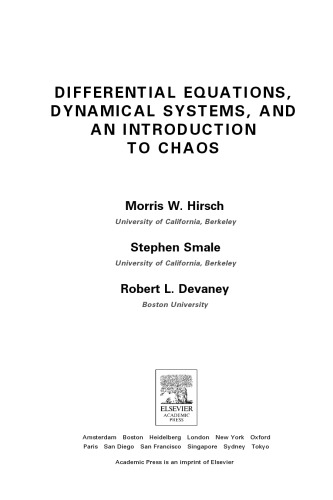
Differential Equations Dynamical Systems and an Intro to Chaos 2nd Edition by M Hirsch ISBN 0123497035 9780123497031

Original price was: $50.00.$35.00Current price is: $35.00.
Differential Equations Dynamical Systems and an Intro to Chaos 2nd Edition by M Hirsch – Ebook PDF Instant Download/Delivery: 0123497035, 9780123497031
Full download Differential Equations Dynamical Systems and an Intro to Chaos 2nd Edition after payment
Product details:
ISBN 10: 0123497035
ISBN 13: 9780123497031
Author: M Hirsch
The authors are tops in the field of advanced mathematics, including Steve Smale who is a recipient of the Field’s Medal for his work in dynamical systems.
* Developed by award-winning researchers and authors
* Provides a rigorous yet accessible introduction to differential equations and dynamical systems
* Includes bifurcation theory throughout
* Contains numerous explorations for students to embark upon
NEW IN THIS EDITION
* New contemporary material and updated applications
* Revisions throughout the text, including simplification of many theorem hypotheses
* Many new figures and illustrations
* Simplified treatment of linear algebra
* Detailed discussion of the chaotic behavior in the Lorenz attractor, the Shil’nikov systems, and the double scroll attractor
* Increased coverage of discrete dynamical systems
Differential Equations Dynamical Systems and an Intro to Chaos 2nd Table of contents:
Chapter 1. First-Order Equations
1.1 The Simplest Example
1.2 The Logistic Population Model
1.3 Constant Harvesting and Bifurcations
1.4 Periodic Harvesting and Periodic Solutions
1.5 Computing the Poincaré Map
1.6 Exploration: A Two-Parameter Family
Chapter 2. Planar Linear Systems
2.1 Second-Order Differential Equations
2.2 Planar Systems
2.3 Preliminaries from Algebra
2.4 Planar Linear Systems
2.5 Eigenvalues and Eigenvectors
2.6 Solving Linear Systems
2.7 The Linearity Principle
Chapter 3. Phase Portraits for Planar Systems
3.1 Real Distinct Eigenvalues
3.2 Complex Eigenvalues
3.3 Repeated Eigenvalues
3.4 Changing Coordinates
Chapter 4. Classification of Planar Systems
4.1 The Trace-Determinant Plane
4.2 Dynamical Classification
4.3 Exploration: A 3D Parameter Space
Chapter 5. Higher Dimensional Linear Algebra
5.1 Preliminaries from Linear Algebra
5.2 Eigenvalues and Eigenvectors
5.3 Complex Eigenvalues
5.4 Bases and Subspaces
5.5 Repeated Eigenvalues
5.6 Genericity
Chapter 6. Higher Dimensional Linear Systems
6.1 Distinct Eigenvalues
6.2 Harmonic Oscillators
6.3 Repeated Eigenvalues
6.4 The Exponential of a Matrix
6.5 Nonautonomous Linear Systems
Chapter 7. Nonlinear Systems
7.1 Dynamical Systems
7.2 The Existence and Uniqueness Theorem
7.3 Continuous Dependence of Solutions
7.4 The Variational Equation
7.5 Exploration: Numerical Methods
Chapter 8. Equilibria in Nonlinear Systems
8.1 Some Illustrative Examples
8.2 Nonlinear Sinks and Sources
8.3 Saddles
8.4 Stability
8.5 Bifurcations
8.6 Exploration: Complex Vector Fields
Chapter 9. Global Nonlinear Techniques
9.1 Nullclines
9.2 Stability of Equilibria
9.3 Gradient Systems
9.4 Hamiltonian Systems
9.5 Exploration: The Pendulum with Constant Forcing
Chapter 10. Closed Orbits and Limit Sets
10.1 Limit Sets
10.2 Local Sections and Flow Boxes
10.3 The Poincaré Map
10.4 Monotone Sequences in Planar Dynamical Systems
10.5 The Poincaré-Bendixson Theorem
10.6 Applications of Poincaré-Bendixson
10.7 Exploration: Chemical Reactions That Oscillate
Chapter 11. Applications in Biology
11.1 Infectious Diseases
11.2 Predator/Prey Systems
11.3 Competitive Species
11.4 Exploration: Competition and Harvesting
Chapter 12. Applications in Circuit Theory
12.1 An RLC Circuit
12.2 The Lienard Equation
12.3 The van der Pol Equation
12.4 A Hopf Bifurcation
12.5 Exploration: Neurodynamics
Chapter 13. Applications in Mechanics
13.1 Newton’s Second Law
13.2 Conservative Systems
13.3 Central Force Fields
13.4 The Newtonian Central Force System
13.5 Kepler’s First Law
13.6 The Two-Body Problem
13.7 Blowing Up the Singularity
13.8 Exploration: Other Central Force Problems
13.9 Exploration: Classical Limits of Quantum Mechanical Systems
Chapter 14. The Lorenz System
14.1 Introduction to the Lorenz System
14.2 Elementary Properties of the Lorenz System
14.3 The Lorenz Attractor
14.4 A Model for the Lorenz Attractor
14.5 The Chaotic Attractor
14.6 Exploration: The Rössler Attractor
Chapter 15. Discrete Dynamical Systems
15.1 Introduction to Discrete Dynamical Systems
15.2 Bifurcations
15.3 The Discrete Logistic Model
15.4 Chaos
15.5 Symbolic Dynamics
15.6 The Shift Map
15.7 The Cantor Middle-Thirds Set
15.8 Exploration: Cubic Chaos
15.9 Exploration: The Orbit Diagram
Chapter 16. Homoclinic Phenomena
16.1 The Shil’nikov System
16.2 The Horseshoe Map
16.3 The Double Scroll Attractor
16.4 Homoclinic Bifurcations
16.5 Exploration: The Chua Circuit
Chapter 17. Existence and Uniqueness Revisited
17.1 The Existence and Uniqueness Theorem
17.2 Proof of Existence and Uniqueness
17.3 Continuous Dependence on Initial Conditions
17.4 Extending Solutions
17.5 Nonautonomous Systems
17.6 Differentiability of the Flow
People also search for Differential Equations Dynamical Systems and an Intro to Chaos 2nd:
what are the principles of physiology
what are the fundamentals of psychology
what are the fundamentals of human behavior
what is human physiology all about
fundamentals of physiology
Tags: M Hirsch, Differential Equations, Chaos