

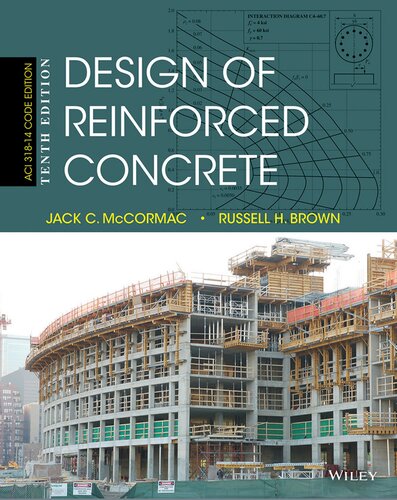
Design of Reinforced Concrete 10th Edition by Jack C Mccormac, Clemson University, Russell H Brown, Clemson University ISBN 1118879104 9781118879108


Original price was: $50.00.$35.00Current price is: $35.00.
Design of Reinforced Concrete 10th Edition by Jack C Mccormac, Clemson University, Russell H Brown, Clemson University – Ebook PDF Instant Download/Delivery: 1118879104, 9781118879108
Full download Design of Reinforced Concrete 10th Edition after payment
Product details:
ISBN 10: 1118879104
ISBN 13: 9781118879108
Author: Jack C Mccormac, Clemson University, Russell H Brown, Clemson University
Design of Reinforced Concrete 10th Table of contents:
Chapter 1 Introduction
1.1 Concrete and Reinforced Concrete
1.2 Advantages of Reinforced Concrete as a Structural Material
1.3 Disadvantages of Reinforced Concrete as a Structural Material
1.4 Historical Background
1.5 Comparison of Reinforced Concrete and Structural Steel for Buildings and Bridges
1.6 Compatibility of Concrete and Steel
1.7 Design Codes
1.8 Summary of 2014 ACI Code Changes
Reorganization
New Chapters
Tables
Other Changes
1.9 SI Units and Shaded Areas
1.10 Types of Portland Cement
1.11 Admixtures
1.12 Properties of Concrete
Compressive Strength
Static Modulus of Elasticity
Dynamic Modulus of Elasticity
Poisson’s Ratio
Shrinkage
Creep
Tensile Strength
Shear Strength
1.13 Aggregates
1.14 High-Strength Concretes
1.15 Fiber-Reinforced Concretes
1.16 Concrete Durability
1.17 Reinforcing Steel
1.18 Grades of Reinforcing Steel
1.19 SI Bar Sizes and Material Strengths
1.20 Corrosive Environments
1.21 Identifying Marks on Reinforcing Bars
1.22 Introduction to Loads
1.23 Dead Loads
1.24 Live Loads
1.25 Environmental Loads
1.26 Selection of Design Loads
1.27 Calculation Accuracy
1.28 Impact of Computers on Reinforced Concrete Design
Problems
Chapter 2 Flexural Analysis of Beams
2.1 Introduction
Uncracked Concrete Stage
Concrete Cracked–Elastic Stresses Stage
Beam Failure—Ultimate-Strength Stage
2.2 Cracking Moment
2.3 Elastic Stresses-Concrete Cracked
Discussion
2.4 Ultimate or Nominal Flexural Moments
2.5 SI Example
2.6 Computer Examples
Problems
Chapter 3 Strength Analysis of Beams According to ACI Code
3.1 Design Methods
3.2 Advantages of Strength Design
3.3 Structural Safety
3.4 Derivation of Beam Expressions
3.5 Strains in Flexural Members
3.6 Balanced Sections, Tension-Controlled Sections, and Compression-Controlled or Brittle Sections
3.7 Strength Reduction or ø Factors
3.8 Minimum Percentage of Steel
3.9 Balanced Steel Percentage
3.10 Example Problems
3.11 Computer Examples
Problems
Chapter 4 Design of Rectangular Beams and One-Way Slabs
4.1 Load Factors
4.2 Design of Rectangular Beams
4.3 Beam Design Examples
Use of Graphs and Tables
4.4 Miscellaneous Beam Considerations
Lateral Support
Skin Reinforcement for Deep Beams
Other Items
Further Notes on Beam Sizes
4.5 Determining Steel Area When Beam Dimensions Are Predetermined
Appendix Tables
Use of p Formula
Trial-and-Error (Iterative) Method
4.6 Bundled Bars
4.7 One-Way Slabs
4.8 Cantilever Beams and Continuous Beams
4.9 SI Example
4.10 Computer Example
Problems
Chapter 5 Analysis and Design of T Beams and Doubly Reinforced Beams
5.1 T Beams
5.2 Analysis of T Beams
5.3 Another Method for Analyzing T Beams
5.4 Design of T Beams
5.5 Design of T Beams for Negative Moments
5.6 L-Shaped Beams
5.7 Compression Steel
5.8 Design of Doubly Reinforced Beams
5.9 SI Examples
5.10 Computer Examples
Problems
Chapter 6 Serviceability
6.1 Introduction
6.2 Importance of Deflections
6.3 Control of Deflections
Minimum Thicknesses
Maximum Deflections
Camber
6.4 Calculation of Deflections
6.5 Effective Moments of Inertia
6.6 Long-Term Deflections
6.7 Simple-Beam Deflections
6.8 Continuous-Beam Deflections
6.9 Types of Cracks
6.10 Control of Flexural Cracks
6.11 ACI Code Provisions Concerning Cracks
6.12 SI Example
6.13 Miscellaneous Cracks
6.14 Computer Example
Problems
Chapter 7 Bond, Development Lengths, and Splices
7.1 Cutting Off or Bending Bars
7.2 Bond Stresses
7.3 Development Lengths for Tension Reinforcement
7.4 Development Lengths for Bundled Bars
7.5 Hooks
7.6 Development Lengths for Welded Wire Fabric in Tension
7.7 Development Lengths for Compression Bars
7.8 Critical Sections for Development Length
7.9 Effect of Combined Shear and Moment on Development Lengths
7.10 Effect of Shape of Moment Diagram on Development Lengths
7.11 Cutting Off or Bending Bars (Continued)
7.12 Bar Splices in Flexural Members
7.13 Tension Splices
7.14 Compression Splices
7.15 Headed and Mechanically Anchored Bars
7.16 SI Example
7.17 Computer Example
Problems
Chapter 8 Shear and Diagonal Tension
8.1 Introduction
8.2 Shear Stresses in Concrete Beams
8.3 Lightweight Concrete
8.4 Shear Strength of Concrete
8.5 Shear Cracking of Reinforced Concrete Beams
8.6 Web Reinforcement
8.7 Behavior of Beams with Web Reinforcement
8.8 Design for Shear
8.9 ACI Code Requirements
8.10 Shear Design Example Problems
8.11 Economical Spacing of Stirrups
8.12 Shear Friction and Corbels
8.13 Shear Strength of Members Subjected to Axial Forces
8.14 Shear Design Provisions for Deep Beams
8.15 Introductory Comments on Torsion
8.16 SI Example
8.17 Computer Example
Problems
Chapter 9 Introduction to Columns
9.1 General
9.2 Types of Columns
9.3 Axial Load Capacity of Columns
9.4 Failure of Tied and Spiral Columns
9.5 Code Requirements for Cast-in-Place Columns
9.6 Safety Provisions for Columns
9.7 Design Formulas
9.8 Comments on Economical Column Design
9.9 Design of Axially Loaded Columns
9.10 SI Example
9.11 Computer Example
Problems
Chapter 10 Design of Short Columns Subject to Axial Load and Bending
10.1 Axial Load and Bending
10.2 The Plastic Centroid
10.3 Development of Interaction Diagrams
10.4 Use of Interaction Diagrams
10.5 Code Modifications of Column Interaction Diagrams
10.6 Design and Analysis of Eccentrically Loaded Columns Using Interaction Diagrams
Caution
10.7 Shear in Columns
10.8 Biaxial Bending
10.9 Design of Biaxially Loaded Columns
10.10 Continued Discussion of Capacity Reduction Factors, ø
10.11 Computer Example
Problems
Chapter 11 Slender Columns
11.1 Introduction
11.2 Nonsway and Sway Frames
11.3 Slenderness Effects
Unsupported Lengths
Effective Length Factors
11.4 Determining k Factors with Alignment Charts
11.5 Determining k Factors with Equations
11.6 First-Order Analyses Using Special Member Properties
11.7 Slender Columns in Nonsway and Sway Frames
Avoiding Slender Columns
11.8 ACI Code Treatments of Slenderness Effects
11.9 Magnification of Column Moments in Nonsway Frames
11.10 Magnification of Column Moments in Sway Frames
11.11 Analysis of Sway Frames
11.12 Computer Examples
Problems
Chapter 12 Footings
12.1 Introduction
12.2 Types of Footings
12.3 Actual Soil Pressures
12.4 Allowable Soil Pressures
12.5 Design of Wall Footings
12.6 Design of Square Isolated Footings
Shears
Moments
12.7 Footings Supporting Round or Regular Polygon-Shaped Columns
12.8 Load Transfer from Columns to Footings
12.9 Rectangular Isolated Footings
12.10 Combined Footings
12.11 Footing Design for Equal Settlements
12.12 Footings Subjected to Axial Loads and Moments
12.13 Transfer of Horizontal Forces
12.14 Plain Concrete Footings
12.15 SI Example
12.16 Computer Examples
Problems
Chapter 13 Retaining Walls
13.1 Introduction
13.2 Types of Retaining Walls
13.3 Drainage
13.4 Failures of Retaining Walls
13.5 Lateral Pressure on Retaining Walls
13.6 Footing Soil Pressures
13.7 Design of Semigravity Retaining Walls
13.8 Effect of Surcharge
13.9 Estimating the Sizes of Cantilever Retaining Walls
Height of Wall
Stem Thickness
Base Thickness
Base Length
13.10 Design Procedure for Cantilever Retaining Walls
Stem
Factor of Safety against Overturning
Factor of Safety against Sliding
Heel Design
Toe Design
13.11 Cracks and Wall Joints
Problems
Chapter 14 Continuous Reinforced Concrete Structures
14.1 Introduction
14.2 General Discussion of Analysis Methods
14.3 Qualitative Influence Lines
14.4 Limit Design
The Collapse Mechanism
Plastic Analysis by the Equilibrium Method
14.5 Limit Design under the ACI Code
14.6 Preliminary Design of Members
14.7 Approximate Analysis of Continuous Frames for Vertical Loads
ACI Coefficients for Continuous Beams and Slabs
Equivalent Rigid-Frame Method
Assumed Points of Inflection
14.8 Approximate Analysis of Continuous Frames for Lateral Loads
Frame Analysis by Portal Method
14.9 Computer Analysis of Building Frames
14.10 Lateral Bracing for Buildings
14.11 Development Length Requirements for Continuous Members
Positive-Moment Reinforcement
Negative-Moment Reinforcement
Problems
Chapter 15 Torsion
15.1 Introduction
15.2 Torsional Reinforcing
15.3 Torsional Moments That Have to Be Considered in Design
15.4 Torsional Stresses
15.5 When Torsional Reinforcement Is Required by the ACI
15.6 Torsional Moment Strength
15.7 Design of Torsional Reinforcing
15.8 Additional ACI Requirements
15.9 Example Problems Using U.S. Customary Units
15.10 SI Equations and Example Problem
15.11 Computer Example
Problems
Chapter 16 Two-Way Slabs, Direct Design Method
16.1 Introduction
16.2 Analysis of Two-Way Slabs
16.3 Design of Two-Way Slabs by the ACI Code
Direct Design Method
Equivalent Frame Method
Design for Lateral Loads
16.4 Column and Middle Strips
16.5 Shear Resistance of Slabs
16.6 Depth Limitations and Stiffness Requirements
Slabs without Interior Beams
Slabs with Interior Beams
16.7 Limitations of Direct Design Method
16.8 Distribution of Moments in Slabs
16.9 Design of an Interior Flat Plate
16.10 Placing of Live Loads
16.11 Analysis of Two-Way Slabs with Beams
16.12 Transfer of Moments and Shears between Slabs and Columns
Factored Moments in Columns and Walls
16.13 Openings in Slab Systems
16.14 Computer Example
Problems
Chapter 17 Two-Way Slabs, Equivalent Frame Method
17.1 Moment Distribution for Nonprismatic Members
17.2 Introduction to the Equivalent Frame Method
17.3 Properties of Slab Beams
17.4 Properties of Columns
17.5 Example Problem
17.6 Computer Analysis
17.7 Computer Example
Problems
Chapter 18 Walls
18.1 Introduction
18.2 Non-Load-Bearing Walls
18.3 Load-Bearing Concrete Walls-Empirical Design Method
18.4 Load-Bearing Concrete Walls-Rational Design
18.5 Shear Walls
18.6 ACI Provisions for Shear Walls
18.7 Economy in Wall Construction
18.8 Computer Example
Problems
Chapter 19 Prestressed Concrete
19.1 Introduction
19.2 Advantages and Disadvantages of Prestressed Concrete
Advantages
Disadvantages
19.3 Pretensioning and Posttensioning
19.4 Materials Used for Prestressed Concrete
19.5 Stress Calculations
19.6 Shapes of Prestressed Sections
19.7 Prestress Losses
Elastic Shortening of the Concrete
Shrinkage and Creep of the Concrete
Relaxation or Creep in the Tendons
Slippage in Posttensioning End Anchorage Systems
Friction along the Ducts Used in Posttensioning
19.8 Ultimate Strength of Prestressed Sections
Discussion
19.9 Deflections
Additional Deflection Comments
19.10 Shear in Prestressed Sections
Approximate Method
More Detailed Analysis
19.11 Design of Shear Reinforcement
19.12 Additional Topics
Stresses in End Blocks
Composite Construction
Continuous Members
Partial Prestressing
19.13 Computer Example
People also search for Design of Reinforced Concrete 10th:
limit state design of reinforced concrete
seismic design of reinforced concrete buildings
illustrated design of reinforced concrete buildings
seismic design of reinforced concrete and masonry buildings
seismic design of reinforced concrete buildings pdf
Tags: Jack C Mccormac, Clemson University, Russell H Brown, Clemson University, Reinforced Concrete