

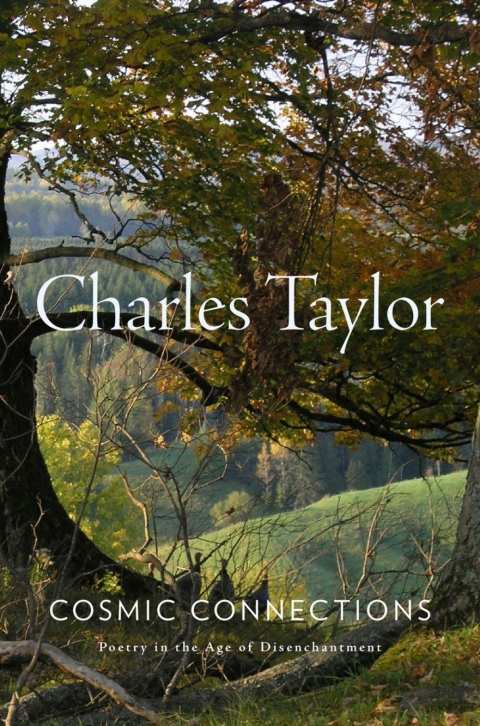
Cosmic Connections Poetry in the Age of Disenchantment 1st Edition by Charles Taylor ISBN 0674296087 978-0674296084

Original price was: $50.00.$35.00Current price is: $35.00.
Cosmic Connections Poetry in the Age of Disenchantment 1st Edition by Charles Taylor – Ebook PDF Instant Download/Delivery:0674296087 ,978-0674296084
Full download Cosmic Connections Poetry in the Age of Disenchantment 1st Edition after payment
Product details:
ISBN 10:0674296087
ISBN 13:978-0674296084
Author:Charles Taylor
A Times Literary Supplement Best Book of the Year
A major new work by Charles Taylor: the long-awaited follow-up to The Language Animal, exploring the Romantic poetics central to his theory of language.
The Language Animal, Charles Taylor’s 2016 account of human linguistic capacity, was a revelation, toppling scholarly conventions and illuminating our most fundamental selves. But, as Taylor noted in that work, there was much more to be said. Cosmic Connections continues Taylor’s exploration of Romantic and post-Romantic responses to disenchantment and innovations in language.
Reacting to the fall of cosmic orders that were at once metaphysical and moral, the Romantics used the symbols and music of poetry to recover contact with reality beyond fragmented existence. They sought to overcome disenchantment and groped toward a new meaning of life. Their accomplishments have been extended by post-Romantic generations into the present day. Taylor’s magisterial work takes us from Hölderlin, Novalis, Keats, and Shelley to Hopkins, Rilke, Baudelaire, and Mallarmé, and on to Eliot, Miłosz, and beyond.
In seeking deeper understanding and a different orientation to life, the language of poetry is not merely a pleasurable presentation of doctrines already elaborated elsewhere. Rather, Taylor insists, poetry persuades us through the experience of connection. The resulting conviction is very different from that gained through the force of argument. By its very nature, poetry’s reasoning will often be incomplete, tentative, and enigmatic. But at the same time, its insight is too moving―too obviously true―to be ignored.
Table of contents:
- PART I
- Chapter One “TRANSLATION” AND THE “SUBTLER LANGUAGES”
In my earlier book, I tried to work out the relevance today of the theory of language which was developed among the German Romantics in the 1790s. In this book, I want to explore the understanding of poetics which was implicit in (indeed, central to) this theory of language, and then see some of the consequences which flowed from this in the poetry of the last two centuries. - In this book, I shall be speaking a lot about “the Romantic era.” So first of all, a word about what I mean by this term. I am at first mainly concentrating…
- Chapter Two EPISTEMIC ISSUES
So we can see two great ontological shifts involved in the Romantics’ taking up of earlier theories of a language which reveals the nature of things. The first was made right at the beginning with Hamann’s “Reden ist übersetzen”: we have no direct contact with the archetypes; we can’t map them in an accurate dictionary. The second followed (one might think) almost inevitably from this first step. If we have no direct contact with the language of things, if we have to derive our own translations, then we are engaged via the “subtler languages” which each poet must invent or… - Chapter Three AN EPOCHAL CHANGE
I have been dealing in this book with the original launching pad of German Romanticism in the generation of the 1790s in Jena and Berlin. There was much that was peculiar to that generation and that didn’t travel elsewhere or to other times. In particular, the background in German Idealism, and the fascination with Renaissance theories of the cosmos and language. Not that these themes don’t continue to figure, but others also enter. - But what remains as a crucial power of poetry is the ability to capture the meaning of an interspace—the situation of a human being before a…
- PART II
- Chapter Four HÖLDERLIN, NOVALIS
First, I want to look at the ways that the poetic tradition has diversified. The starting point of the “poetic tradition,” as I am trying to expound it, is the generation of the 1790s in Germany. What was elaborated there was the basic idea of two kinds of language, or uses of language: a dead, instrumental one, and a living, disclosive, epiphanic one. - This starts off in close symbiosis with a unified theory, englobing philosophy and poetics, that was worked out, and in broad lines more or less accepted, by this generation, which included Hölderlin, Novalis, the Schlegels, Schiller, Schelling,…
- Chapter Five NATURE, HISTORY
In the first chapters, I have mainly focused on the way certain poets of the Romantic period create a powerful sense of connection to cosmic orders. These are modeled on the traditional notion of such orders, but the poets I have been discussing stop short of a claim to define these orders as they exist in nature, independently of us, poets and readers. That would require a convincing underlying story, which has yet to be provided. - My examples are drawn from English and German literature, most prominently Wordsworth and Hölderlin, but the underlying theory has been drawn…
- Chapter Six SHELLEY, KEATS (AFTER WORDSWORTH)
As the parallels noted above between Wordsworth and Hölderlin indicate, there were analogies between the “Romantic” poets of the two nations, even though the elaborate German philosophical-aesthetic theory played no role in the English case at the beginning. And even after it was introduced to the anglophone world by Coleridge, it took some time for its influence to be felt. - But we should take a look at other English poets of the Romantic period, in order to see how some analogous formative ideas were worked out differently.
- Let us first look at Shelley: he seems to believe in a power…
- PART II
- Chapter Seven HOPKINS, INSCAPE AND AFTER
Gerard Manley Hopkins extends the scope of Romantic poetry, as I’ve been describing it, by developing a new mode or form of—or perhaps a new route to—(re)connection. This is to capture and present to us the inner force which shapes a given particular being, which Hopkins describes as its “inscape” (see Chapter 3, Section II). - For this, he uses the full range of fused, multilevel poetry that we saw in Chapter 2, Section II.3: incorporating the “music” of speech or sound, the “music” of thoughts or images, and the assertions made. But the special feature of…
- Chapter Eight RILKE
There is an interesting relationship between the notion of “inscape” which we explored in connection with Gerard Manley Hopkins, on one hand, and the development of Rilke’s poetry, on the other. Not that there was any question of influence: Hopkins’ work wasn’t published until near the end of Rilke’s life. The connection is rather one of overlapping concerns. - From relatively early on, Rilke sees his task as a poet, and indeed the task of human beings, one could say the purpose of our lives, as discerning the meaning of things, the world, the cosmos. In other terms, closing a gap,…
- Chapter Nine EPISTEMIC RETREAT AND THE NEW CENTRALITY OF TIME
A central theme of my discussion of post-Romantic poetry has been (re-)connection. The prefix “re” here reflects the sense of loss and then recovery. The loss came with the uncertainty about, and growing loss of confident contact with, traditional and Renaissance notions of cosmic order: the Great Chain of Being, the Creation as a communication from God, the Kabbalah, and the like. - This traditional cosmos was ordered with higher and lower levels. This hierarchy was seen as a scale of value, but not simply subjective. It was also a standard which exercises power to shape reality. So it is…
- PART IV
- Chapter Ten BAUDELAIRE
In the previous chapters, I have been looking at the way post-Romantic poetry strives to reconnect with Nature, or the cosmos, or some phenomena in the world, understanding this connection as essential to human fulfillment. What is being defined and sought here is our proper relation to the spatiotemporal world. But there are other issues which concern more narrowly how we inhabit time, and which equally raise questions about our essential fulfillment as human beings. As we shall see, there are reasons why these should have come to the fore in the last two centuries. There is no better door… - Chapter Eleven AFTER BAUDELAIRE
Lived time and “higher times” In the early Romantic period, we can speak of attempts to (re)connect through poetry with a continuing cosmic order. It was unclear what (if anything) corresponds in the cosmos, as it objectively is beyond human consciousness, to this experience of connection, but the assumption was that the orders which poetry invokes were like the traditionally accepted cosmic orders, eternal or coeval with the cosmos itself. They were not subject to time, although our contact with them could (and for many, did) go through loss and renewal, occlusion and recovery. - But with Baudelaire, the field in…
- Chapter Twelve MALLARMÉ
Mallarmé as a boy, as a teenager, had a love and longing for beauty in a transcendent sense. This is the ideal of a perfect coincidence between Beauty, the Highest goal, and desire. By beauty, I mean what moves us as beautiful in nature and works of art. This is hard to define further, as we saw earlier. But for Mallarmé, it was given obvious and undeniable shape by the example of the great poets of French Romanticism and beyond; in particular, Hugo and Gautier. - The Ideal is when what moves us as beauty is also what gives the highest…
- PART V. THE MODERNIST TURN
- Chapter Thirteen T. S. ELIOT
After the flowering of symbolism, and the full-scale epistemic retreat it involves, Eliot finds an original way to create a picture of a believable cosmic order, theologically centered, which is light-years away from the invocations of order of the early Romantics (which remain underappreciated by Eliot). - Even more surprising, the path which will eventually lead him to this discovery begins with the inspiration he took from the poetry of Jules Laforgue, usually seen as a writer of the “decadent” wing of symbolism.
- Many of Laforgue’s poems follow a similar trajectory: Take the highest aspirations—to love, to beauty, to…
- Chapter Fourteen MIŁOSZ
The twentieth century saw some terrible horrors, but one of the really unfortunate places to live was Poland, which spent half the century (1939–1989) under first Hitler, and then Stalin, followed by Stalinism. For a poet, there might be an understandable temptation to ignore history, and write about beautiful things; nature, gardens, flowers, finer feelings. But for Czesław Miłosz, this was impermissible. From “Dedication”: “What is poetry which does not save /nations or people?” - I will start from his Treatise on Poetry (1957): We have to be, and act, in history. But the Spirit of History, at least in…
- PART VI. RELATION TO HISTORY AND THE PRESENT
- Chapter Fifteen HISTORY OF ETHICAL GROWTH
This chapter follows Chapter 14, which takes up the basic issue raised by Miłosz’s work, in particular his (for many, startling) claim “The poetic act both anticipates the future and speeds its coming.” The future must contain potentially something better for this claim to make moral sense; so something like Martin Luther King Jr.’s quote “The arc of the moral universe is long but it bends toward justice” must be true. But is it? - Is there something like ethical or moral growth in history? When we look at the standards we now recognize, and try to hold one another…
- Chapter Sixteen COSMIC CONNECTION TODAY—AND PERENNIALLY
Where does the concern for cosmic connection go in the later twentieth century, and beyond into the new millennium? - There are traces in poetry—for instance, in the work of Wallace Stevens. But the most prominent strand is a continuation of the Goethe-Humboldt response to the discoveries of science, and the more and more detailed grasp of the intricate orders, both macroscopic and microscopic, in which we live. There are no more higher and lower levels in this cosmology, but the whole structure and its evolution over eons inspires awe, and (in us conscious animals) a sense of gratitude for…
People also search for:
the disenchantment of the world
the cosmic connection an extraterrestrial perspective
disenchantment the limits of immortality
power of love disenchantment
characteristics of metaphysical poetry
Tags: Charles Taylor, Cosmic, Connections