

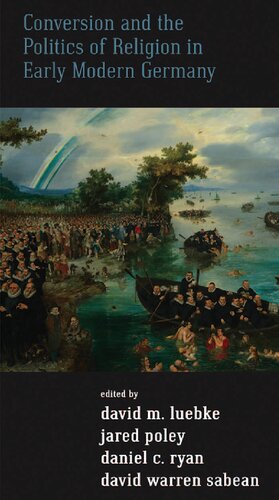
Conversion and the Politics of Religion in Early Modern Germany 1st Edition by David M Luebke,Jared Poley , Daniel C Ryan ISBN 0857453750 978-0857453754
Original price was: $50.00.$35.00Current price is: $35.00.
Conversion and the Politics of Religion in Early Modern Germany 1st Edition by David M Luebke,Jared Poley , Daniel C Ryan – Ebook PDF Instant Download/Delivery:0857453750 ,978-0857453754
Full download Conversion and the Politics of Religion in Early Modern Germany 1st Edition after payment
Product details:
ISBN 10: 0857453750
ISBN 13: 978-0857453754
Author: David M Luebke,Jared Poley , Daniel C Ryan
The Protestant and Catholic Reformations thrust the nature of conversion into the center of debate and politicking over religion as authorities and subjects imbued religious confession with novel meanings during the early modern era. The volume offers insights into the historicity of the very concept of “conversion.” One widely accepted modern notion of the phenomenon simply expresses denominational change. Yet this concept had no bearing at the outset of the Reformation. Instead, a variety of processes, such as the consolidation of territories along confessional lines, attempts to ensure civic concord, and diplomatic quarrels helped to usher in new ideas about the nature of religious boundaries and, therefore, conversion. However conceptualized, religious change― conversion―had deep social and political implications for early modern German states and societies.
Table of contents:
INTRODUCTION. The Politics of Conversion in Early Modern Germany
DAVID M. LUEBKE
In the beginning was a conversion—or, more precisely, the memory of a profound change, given clarity and meaning with each retelling through the years. Near the end of his life, in 1545, Martin Luther published an account of what came to be known as the “Tower Experience.” After “meditating day and night” over the Epistle of Paul to the Romans, Luther arrived at the realization that his angry struggles to comprehend the meaning of divine righteousness were themselves the work of God within him.
CHAPTER ONE: Paths of Salvation and Boundaries of Belief: Spatial Discourse and the Meanings of Conversion in Early Modern Germany
DUANE J. CORPIS
Both Catholic and Lutheran writers in the Holy Roman Empire articulated the concept of conversion after the Reformation with a cluster of related words and expressions. Conversio was the main Latin word for conversion, and its most common German equivalent was Bekehrung. This term denoted both internal spiritual renewal and the external act of changing religion.
CHAPTER TWO: Conversion Concepts in Early Modern Germany: Protestant and Catholic
ERIC-OLIVER MADER
Religious conversion has become a popular field of research, with growing interdisciplinary interest. Recent studies challenge older, confessional-biased approaches and explore broader questions beyond the religion-politics binary, including personal, social, and institutional dynamics of conversion.
CHAPTER THREE: Turning Dutch? Conversion in Early Modern Wesel
JESSE SPOHNHOLZ
After 1552, Wesel aligned with Lutheranism but later became a Calvinist stronghold. This chapter reevaluates the traditional narrative of Calvinist success in Wesel, focusing instead on the town’s complex religious and political transformations.
CHAPTER FOUR: The Right to Be Catholic—The Right to Be Protestant? Perspectives on Conversion before and after the Peace of Westphalia
RALF-PETER FUCHS
This chapter examines changing attitudes toward religious freedom and conversion rights in the Holy Roman Empire, highlighting how the Peace of Westphalia (1648) marked a turning point in the perception and legal status of conversion.
CHAPTER FIVE: Conversion and Diplomacy in Absolutist Northern Europe
DANIEL RICHES
In 1690, a diplomatic conflict between Sweden and Brandenburg centered on the religious conversion of a diplomat’s wife. Her shift to Calvinism sparked political tensions, illustrating how religious identity remained entangled with statecraft.
CHAPTER SIX: Irenicism and the Challenges of Conversion in the Early Eighteenth Century
ALEXANDER SCHUNKA
Through the lens of dynastic marriage, this chapter explores religious toleration and irenicism (efforts to promote Christian unity) in the early 1700s. It focuses on Duke Anton Ulrich’s controversial family alliances, especially Elisabeth Christine’s conversion before marrying Charles VI.
CHAPTER SEVEN: Mish-Mash with the Enemy: Identity, Politics, Power, and the Threat of Forced Conversion in Frederick William I’s Prussia
BENJAMIN MARSCHKE
This essay critiques the “confessionalization” thesis by exploring a case where religious identity and conversion were influenced by power dynamics and irenic efforts rather than rigid confessional enforcement.
CHAPTER EIGHT: Pietist Conversion Narratives and Confessional Identity
JONATHAN STROM
Pietist narratives often involve dramatic inner struggle followed by spiritual awakening. This chapter distinguishes Pietist conversion from other early modern forms by highlighting its emotional intensity and focus on inward transformation.
CHAPTER NINE: Conversion and Sarcasm in the Autobiography of Johann Christian Edelmann
DOUGLAS H. SHANTZ
Edelmann, a radical Enlightenment thinker, rejected orthodox Christianity and embraced Spinoza’s philosophy. His writings used conversion language ironically, challenging traditional religious narratives.
Afterword
JARED POLEY
Reflecting on the themes of the book, the Afterword draws parallels with Max Weber’s personal and intellectual crises, suggesting that personal transformation and identity struggles—like religious conversion—are central to understanding historical change.
People also search for:
conversion and the politics of religion in early modern germany
what is the relationship between politics and religion
conversion and narrative reading and religious authority in medieval polemic
what does religious conversion mean
Tags: David M Luebke, Jared Poley, Daniel C Ryan, Conversion, Politics of Religion