

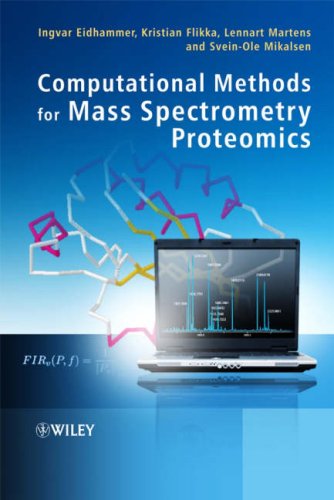
Computational methods for mass spectrometry proteomics 1st Edition by Ingvar Eidhammer, Kristian Flikka, Lennart Martens, Svein Ole Mikalsen ISBN 0470724293 9780470724293

Original price was: $50.00.$35.00Current price is: $35.00.
Computational methods for mass spectrometry proteomics 1st Edition by Ingvar Eidhammer, Kristian Flikka, Lennart Martens, Svein Ole Mikalsen – Ebook PDF Instant Download/Delivery: 0470724293, 9780470724293
Full download Computational methods for mass spectrometry proteomics 1st Edition after payment
Product details:
ISBN 10: 0470724293
ISBN 13: 9780470724293
Author: Ingvar Eidhammer, Kristian Flikka, Lennart Martens, Svein Ole Mikalsen
Computational methods for mass spectrometry proteomics 1st Table of contents:
1 Protein, proteome, and proteomics
1.1 Primary goals for studying proteomes
1.2 Defining the protein
1.3 Protein properties – attributes and values
1.4 Posttranslational modifications
1.5 Protein sequence databases
1.6 Identification and characterization of proteins
1.7 Two approaches for bottom-up protein analysis by mass spectrometry
1.8 Instrument calibration and measuring errors
Exercises
Bibliographic notes
2 Protein separation – 2D gel electrophoresis
2.1 Separation on molecular mass – SDS-PAGE
2.2 Separation on isoelectric point – IEF
2.3 Separation on mass and isoelectric point – 2D SDS-PAGE
2.4 2D SDS-PAGE for (complete) proteomics
Exercises
Bibliographic notes
3 Protein digestion
3.1 Experimental digestion
3.2 In silico digestion
Exercises
Bibliographic notes
4 Peptide separation – HPLC
4.1 High-pressure liquid chromatography, HPLC
4.2 Stationary phases and separation modes
4.3 Component migration and retention time
4.4 The shape of the peaks
4.5 Chromatography used for protein identification
4.6 Chromatography used for quantification
Exercises
Bibliographic notes
5 Fundamentals of mass spectrometry
5.1 The principle of mass spectrometry
5.2 Ionization sources
5.3 Mass analyzers
5.4 Isotopic composition of peptides
5.5 Fractional masses
5.6 The raw data
5.7 Mass resolution and resolving power
Exercises
Bibliographic notes
6 Mass spectrometry – MALDI-TOF
6.1 TOF analyzers and their resolution
6.2 Constructing the peak list
6.3 Peak list preprocessing
6.4 Peak list format
6.5 Automation of MALDI-TOF-MS
Exercises
Bibliographic notes
7 Protein identification and characterization by MS
7.1 The main search procedure
7.2 The peptide mass comparison
7.3 Database search and recalibration
7.4 Score calculation
7.5 Statistical significance – the P-value
7.6 Characterization
Exercises
Bibliographic notes
8 Tandem MS or MS/MS analysis
8.1 Peptide fragments
8.2 Fragmentation techniques
8.3 MS/MS spectrometers
8.4 Different types of analyzers
8.5 Overview of the process for MS/MS analysis
8.6 Fragment ion masses and residue masses
8.7 Deisotoping and charge state deconvolution
8.8 Precursor treatment
8.9 MS3 spectra
Exercises
Bibliographic notes
9 Fragmentation models
9.1 Chemical approach
9.2 Statistical approach
9.3 Learning (collecting statistics)
9.4 The effect of amino acids on the fragmentation
Exercises
Bibliographic notes
10 Identification and characterization by MS/MS
10.1 Effect of operations (modifications, mutations) on spectra
10.2 Filtering and organization of the database
10.3 Scoring and statistical significance
Exercises
11 Spectral comparisons
11.1 Constructing a theoretical spectrum
11.2 Non-probabilistic scoring
11.3 Probabilistic scoring
11.4 Comparison with modifications
Exercises
Bibliographic notes
12 Sequential comparison – de novo sequencing
12.1 Spectrum graphs
12.2 Preprocessing
12.3 Node scores
12.4 Constructing the spectrum graph
12.5 The sequencing procedure using spectrum graphs
12.6 Combined spectra to improve de novo sequencing
Exercises
Bibliographic and additional notes
13 Database searching for de novo sequences
13.1 Using general sequence search programs
13.2 Specialized search programs
13.3 Peptide sequence tags
13.4 Comparison by threading
Exercises
Bibliographic notes
14 Large-scale proteomics
14.1 Coverage and complexity
14.2 Selecting a representative peptide sample – COFRADIC
14.3 Separating peptides into fractions
14.4 Producing MS/MS spectra
14.5 Spectrum filtering
14.6 Spectrum clustering
14.7 Searching the database
14.8 LIMS
Exercises
Bibliographic notes
15 Quantitative MS-based proteomics
15.1 Defining the quantification task
15.2 mRNA and protein quantification
15.3 Quantification of peaks
15.4 Normalization
15.5 Different methods for quantification
15.6 Label-free quantification
15.7 Label-based quantification
15.8 Variance-stabilizing transformations
15.9 Dynamic range
15.10 Inferring relative quantity from peptide identification scores
15.11 Absolute quantification methods
Bibliographic notes
16 Peptides to proteins
16.1 Peptides and proteins
16.2 Protein identification using peptide masses: an example revisited
16.3 Minimal and maximal explanatory sets
Bibliographic notes
17 Top-down proteomics
17.1 Separation of intact proteins
17.2 Ionization of intact proteins
17.3 Resolution and accuracy requirements for charge state determination and mass calculation
17.4 Fragmentation of intact proteins
17.5 Charges of the fragments
17.6 Protein identification
17.7 Protein characterization – detecting modifications
17.8 Problems with top-down approach
Exercises
Bibliographic notes
18 Standards
18.1 Standard creation
18.2 Standards from a proteomics perspective
18.3 The Proteomics Standards Initiative
18.4 Mass spectrometry standards
18.5 Modification standards
18.6 Identification standards
People also search for Computational methods for mass spectrometry proteomics 1st:
computational methods for mass spectrometry proteomics pdf
mass spectrometry methods
how to find mass spectroscopy
computational mass spectrometry
computational methods for understanding mass spectrometry
Tags: Ingvar Eidhammer, Kristian Flikka, Lennart Martens, Svein Ole Mikalsen, Computational methods, spectrometry proteomics