

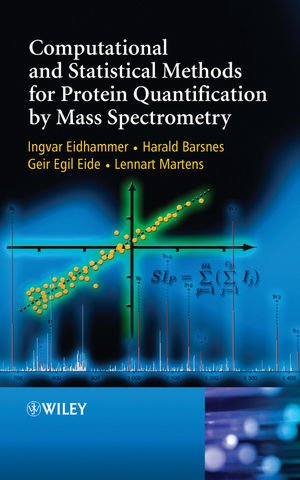
Computational and Statistical Methods for Protein Quantification by Mass Spectrometry 1st Edition by Ingvar Eidhammer, Harald Barsnes, Geir Egil Eide, Lennart Martens ISBN 978-1119964001 1119964008

Original price was: $50.00.$35.00Current price is: $35.00.
Computational and Statistical Methods for Protein Quantification by Mass Spectrometry 1st Edition by Ingvar Eidhammer, Harald Barsnes, Geir Egil Eide, Lennart Martens – Ebook PDF Instant Download/Delivery: 978-1119964001, 1119964008
Full download Computational and Statistical Methods for Protein Quantification by Mass Spectrometry 1st Edition after payment
Product details:
ISBN 10: 1119964008
ISBN 13: 978-1119964001
Author: Ingvar Eidhammer, Harald Barsnes, Geir Egil Eide, Lennart Martens
The definitive introduction to data analysis in quantitative proteomics
This book provides all the necessary knowledge about mass spectrometry based proteomics methods and computational and statistical approaches to pursue the planning, design and analysis of quantitative proteomics experiments. The author’s carefully constructed approach allows readers to easily make the transition into the field of quantitative proteomics. Through detailed descriptions of wet-lab methods, computational approaches and statistical tools, this book covers the full scope of a quantitative experiment, allowing readers to acquire new knowledge as well as acting as a useful reference work for more advanced readers.
Computational and Statistical Methods for Protein Quantification by Mass Spectrometry:
- Introduces the use of mass spectrometry in protein quantification and how the bioinformatics challenges in this field can be solved using statistical methods and various software programs.
- Is illustrated by a large number of figures and examples as well as numerous exercises.
- Provides both clear and rigorous descriptions of methods and approaches.
- Is thoroughly indexed and cross-referenced, combining the strengths of a text book with the utility of a reference work.
- Features detailed discussions of both wet-lab approaches and statistical and computational methods.
With clear and thorough descriptions of the various methods and approaches, this book is accessible to biologists, informaticians, and statisticians alike and is aimed at readers across the academic spectrum, from advanced undergraduate students to post doctorates entering the field.
Table of contents:
1. Introduction
1.1 The Composition of an Organism
1.1.1 A Simple Model of an Organism
1.1.2 Composition of Cells
1.2 Homeostasis, Physiology, and Pathology
1.3 Protein Synthesis
1.4 Site, Sample, State, and Environment
1.5 Abundance and Expression – Protein and Proteome Profiles
1.5.1 The Protein Dynamic Range
1.6 The Importance of Exact Specification of Sites and States
1.6.1 Biological Features
1.6.2 Physiological and Pathological Features
1.6.3 Input Features
1.6.4 External Features
1.6.5 Activity Features
1.6.6 The Cell Cycle
1.7 Relative and Absolute Quantification
1.7.1 Relative Quantification
1.7.2 Absolute Quantification
1.8 In Vivo and In Vitro Experiments
1.9 Goals for Quantitative Protein Experiments
1.10 Exercises
2. Correlations of mRNA and Protein Abundances
2.1 Investigating the Correlation
2.2 Codon Bias
2.3 Main Results from Experiments
2.4 The Ideal Case for mRNA–Protein Comparison
2.5 Exploring Correlation across Genes
2.6 Exploring Correlation within One Gene
2.7 Correlation across Subsets
2.8 Comparing mRNA and Protein Abundances across Genes from Two Situations
2.9 Exercises
2.10 Bibliographic Notes
3. Protein Level Quantification
3.1 Two-Dimensional Gels
3.1.1 Comparing Results from Different Experiments – DIGE
3.2 Protein Arrays
3.2.1 Forward Arrays
3.2.2 Reverse Arrays
3.2.3 Detection of Binding Molecules
3.2.4 Analysis of Protein Array Readouts
3.3 Western Blotting
3.4 ELISA – Enzyme-Linked Immunosorbent Assay
3.5 Bibliographic Notes
4. Mass Spectrometry and Protein Identification
4.1 Mass Spectrometry
4.1.1 Peptide Mass Fingerprinting (PMF)
4.1.2 MS/MS – Tandem MS
4.1.3 Mass Spectrometers
4.2 Isotope Composition of Peptides
4.2.1 Predicting the Isotope Intensity Distribution
4.2.2 Estimating the Charge
4.2.3 Revealing Isotope Patterns
4.3 Presenting the Intensities – The Spectra
4.4 Peak Intensity Calculation
4.5 Peptide Identification by MS/MS Spectra
4.5.1 Spectral Comparison
4.5.2 Sequential Comparison
4.5.3 Scoring
4.5.4 Statistical Significance
4.6 The Protein Inference Problem
4.6.1 Determining Maximal Explanatory Sets
4.6.2 Determining Minimal Explanatory Sets
4.7 False Discovery Rate for the Identifications
4.7.1 Constructing the Decoy Database
4.7.2 Separate or Composite Search
4.8 Exercises
4.9 Bibliographic Notes
5. Protein Quantification by Mass Spectrometry
5.1 Situations, Protein, and Peptide Variants
5.1.1 Situation
5.1.2 Protein Variants – Peptide Variants
5.2 Replicates
5.3 Run – Experiment – Project
5.3.1 LC-MS/MS Run
5.3.2 Quantification Run
5.3.3 Quantification Experiment
5.3.4 Quantification Project
5.3.5 Planning Quantification Experiments
5.4 Comparing Quantification Approaches/Methods
5.4.1 Accuracy
5.4.2 Precision
5.4.3 Repeatability and Reproducibility
5.4.4 Dynamic Range and Linear Dynamic Range
5.4.5 Limit of Blank (LOB)
5.4.6 Limit of Detection (LOD)
5.4.7 Limit of Quantification (LOQ)
5.4.8 Sensitivity
5.4.9 Selectivity
5.5 Classification of Approaches for Quantification Using LC-MS/MS
5.5.1 Discovery or Targeted Protein Quantification
5.5.2 Label-Based vs. Label-Free Quantification
5.5.3 Abundance Determination – Ion Current vs. Peptide Identification
5.5.4 Classification
5.6 The Peptide (Occurrence) Space
5.7 Ion Chromatograms
5.8 From Peptides to Protein Abundances
5.8.1 Combined Single Abundance from Single Abundances
5.8.2 Relative Abundance from Single Abundances
5.8.3 Combined Relative Abundance from Relative Abundances
5.9 Protein Inference and Protein Abundance Calculation
5.9.1 Use of the Peptides in Protein Abundance Calculation
5.9.2 Classifying the Proteins
5.9.3 Can Shared Peptides Be Used for Quantification?
5.10 Peptide Tables
5.11 Assumptions for Relative Quantification
5.12 Analysis for Differentially Abundant Proteins
5.13 Normalization of Data
5.14 Exercises
5.15 Bibliographic Notes
6. Statistical Normalization
6.1 Some Illustrative Examples
6.2 Non-Normally Distributed Populations
6.2.1 Skewed Distributions
6.2.2 Measures of Skewness
6.2.3 Steepness of the Peak – Kurtosis
6.3 Testing for Normality
6.3.1 Normal Probability Plot
6.3.2 Test Statistics for Normality Testing
6.4 Outliers
6.4.1 Identification of a Single Outlier
6.4.2 Testing for More than One Outlier
6.4.3 Robust Statistics
6.4.4 Outliers in Regression
6.5 Variance Inequality
6.6 Normalization and Logarithmic Transformation
6.6.1 The Logarithmic Function
6.6.2 Choosing the Base
6.6.3 Logarithmic Normalization
6.6.4 Pitfalls of Logarithmic Transformations
6.6.5 Variance Stabilization
6.6.6 Logarithmic Scale for Presentation
6.7 Exercises
6.8 Bibliographic Notes
People also search for:
computational analysis of proteins
a computational approach to statistical learning
computational analysis of protein-protein interaction
what is computational statistics and data analysis
computational formula for standard deviation
Tags: Ingvar Eidhammer, Harald Barsnes, Geir Egil Eide, Lennart Martens, Computational and Statistical, Protein Quantification