

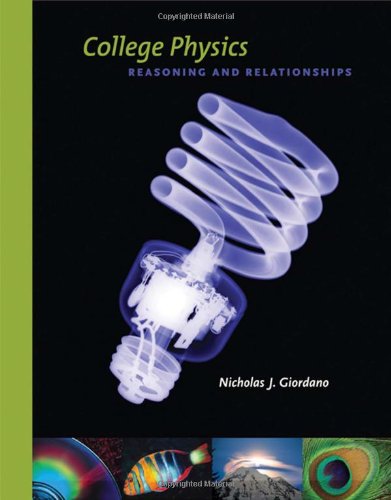
College Physics Reasoning and Relationships 1st Edition by Nicholas Giordano ISBN 0534424716 9780534424718


Original price was: $50.00.$35.00Current price is: $35.00.
College Physics Reasoning and Relationships 1st Edition by – Ebook PDF Instant Download/Delivery: 0534424716, 9780534424718
Full download College Physics Reasoning and Relationships 1st Edition after payment
Product details:
ISBN 10: 0534424716
ISBN 13: 9780534424718
Author: Nicholas Giordano
College Physics Reasoning and Relationships 1st Table of contents:
Chapter 1. Introduction
1.1. The Purpose of Physics
1.2. Problem Solving in Physics: Reasoning and Relationships
1.3. Dealing with Numbers
Scientific Notation
Significant Figures
1.4. Physical Quantities and Units of Measure
Units of Time and Mass
The SI System of Units
Powers of 10 and Prefixes
1.5. Dimensions and Units
Dimensions and Dimensional Analysis
1.6. Algebra and Simultaneous Equations
Checking the Units of an Answer
1.7. Trigonometry
Measuring Angles
1.8. Vectors
Adding Vectors
Multiplying a Vector by a Scalar and Subtracting Vectors
Vectors and Components
Section Content
Problems Icon Guide
Questions
Problems: 1.3. Dealing with Numbers
Problems: 1.4. Physical Quantities and Units of Measure
Problems: 1.5. Dimensions and Units
Problems: 1.6. Algebra and Simultaneous Equations
Problems: 1.7. Trigonometry
Problems: 1.8. Vectors
Additional Problems
Chapter 2. Motion, Forces, and Newton’s Laws
2.1. Aristotle’s Mechanics
The Failures of Aristotle’s Ideas about Mechanics
2.2. What Is Motion?
Velocity and Speed
How Is an Object’s Velocity Related to Its Position?
Average Velocity and Instantaneous Velocity
Acceleration
The Relation between Velocity and Acceleration
2.3. The Principle of Inertia
Galileo’s Experiments on Motion
2.4. Newton’s Laws of Motion
Newton’s First Law
Inertia and Mass
Newton’s Second Law
Newton’s Second Law and the Directions of v → and a →
Newton’s Third Law
Which Law Do We Use?
2.5. Why Did It Take Newton to Discover Newton’s Laws?
Forces on a Swimming Bacterium
2.6. Thinking about the Laws of Nature
Discovery of a New Law of Physics
After Newton, What Next?
Key Concepts and Principles
Applications
Problems Icon Guide
Questions
Problems: 2.2. What Is Motion?
Problems: 2.3. The Principle of Inertia
Problems: 2.4. Newton’s Laws of Motion
Additional Problems
Chapter 3. Forces and Motion in One Dimension
3.1. Motion of a Spacecraft in Interstellar Space
Motion with a Constant Nonzero Acceleration
Relations for Motion with Constant Acceleration
3.2. Normal Forces and Weight
Free-Body Diagrams
Acceleration and Apparent Weight
All Forces Come from Interactions
What Is “Mass”?
3.3. Adding Friction to the Mix
Kinetic Friction
Analyzing Motion in the Presence of Friction
Static Friction
Comparing Kinetic Friction and Static Friction
The Role of Friction in Walking and Rolling
3.4. Free Fall
Motion of a Dropped Ball
3.5. Cables, Strings, and Pulleys: Transmitting Forces from Here to There
Tension Forces
Some Cables Are Not Massless
Using Pulleys to Redirect a Force
Amplifying Forces
3.6. Reasoning and Relationships: Finding the Missing Piece
Jumping off a Ladder
3.7. Parachutes, Air Drag, and Terminal Speed
Skydiving and Air Drag
3.8. Life as a Bacterium
Key Concepts and Principles
Applications
Problems Icon Guide
Questions
Problems: 3.1. Motion of a Spacecraft in Interstellar Space
Problems: 3.2. Normal Forces And Weight
Problems: 3.3. Adding Friction to the Mix
Problems: 3.4. Free Fall
Problems: 3.5. Cables, Strings, and Pulleys: Transmitting Forces from Here to There
Problems: 3.6. Reasoning and Relationships: Finding the Missing Piece
Problems: 3.7. Parachutes, Air Drag, and Terminal Speed
Problems: 3.8. Life as a Bacterium
Additional Problems
Chapter 4. Forces and Motion in Two and Three Dimensions
4.1. Statics
Conditions for Translational Equilibrium
A Tightrope Walker in Equilibrium
Static Equilibrium and Frictional Forces
4.2. Projectile Motion
Rolling Off a Cliff
Independence of the Vertical and Horizontal Motion of Projectiles
Projectile Motion and Target Practice
Motion of a Baseball: Calculating the Trajectory and the Velocity
Motion of a Baseball: Analyzing the Results
4.3. A First Look at Reference Frames and Relative Velocity
Relative Velocity
4.4. Further Applications of Newton’s Laws
Traveling Down a Hill
Adding the Frictional Force
Pulleys and Cables
4.5. Detecting Acceleration: Reference Frames and the Workings of the Ear
The Accelerometer in Your Ear
Inertial Reference Frames
4.6. Projectile Motion Revisited: The Effect of Air Drag
Effect of Air Drag on a Bicycle
Key Concepts and Principles
Applications
Problems Icon Guide
Questions
Problems: 4.1. Statics
Problems: 4.2. Projectile Motion
Problems: 4.3. A First Look at Reference Frames and Relative Velocity
Problems: 4.4. Further Applications of Newton’s Laws
Problems: 4.5. Detecting Acceleration: Reference Frames and the Workings of the Ear
Problems: 4.6. Projectile Motion Revisited: the Effect of Air Drag
Additional Problems
Chapter 5. Circular Motion and Gravitation
5.1. Uniform Circular Motion
Centripetal Acceleration
Circular Motion and Forces
Centripetal Acceleration of a Turning Car: What Are the Forces?
A Car on a Banked Turn: Analyzing the Forces
5.2. Examples of Circular Motion
Twirling a Rock on a String: What Is the Tension in the String?
Circular Motion and Amusement Park Activities: Maximum Speed of a Roller Coaster
“Artificial Gravity” and a Rotating Space Station
Physics of a Centrifuge
Inertial and Noninertial Reference Frames Applied to a Centrifuge
5.3. Newton’s Law of Gravitation
Gravitation and the Orbital Motion of the Moon
Applying Newton’s Law of Gravitation: Calculating the Value of g
Measuring G : The Cavendish Experiment
Newton’s Apple
5.4. Planetary Motion and Kepler’s Laws
Kepler’s First Law
Kepler’s Second Law
Kepler’s Third Law
Satellite Orbits around the Earth
Kepler’s Laws, Putting a Satellite into Orbit, and the Origin of the Solar System
5.5. Moons and Tides
The Origin of Tides
5.6. Deep Notions Contained in Newton’s Law of Gravitation
The Inverse Square Law
Gravitation and Mass
Key Concepts and Principles
Applications
Problems Icon Guide
Questions
Problems: 5.1. Uniform Circular Motion
Problems: 5.2. Examples of Circular Motion
Problems: 5.3. Newton’s Law of Gravitation
Problems: 5.4. Planetary Motion and Kepler’s Laws
Problems: 5.5. Moons and Tides
Additional Problems
Chapter 6. Work and Energy
6.1. Force, Displacement, and Work
W Depends on the Direction of the Force Relative to the Displacement
How Physics Uses the Term Work
What Does the Work?
Graphical Analysis and Work Done by a Variable Force
6.2. Kinetic Energy and the Work–Energy Theorem
Work, Energy, and Amplifying Forces
6.3. Potential Energy and Conservation of Energy
Potential Energy Is Stored Energy
Potential Energy and Conservative Forces
Potential Energy, the Work–Energy Theorem, and Conservation of Energy
Conservation of Mechanical Energy and the Speed of a Snowboarder
Charting the Energy
Why Is the Principle of Conservation of Energy Useful?
Projectile Motion and Conservation of Energy
Only Changes in Potential Energy Matter
6.4. More Potential Energy Functions
Gravitational Potential Energy in the Solar System
Gravitational Potential Energy: Launching a Satellite into Space
Elastic Forces and Potential Energy: Springs
Potential Energy Stored in a Spring
Spring Forces and Potential Energy: A Recap
Total Potential Energy with Multiple Forces
Elastic Forces and the “Feeling” of Holding a Heavy Object
6.5. Conservative versus Nonconservative Forces and Conservation of Energy
The Work Done by Friction Depends on the Path
The Work–Energy Theorem Revisited: Including Nonconservative Forces
Conservation of Energy of a System
6.6. The Nature of Nonconservative Forces: What Is Friction Anyway?
6.7. Power
Power and Velocity
Power, Force, and Efficiency
6.8. Work, Energy, and Molecular Motors
Calculating the Force Exerted by a Molecular Motor
Key Concepts and Principles
Applications
Problems Icon Guide
Questions
Problems: 6.1. Force, Displacement, and Work
Problems: 6.2. Kinetic Energy and the Work–Energy Theorem
Problems: 6.3. Potential Energy and Conservation of Energy
Problems: 6.4. More Potential Energy Functions
Problems: 6.5. Conservative versus Nonconservative Forces and Conservation of Energy
Problems: 6.7. Power
Problems: 6.8. Work, Energy, and Molecular Motors
Additional Problems
Chapter 7. Momentum, Impulse, and Collisions
7.1. Momentum
Momentum of a System of Particles
7.2. Force and Impulse
Impulse Associated with a Variable Force
Impulse and the Average Force
Minimizing Collision Forces
7.3. Conservation of Momentum
Conservation of Momentum for a System of Many Particles
Momentum Conservation and External Forces
7.4. Collisions
Elastic Collisions in One Dimension
A Collision between Two Billiard Balls
The Power of Conservation Principles
Inelastic Collisions in One Dimension
Completely Inelastic Collisions
Inelastic Collisions: What Happens to the Kinetic Energy?
Collisions in Two Dimensions
A Collision in Two Dimensions: A Rocket, an Asteroid, and Saving the Earth
7.5. Using Momentum Conservation to Analyze Inelastic Events
Applying the Principle of Conservation of Momentum to Inelastic Events
Inelastic Processes Are Similar to Collisions
Splitting Asteroids
7.6. Center of Mass
What Is the Center of Mass and How Is It Useful?
Motion of the Center of Mass
Translational Motion of a System
7.7. A Bouncing Ball and Momentum Conservation
7.8. The Importance of Conservation Principles in Physics
Key Concepts and Principles
Applications
Problems Icon Guide
Questions
Problem: 7.1. Momentum
Problem: 7.2. Force and Impulse
Problem: 7.3. Conservation of Momentum
Problem: 7.4. Collisions
Problem: 7.5. Using Momentum Conservation to Analyze Inelastic Events
Problem: 7.6. Center of Mass
Problem: 7.7. A Bouncing Ball and Momentum Conservation
Additional Problems
Chapter 8. Rotational Motion
8.1. Describing Rotational Motion
Angular Velocity and Acceleration
Angular and Centripetal Acceleration Are Different
The Period of Rotational Motion
The Connection between Linear and Rotational Motion
8.2. Torque and Newton’s Laws for Rotational Motion
Torque and Lever Arm
Relating Torque and Angular Acceleration
Newton’s Second Law for Rotational Motion and the Analogy with Translational Motion
Torques and Lever Arms Revisited: A More General Definition
Two Ways to Think about Torque
Center of Gravity, Center of Mass, and the Direction of Torque
8.3. Rotational Equilibrium
Rotational Equilibrium of a Lever: Amplifying Forces
Amplification of Forces in the Ear
Pushing on a Crate: When Will It Tip?
8.4. Moment of Inertia
8.5. Rotational Dynamics
Angular Motion of a Compact Disc
Pulling on a Pulley: Real Pulleys with Mass
Motion of a Pulley and Crate: Example of Combined Translational and Rotational Motion
8.6. Combined Rotational and Translational Motion
Rolling Motion
Sweet Spot of a Baseball Bat
Key Concepts and Principles
Applications
Problems Icon Guide
Questions
Problems: 8.1. Describing Rotational Motion
Problems: 8.2. Torque and Newton’s Laws for Rotational Motion
Problems: 8.3. Rotational Equilibrium
Problems: 8.4. Moment of Inertia
Problems: 8.5. Rotational Dynamics
Problems: 8.6. Combined Rotational and Translational Motion
Additional Problems
Chapter 9. Energy and Momentum of Rotational Motion
9.1. Kinetic Energy of Rotation
The Total Kinetic Energy of an Object Is the Sum of the Rotational and Translational Kinetic Energies
Rolling Motion and the Distribution of Kinetic Energy
Torque and Rotational Kinetic Energy: Rotational Version of the Work–Energy Theorem
9.2. Conservation of Energy and Rotational Motion
9.3. Angular Momentum
Conservation of Angular Momentum and a Spinning Skater
Problem Solving with Angular Momentum
Angular Momentum and Kinetic Energy
9.4. Angular Momentum and Kepler’s Second Law of Planetary Motion
Angular Momentum of an Orbiting Planet
9.5. The Vector Nature of Rotational Motion: Gyroscopes
The Earth as a Gyroscope
Angular Momentum and the Stability of a Spinning Wheel
Precession
9.6. Cats and Other Rotating Objects
Rotating Cats
Angular Momentum and Motorcycles
Key Concepts and Principles
Applications
Problems Icon Guide
Questions
Problems: 9.1. Kinetic Energy of Rotation
Problems: 9.2. Conservation of Energy and Rotational Motion
Problems: 9.3. Angular Momentum
Problems: 9.4. Angular Momentum and Kepler’s Second Law of Planetary Motion
Problems: 9.5. The Vector Nature of Rotational Motion: Gyroscopes
Problems: 9.6. Cats and Other Rotating Objects
Additional Problems
Chapter 10. Fluids
10.1. Pressure and Density
Atmospheric Pressure
Vacuum and the Magdeburg Experiment
Gauge Pressure versus Absolute Pressure
Density
10.2. Fluids and the Effect of Gravity
Pressure in a U-Tube
Barometers, Vacuums, and Measuring Pressure
Units for Measuring Pressure
Pumping a Liquid
Pressure in a Compressible Fluid
10.3. Hydraulics and Pascal’s Principle
Designing a Hydraulic Lift: Amplifying Forces
Work–Energy Analysis of a Hydraulic System
10.4. Buoyancy and Archimedes’s Principle
Examples and Applications of Archimedes’s Principle
Archimedes’s Principle Holds for Objects of Any Shape, in Both Incompressible and Compressible Fluids
10.5. Fluids in Motion: Continuity and Bernoulli’s Equation
Bernoulli’s Equation
Interpreting Bernoulli’s Equation
Applications of Bernoulli’s Equation
10.6. Real Fluids: A Molecular View
Viscosity and Poiseuille’s Law
Viscosity and Stokes’s Law
Surface Tension
Capillary Pressure
How Plants Use Capillary Pressure
10.7. Turbulence
Key Concepts and Principles
Applications
Problems Icon Guide
Questions
Problems: 10.1. Pressure and Density
Problems: 10.2. Fluids and the Effect of Gravity
Problems: 10.3. Hydraulics and Pascal’s Principle
Problems: 10.4. Buoyancy and Archimedes’s Principle
Problems: 10.5. Fluids in Motion: Continuity and Bernoulli’s Equation
Problems: 10.6. Real Fluids: A Molecular View
Additional Problems
Chapter 11. Harmonic Motion and Elasticity
11.1. General Features of Harmonic Motion
Simple Harmonic Motion
The Connection between Simple Harmonic Motion and Circular Motion
11.2. Examples of Simple Harmonic Motion
Mass on a Spring
Mass on a Vertical Spring: Bungee Jumping Revisited
The Simple Pendulum
The Human Arm as a Pendulum
The Torsional Oscillator
Features Common to All Simple Harmonic Oscillators
The Frequency of a Simple Harmonic Oscillator Is Independent of the Amplitude
11.3. Harmonic Motion and Energy
11.4. Stress, Strain, and Hooke’s Law
Elastic versus Plastic Deformations
The Shear Modulus
The Bulk Modulus
Elastic Properties and Simple Harmonic Motion
11.5. Damping and Resonance
The Driven Oscillator
11.6. Detecting Small Forces
The Cavendish Experiment
The Atomic Force Microscope
Key Concepts and Principles
Applications
Problems Icon Guide
Questions
Problems: 11.1. General Features of Harmonic Motion
Problems: 11.2. Examples of Simple Harmonic Motion
Problems: 11.3. Harmonic Motion and Energy
Problems: 11.4. Stress, Strain, and Hooke’s Law
Problems: 11.5. Damping and Resonance
Problems: 11.6. Detecting Small Forces
Additional Problems
Chapter 12. Waves
12.1. What Is a Wave?
12.2. Describing Waves
The “Equation” of a Wave
Speed of a Wave
12.3. Examples of Waves
Waves on a String
Sound
Wave Propagation in a Solid
Visible Light and Other Electromagnetic Waves
Water Waves
12.4. The Geometry of a Wave: Wave Fronts
Spherical Waves
Plane Waves
Intensity and Amplitude of a Wave
12.5. Superposition and Interference
Constructive and Destructive Interference
Interference of Periodic Waves
12.6. Reflection
Radar
12.7. Refraction
12.8. Standing Waves
Musical Tones
12.9. Seismic Waves and the Structure of the Earth
Key Concepts and Principles
Applications
Problems Icon Guide
Questions
Problems: 12.1. What Is a Wave?
Problems: 12.2. Describing Waves
Problems: 12.3. Examples of Waves
Problems: 12.4. The Geometry of a Wave: Wave Fronts
Problems: 12.5. Superposition and Interference
Problems: 12.6. Reflection
Problems: 12.7. Refraction
Problems: 12.8. Standing Waves
Problems: 12.9. Seismic Waves and the Structure of the Earth
Additional Problems
Chapter 13. Sound
13.1. Sound Is a Longitudinal Wave
The Speed of Sound
Musical Tones and Pitch
13.2. Amplitude and Intensity of a Sound Wave
Decibels
Human Perception of Sound
The Ear as a Pressure Detector
13.3. Standing Sound Waves
Standing Waves in a Pipe Closed at Both Ends
Standing Waves in a Pipe Open at One End and Closed at the Other
Composition of a Real Musical Tone
13.4. Beats
13.5. Reflection and Scattering of Sound
13.6. The Doppler Effect
Speed Guns, Bats, and the Doppler Effect
Moving Sources and Shock Waves
13.7. Applications
Using Sound to Study Global Warming
Imaging with Ultrasound
Key Concepts and Principles
Applications
Problems Icon Guide
Questions
Problems: 13.1. Sound is a Longitudinal Wave
Problems: 13.2. Amplitude and Intensity of a Sound Wave
Problems: 13.3. Standing Sound Waves
Problems: 13.4. Beats
Problems: 13.5. Reflection and Scattering of Sound
Problems: 13.6. The Doppler Effect
Problems: 13.7. Applications
Additional Problems
Chapter 14. Temperature and Heat
14.1. Thermodynamics: Applying Physics to a “System”
14.2. Temperature and Heat
Units of Heat
Temperature: A Microscopic Picture
Temperature Scales
Very High and Very Low Temperatures: What Are the Limits?
14.3. Thermal Equilibrium and the Zeroth Law of Thermodynamics
14.4. Phases of Matter and Phase Changes
Internal Energy
Phase Changes
Specific Heat and Heat Capacity
Why Is Specific Heat Important?
Calorimetry
Latent Heat
Calorimetry: Including the Latent Heat
14.5. Thermal Expansion
Effects of Thermal Expansion
Thermal Expansion of Water
14.6. Heat Conduction
Why Do Metals “Feel” Cold?
14.7. Convection
Wind Chill
14.8. Heat and Radiation
Radiation and the Notion of a “Blackbody”
The Stefan–Boltzmann Law and Heat Flow
Radiation from the Sun and the Temperature of the Earth
Medical Uses of Heat Radiation
The Greenhouse Effect
Key Concepts and Principles
Applications
Problems Icon Guide
Questions
Problems: 14.2. Temperature and Heat
Problems: 14.4. Phases of Matter and Phase Changes
Problems: 14.5. Thermal Expansion
Problems: 14.6. Heat Conduction
Problems: 14.7. Convection
Problems: 14.8. Heat and Radiation
Additional Problems
Chapter 15. Gases and Kinetic Theory
15.1. Molecular Picture of a Gas
15.2. Ideal Gases: An Experimental Perspective
Absolute Temperature and the Kelvin Scale
The Ideal Gas Law
15.3. Ideal Gases and Newton’s Laws
Pressure Comes from Collisions with Gas Molecules
The Microscopic Basis of Temperature
15.4. Kinetic Theory
Internal Energy of an Ideal Gas
Specific Heat of an Ideal Gas
Polyatomic Gases
Distribution of Speeds in a Gas
15.5. Diffusion
Using Diffusion in Medicine
Isotope Separation
Diffusion, Brownian Motion, and the Discovery of Atoms
The Arrow of Time
15.6. Deep Puzzles in Kinetic Theory
Key Concepts and Principles
Applications
Problems Icon Guide
Questions
Problems: 15.1. Molecular Picture of a Gas
Problems: 15.2. Ideal Gases: An Experimental Perspective
Problems: 15.3. Ideal Gases and Newton’s Laws
Problems: 15.4. Kinetic Theory
Problems: 15.5. Diffusion
Additional Problems
Chapter 16. Thermodynamics
16.1. Thermodynamics Is about the Way a System Exchanges Energy with Its Environment
16.2. The Zeroth Law of Thermodynamics and the Meaning of Temperature
16.3. The First Law of Thermodynamics and the Conservation of Energy
The First Law of Thermodynamics: The Meaning of Q and W
The Signs of Q and W in the First Law of Thermodynamics
16.4. Thermodynamic Processes
Thermal Reservoirs
Calculating the Work Done in a Thermodynamic Process
Examples of Thermodynamic Processes
Some Properties of Q and W
Work Done by a Cyclic Process
16.5. The Second Law of Thermodynamics
16.6. Heat Engines and Other Thermodynamic Devices
Carnot’s Engine
Perpetual Motion and the Second Law of Thermodynamics
The Carnot Cycle
Thermodynamic Devices: The Refrigerator
Heat Pumps
16.7. Entropy
Entropy: A Microscopic View
Entropy and Probability
16.8. The Third Law of Thermodynamics and Absolute Zero
16.9. Thermodynamics and Photosynthesis
16.10. Converting Heat Energy to Mechanical Energy and the Origin of the Second Law of Thermodynamics
Key Concepts and Principles
Applications
Problems Icon Guide
Questions
Problems: 16.3. The First Law of Thermodynamics and the Conservation of Energy
Problems: 16.4. Thermodynamic Processes
Problems: 16.6. Heat Engines and Other Thermodynamic Devices
Problems: 16.7. Entropy
Additional Problems
Chapter 17. Electric Forces and Fields
17.1. Evidence for Electric Forces: The Observational Facts
What Is Electric Charge?
17.2. Electric Forces and Coulomb’s Law
Important Features of Coulomb’s Law
Superposition of Electric Forces
17.3. The Electric Field
Using a Test Charge to Measure E →
Why Do We Need the Electric Field?
Electric Field Lines and the Inverse Square Law
17.4. Conductors, Insulators, and the Motion of Electric Charge
The Structure of Matter from an “Electrical” Viewpoint
Placing Charge on an Insulator
Excess Charge Goes to the Surface of a Metal
Charging an Object by Rubbing It
The Concept of Electrical “Ground”
Charging by Contact and by Induction
17.5. Electric Flux and Gauss’s Law
Gauss’s Law
Using Gauss’s Law to Find E → for a Point Charge
More Applications of Gauss’s Law
Electric Field Near a Charged Metal Plate
17.6. Applications: DNA Fingerprinting
17.7. “Why Is Charge Quantized?” and Other Deep Questions
How Are Protons Held Together?
Electrons Are Point Charges
Conservation of Charge
Key Concepts and Principles
Applications
Problems Icon Guide
Questions
Problems: 17.1. Evidence for Electric Forces: The Observational Facts
Problems: 17.2. Electric Forces and Coulomb’s Law
Problems: 17.3. The Electric Field
Problems: 17.4. Conductors, Insulators, and the Motion of Electric Charge
Problems: 17.5. Electric Flux and Gauss’s Law
Problems: 17.6. Applications: DNA Fingerprinting
Problems: 17.7. “Why Is Charge Quantized?” and Other Deep Questions
Additional Problems
Chapter 18. Electric Potential
18.1. Electric Potential Energy
Potential Energy Is Stored Energy
Potential Energy of Two Point Charges
Electric Potential Energy and Superposition
Using the Principle of Conservation of Energy
18.2. Electric Potential: Voltage
Using an Electric Potential Difference to Accelerate Charged Particles
Relating the Electric Potential to the Electric Field
The Electron-volt as a Unit of Energy
Electric Potential Due to a Point Charge
Only Changes in Electric Potential Matter
Electric Potential and Field Near a Metal
Electric Field Near a Lightning Rod
Shielding Out the Electric Field
18.3. Equipotential Lines and Surfaces
18.4. Capacitors
Storing Energy in a Capacitor
Capacitors in Series
Capacitors in Parallel
Combinations of Three or More Capacitors
18.5. Dielectrics
The Term Dielectric Is Used to Describe Any Insulating Material
Why Does a Dielectric Change the Capacitance?
Effects of Very Large Electric Fields
18.6. Electricity in the Atmosphere
18.7. Biological Examples and Applications
18.8. Electric Potential Energy Revisited: Where Is the Energy?
Key Concepts and Principles
Applications
Problems Icon Guide
Questions
Problems: 18.1. Electric Potential Energy
Problems: 18.2. Electric Potential: Voltage
Problems: 18.3. Equipotential Lines and Surfaces
Problems: 18.4. Capacitors
Problems: 18.5. Dielectrics
Problems: 18.6. Electricity in the Atmosphere
Problems: 18.7. Biological Examples and Applications
Problems: 18.8. Electric Potential Energy Revisited: Where Is the Energy?
Additional Problems
Chapter 19. Electric Currents and Circuits
19.1. Electric Current: The Flow of Charge
Which Way Does the Charge Move?
19.2. Batteries
Electric Current and Potential Energy
Construction of a Battery
Ideal Batteries and Real Batteries
19.3. Current and Voltage in a Resistor Circuit
Drift Velocity and Current
Ohm’s Law
Wires and Resistors
Speed of an Electric Current
19.4. DC Circuits: Batteries, Resistors, and Kirchhoff’s Rules
What Is a “Circuit”?
One-Loop Circuits: Kirchhoff’s Loop Rule
Dissipation of Energy in a Resistor
Resistors in Series
Multibranch Circuits
Kirchhoff’s Rules
Using Kirchhoff’s Rules
Resistors in Parallel
Real Batteries
19.5. DC Circuits: Adding Capacitors
Applying Kirchhoff’s Rules to a Circuit with a Capacitor
RC Circuits: A Qualitative Analysis
Discharging a Capacitor
Capacitor Combinations
19.6. Making Electrical Measurements: Ammeters and Voltmeters
19.7. RC Circuits as Filters
Electric Currents in Nerves
Designing a Better Nerve Fiber
19.8. Electric Currents in the Human Body
19.9. Household Circuits
Safety in Home Circuits
19.10. Temperature Dependence of Resistance and Superconductivity
Key Concepts and Principles
Applications
Problems Icon Guide
Questions
Problems: 19.1. Electric Current: The Flow of Charge
Problems: 19.2. Batteries
Problems: 19.3. Current and Voltage in a Resistor Circuit
Problems: 19.4. DC Circuits: Batteries, Resistors, and Kirchhoff’s Rules
Problems: 19.5. DC Circuits: Adding Capacitors
Problems: 19.6. Making Electrical Measurements: Ammeters and Voltmeters
Problems: 19.7. RC Circuits as Filters
Problems: 19.8. Electric Currents in the Human Body
Problems: 19.10. Temperature Dependence of Resistance and Superconductivity
Additional Problems
Chapter 20. Magnetic Fields and Forces
20.1. Sources of Magnetic Fields
Magnetic Fields Produced by an Electric Current
Plotting Magnetic Fields and Field Lines
Magnetic Fields and Superposition
20.2. Magnetic Forces Involving Bar Magnets
20.3. Magnetic Force on a Moving Charge
Magnetic Force on an Electron: How Big Is It?
Motion of a Charged Particle in a Magnetic Field
Applying the Right-Hand Rules
20.4. Magnetic Force on an Electric Current
20.5. Torque on a Current Loop and Magnetic Moments
20.6. Motion of Charged Particles in the Presence of Electric and Magnetic Fields
The Mass Spectrometer
Hall Effect: How Do We Know If the Charge Carriers Are Positive or Negative?
20.7. Calculating the Magnetic Field: Ampère’s Law
Applying Ampère’s Law: The Magnetic Field Produced by a Straight Wire
Field from a Current Loop
Field Inside a Solenoid
20.8. Magnetic Materials: What Goes On Inside?
Permanent Magnets: A Microscopic View
Lining Up the Atomic Magnets to Make a Permanent Magnet
Induced Magnetism and Magnetic Domains
20.9. The Earth’s Magnetic Field
Cosmic Rays and the Earth’s Magnetic Field
20.10. Applications of Magnetism
Blood-Flow Meters
Relays
Making an Electric Motor
Magnetic Bacteria
Magnetic Dating
20.11. The Puzzle of a Velocity-Dependent Force
Key Concepts and Principles
Applications
Problems Icon Guide
Questions
Problems: 20.1. Sources of Magnetic Fields
Problems: 20.2. Magnetic Forces Involving Bar Magnets
Problems: 20.3. Magnetic Force on a Moving Charge
Problems: 20.4. Magnetic Force on an Electric Current
Problems: 20.5. Torque on a Current Loop and Magnetic Moments
Problems: 20.6. Motion of Charged Particles in the Presence of Electric and Magnetic Fields
Problems: 20.7. Calculating the Magnetic Field: Ampère’s Law
Problems: 20.8. Magnetic Materials: What Goes on Inside?
Problems: 20.9. The Earth’s Magnetic Field
Problems: 20.10. Applications of Magnetism
Problems: 20.11. The Puzzle of a Velocity-Dependent Force
Additional Problems
Chapter 21. Magnetic Induction
21.1. Why Is It Called Electromagnetism?
21.2. Magnetic Flux and Faraday’s Law
Faraday’s Law
Key Features of Faraday’s Law
Magnetic Flux through a Changing Area
Conservation of Energy and the Induced emf
Designing a Practical Electrical Generator
21.3. Lenz’s Law and Work–Energy Principles
Applying Lenz’s Law
Lenz’s Law and Conservation of Energy
21.4. Inductance
Inductance of a Solenoid
Mutual Inductance
21.5. RL Circuits
Quantitative Behavior of an RL Circuit
21.6. Energy Stored in a Magnetic Field
21.7. Applications
Bicycle Odometers
Ground Fault Interrupters
Electric Guitars
Generators, Motors, and Hybrid Cars
21.8. The Puzzle of Induction from a Distance
Key Concepts and Principles
Applications
Problems Icon Guide
Questions
Problems: 21.2. Magnetic Flux and Faraday’s Law
Problems: 21.3. Lenz’s Law and Work–Energy Principles
Problems: 21.4. Inductance
Problems: 21.5. RL Circuits
Problems: 21.6. Energy Stored in a Magneic Field
Problems: 21.7. Applications
Problems: 21.8. The Puzzle of Induction from a Distance
Additional Problems
Chapter 22. Alternating-Current Circuits and Machines
22.1. Generation of AC Voltages
AC Circuits and Simple Harmonic Motion
22.2. Analysis of AC Resistor Circuits
Root-Mean-Square Values
Power in an AC Circuit
Describing AC Voltages and Currents: Phasors
22.3. AC Circuits with Capacitors
Power in a Circuit with Capacitors
22.4. AC Circuits with Inductors
Power in a Circuit Containing an Inductor
22.5. LC Circuits
Energy Conservation and the Oscillations in an LC Circuit
Frequency of Oscillations in an LC Circuit
22.6. Resonance
Applications of Resonance in Electronic Circuits
22.7. AC Circuits and Impedance
Impedance of an LCR Circuit
22.8. Frequency-Dependent Behavior of AC Circuits: A Conceptual Recap
Circuit Behavior at Low and High Frequencies
When Are We at Low or High Frequency?
22.9. Transformers
Applications of Transformers
Transforming Voltage and Power
22.10. Motors
22.11. What Can AC Circuits Do that DC Circuits Cannot?
Key Concepts and Principles
Applications
Problems Icon Guide
Questions
Problems: 22.1. Generation of AC Voltages
Problems: 22.2. Analysis of AC Resistor Circuits
Problems: 22.3. AC Circuits with Capacitors
Problems: 22.4. AC Circuits with Inductors
Problems: 22.5. LC Circuits
Problems: 22.6. Resonance
Problems: 22.7. AC Circuits and Impedance
Problems: 22.8. Frequency-Dependent Behavior of AC Circuits: A Conceptual Recap
Problems: 22.9. Transformers
Problems: 22.10. Motors
Problems: 22.11. What Can AC Circuits Do that DC Circuits Cannot?
Additional Problems
Chapter 23. Electromagnetic Waves
23.1. The Discovery of Electromagnetic Waves
23.2. Properties of Electromagnetic Waves
Electromagnetic Waves Are Transverse Waves
Light Is an Electromagnetic Wave
Electromagnetic Waves Can Travel through a Vacuum, All at the Same Speed
Electromagnetic Waves Travel Slower Than c in Material Substances
23.3. Electromagnetic Waves Carry Energy and Momentum
Intensity of an Electromagnetic Wave
Electromagnetic Waves Carry Momentum
Radiation Pressure
23.4. Types of Electromagnetic Radiation: The Electromagnetic Spectrum
Radio Waves
Microwaves
Infrared Radiation
Visible Light
Ultraviolet Light
X-Rays
Gamma Rays
Astronomy and Electromagnetic Radiation
23.5. Generation and Propagation of Electromagnetic Waves
Antennas
Propagation and Intensity
23.6. Polarization
Polarizers
How Does a Polarizer Work?
Polarization by Scattering and Reflection of Light
Optical Activity
Applications of Polarized Light
23.7. Doppler Effect
23.8. Deep Concepts and Puzzles Connected with Electromagnetic Waves
Fields Are Real
How Can Electromagnetic Waves Travel through a Vacuum?
Electromagnetic Waves and Quantum Theory
Key Concepts and Principles
Applications
Problems Icon Guide
Questions
Problems: 23.2. Properties of Electromagnetic Waves
Problems: 23.3. Electromagnetic Waves Carry Energy and Momentum
Problems: 23.4. Types of Electromagnetic Radiation: The Electromagnetic Spectrum
Problems: 23.5. Generation and Propagation of Electromagnetic Waves
Problems: 23.6. Polarization
Problems: 23.7. Doppler Effect
Additional Problems
Chapter 24. Geometrical Optics
24.1. Ray (Geometrical) Optics
Forming an Image: Ray Tracing
24.2. Reflection from a Plane Mirror: The Law of Reflection
Image Formation by a Plane Mirror
24.3. Refraction
The Index of Refraction and Snell’s Law
Applying Snell’s Law
Total Internal Reflection
Dispersion
24.4. Reflections and Images Produced by Curved Mirrors
Ray Tracing for Spherical Concave Mirrors
Properties of an Image
Forming a Virtual Image
Rules for Ray Tracing with Mirrors
Ray Tracing for Spherical Convex Mirrors
Finding the Location of the Image: The Mirror Equation
The Mirror Equation and Focal Length
Sign Conventions
Applications of the Mirror Equation
24.5. Lenses
Forming an Image with a Lens: Ray Tracing
Finding the Image Location for a Lens
The Thin-Lens Equation
Applying the Thin-Lens Equation
24.6. How the Eye Works
A Simple Model of the Eye: Corneal Refraction
Properties of the Spherical Eye
Refining the Model: Adding the Lens
Applying the Lens Maker’s Formula
24.7. Optics in the Atmosphere
Rainbows
Why Stars Twinkle
24.8. Aberrations
Chromatic Aberration
Spherical Aberration
Key Concepts and Principles
Applications
Problems Icon Guide
Questions
Problems: 24.1. Ray (Geometrical) Optics
Problems: 24.2. Reflection from a Plane Mirror: The Law of Reflection
Problems: 24.3. Refraction
Problems: 23.4. Reflections and Images Produced by Curved Mirrors
Problems: 24.5. Lenses
Problems: 24.6. How the Eye Works
Problems: 24.7. Optics in the Atmosphere
Problems: 24.8. Aberrations
Additional Problems
Chapter 25. Wave Optics
25.1. Coherence and Conditions for Interference
Coherence
25.2. The Michelson Interferometer
Using a Michelson Interferometer to Measure Length
25.3. Thin-Film Interference
Effect of Reflection on the Phase of a Light Wave
Thin-Film Interference with White Light
Antireflection Coatings
25.4. Light Through a Single Slit: Qualitative Behavior
25.5. Double-Slit Interference: Young’s Experiment
Where Are the Fringes?
Interference with Monochromatic Light
25.6. Single-Slit Diffraction: Interference of Light from a Single Slit
Analysis of Single-Slit Diffraction
Where Are the Dark Fringes?
Analyzing the Complete Diffraction Pattern
Double-Slit Interference with Wide Slits
25.7. Diffraction Gratings
Using a Grating to “Separate” Colors
Diffraction and the “Color” of a CD
Diffraction of X-rays by a Crystal
25.8. Optical Resolution and the Rayleigh Criterion
Limits on Focusing
25.9. Why Is the Sky Blue?
25.10. The Nature of Light: Wave or Particle?
Origin of Color Vision
Key Concepts and Principles
Applications
Problems Icon Guide
Questions
Problems: 25.1. Coherence and Conditions for Interference
Problems: 25.2. The Michelson Interferometer
Problems: 25.3. Thin-Film Interference
Problems: 25.4. Light Through a Single Slit: Qualitative Behavior
Problems: 25.5. Double-Slit Interference: Young’s Experiment
Problems: 25.6. Single-Slit Diffraction: Interference of Light from a Single Slit
Problems: 25.7. Diffraction Gratings
Problems: 25.8. Optical Resolution and the Rayleigh Criterion
Problems: 25.9. Why Is the Sky Blue?
Additional Problems
Chapter 26. Applications of Optics
26.1. Applications of a Single Lens: Contact Lenses, Eyeglasses, and the Magnifying Glass
Eyeglasses and Contact Lenses: Adding a Lens in Front of the Eye
Designing a Pair of Contact Lenses
Designing a Pair of Eyeglasses
The Magnifying Glass
Image Properties with a Magnifying Glass
26.2. Microscopes
Advances in Microscope Design
Ultimate Resolution of a Microscope
The Confocal Microscope
26.3. Telescopes
Refracting Telescopes
Reflecting Telescopes
Magnification of a Reflecting Telescope
Resolution of a Telescope
Adaptive Optics
26.4. Cameras
Design and Operation of a Camera
Detecting Light with a CCD: What Is a Pixel?
Optics of Cell Phone Cameras
Changing the Magnification of a Camera
f -Number
Depth of Focus
The Pinhole Camera
26.5. CDs and DVDs
26.6. Optical Fibers
26.7. Microscopy with Optical Fibers
Key Concepts and Principles
Applications
Problems Icon Guide
Questions
Problems: 26.1. Applications of a Single Lens: Contact Lenses, Eyeglasses, and the Magnifying Glass
Problems: 26.2. Microscopes
Problems: 26.3. Telescopes
Problems: 26.4. Cameras
Problems: 26.5. CDs and DVDs
Problems: 26.6. Optical Fibers
Additional Problems
Chapter 27. Relativity
27.1. Newton’s Mechanics and Relativity
27.2. The Postulates of Special Relativity
Finding an Inertial Reference Frame
The Earth as a Reference Frame
27.3. Time Dilation
Analysis of a Moving Light Clock
Moving Clocks Run Slow
Nature’s Speed Limit
Proper Time
The Twin Paradox
How Do We Know That Time Dilation Really Happens?
27.4. Simultaneity Is Not Absolute
27.5. Length Contraction
Proper Length
What Is “Relative” and What Is Not?
27.6. Addition of Velocities
Relativistic Addition of Velocities
Relativistic Velocities and the Speed of Light as a “Speed Limit”
27.7. Relativistic Momentum
27.8. What Is “Mass”?
27.9. Mass and Energy
Mass–Energy Conversion and Chemical Reactions
27.10. The Equivalence Principle and General Relativity
Black Holes
Detecting a Black Hole: Gravitational Lensing
27.11. Relativity and Electromagnetism
27.12. Why Relativity Is Important
Key Concepts and Principles
Applications
Problems Icon Guide
Questions
Problems: 27.1. Newton’s Mechanics and Relativity
Problems: 27.2. The Postulates of Special Relativity
Problems: 27.3. Time Dilation
Problems: 27.4. Simultaneity Is Not Absolute
Problems: 27.5. Length Contraction
Problems: 27.6. Addition of Velocities
Problems: 27.7. Relativistic Momentum
Problems: 27.8. What Is “Mass”?
Problems: 27.9. Mass and Energy
Problems: 27.10. The Equivalence Principle and General Relativity
Additional Problems
Chapter 28. Quantum Theory
28.1. Particles, Waves, and “Particle-Waves”
How Do Waves and Particles Differ?
An Interference Experiment with Electrons
28.2. Photons
The Photoelectric Effect
Photons Carry Energy and Momentum
Blackbody Radiation
Planck’s Hypothesis and Quanta of Electromagnetic Radiation
Particle-Wave Nature of Light
28.3. Wavelike Properties of Classical Particles
Why Don’t You See Wave Interference with Baseballs?
28.4. Electron Spin
Quantization of Electron Spin
28.5. The Meaning of the Wave Function
The Heisenberg Uncertainty Principle
Relating the Uncertainties in Position ( Δ x ) and Momentum ( Δ p )
Position, Momentum, and Energy of a Particle: How Accurately Can We Know Them?
Philosophical and Practical Implications of the Uncertainty Principle
28.6. Tunneling
Using Quantum Mechanics to Make a New Kind of Microscope
28.7. Detection of Photons by the Eye
Can the Eye Detect Single Photons?
Color Vision
28.8. The Nature of Quanta: A Few Puzzles
Key Concepts and Principles
Applications
Problems Icon Guide
Questions
Problems: 28.1. Particles, Waves, and “Particle-Waves”
Problems: 28.2. Photons
Problems: 28.3. Wavelike Properties of Classical Particles
Problems: 28.4. Electron Spin
Problems: 28.5. The Meaning of the Wave Function
Problems: 28.6. Tunneling
Problems: 28.7. Detection of Photons by the Eye
Additional Problems
Chapter 29. Atomic Theory
29.1. Structure of the Atom: What’s Inside?
Plum-Pudding Model of the Atom
The Atomic Nucleus
The Planetary Model: Energy of an Orbiting Electron
Problems with the Planetary Model of the Atom
29.2. Atomic Spectra
Atoms Have Quantized Energy Levels
29.3. Bohr’s Model of the Atom
Quantum States and Energy-Level Diagrams
Quantization of Angular Momentum Leads to Quantized States with the Correct Energies
Quantized Energies of the Bohr Atom
Generation of X-rays by Atoms
Continuous Spectra
Why Is Angular Momentum Quantized?
Problems with the Bohr Model: Where Do We Go Next?
29.4. Wave Mechanics and the Hydrogen Atom
The Four Quantum Numbers for Electron States in Atoms
Electron Shells and Probability Distributions
29.5. Multielectron Atoms
29.6. Chemical Properties of the Elements and the Periodic Table
Closed Shells and the Periodic Table
Structure of the Periodic Table
29.7. Applications
Atomic Clocks and the Definition of the Second
Fluorescent Lights
Lasers
The Force between Two Atoms
29.8. Quantum Mechanics and Newton’s Mechanics: Some Philosophical Issues
Where Quantum Theory Meets Newton
Key Concepts and Principles
Applications
Problems Icon Guide
Questions
Problems: 29.1. Structure of the Atom: What’s Inside?
Problems: 29.2. Atomic Spectra
Problems: 29.3. Bohr’s Model of the Atom
Problems: 29.4. Wave Mechanics and the Hydrogen Atom
Problems: 29.5. Multielectron Atoms
Problems: 29.6. Chemical Properties of the Elements and the Periodic Table
Problems: 29.7. Applications
Additional Problems
Chapter 30. Nuclear Physics
30.1. Structure of the Nucleus: What’s Inside?
Isotopes and Atomic Mass
Size of the Nucleus
Electric Potential Energy of a Nucleus
Forces in the Nucleus
Stability of the Nucleus
Mass and Energy Scales in Nuclear Physics
30.2. Nuclear Reactions: Spontaneous Decay of a Nucleus
Radioactivity
Conservation Rules in Nuclear Reactions
Radioactive Decay Series
Calculating the Binding Energy of a Nucleus
Finding the Energy Released in a Nuclear Reaction
Half-life
How Do We “Measure” Radioactivity?
30.3. Stability of the Nucleus: Fission and Fusion
Nuclear Binding Energy
Nuclear Fission
Energy from Fission
Nuclear Power Plants
Nuclear Fusion
The Sun’s Power Comes from Fusion
30.4. Biological Effects of Radioactivity
Some Facts about Radiation Damage
Sources of Radioactivity in Everyday Life
30.5. Applications of Nuclear Physics in Medicine and Other Fields
Radioactive Tracers
Using Radiation to Fight Cancer
Carbon Dating
Magnetic Resonance Imaging
30.6. Questions about the Nucleus
Key Concepts and Principles
Applications
Problems Icon Guide
Questions
Problems: 30.1. Structure of the Nucleus: What’s Inside?
Problems: 30.2. Nuclear Reactions: Spontaneous Decay of a Nucleus
Problems: 30.3. Stability of the Nucleus: Fission and Fusion
Problems: 30.4. Biological Effects of Radioactivity
Problems: 30.5. Applications of Nuclear Physics in Medicine and Other Fields
Additional Problems
Chapter 31. Physics in the 21st Century
31.1. Cosmic Rays
31.2. Matter and Antimatter
Conservation Rules for Particle Reactions
The Stability of Antimatter
31.3. Quantum Electrodynamics
31.4. Elementary Particle Physics: The Standard Model
Quarks Bind Together to Form Hadrons
Rules for “Making” Baryons and Mesons, and Their Reactions
Leptons
31.5. The Fundamental Forces of Nature
The Strong Nuclear Force Only Acts on Quarks
The Strong Force Is Mediated by Gluons
Forces Acting on Leptons: Electromagnetism and the Weak Force
Unification of the Weak Force and Electromagnetism
Gravitation
The Four Forces in Nature and Their Unification
31.6. Elementary Particle Physics: Is This the Final Answer?
31.7. Astrophysics and the Universe
The Big Bang and the Expansion of the Universe
Fate of the Universe
31.8. Physics and Interdisciplinary Science
Key Concepts and Principles
Applications
Problems Icon Guide
Questions
Problems: 31.1. Cosmic Rays
Problems: 31.2. Matter and Antimatter
Problems: 31.4. Elementary Particle Physics: The Standard Model
Problems: 31.5. The Fundamental Forces of Nature
Problems: 31.7. Astrophysics and the Universe
People also search for College Physics Reasoning and Relationships 1st:
college physics reasoning and relationships
college physics reasoning and relationships pdf
college physics reasoning and relationships 2nd edition
relationship between logic and reasoning
reasoning vs argument
Tags:
Nicholas Giordano,Physics,Relationships