

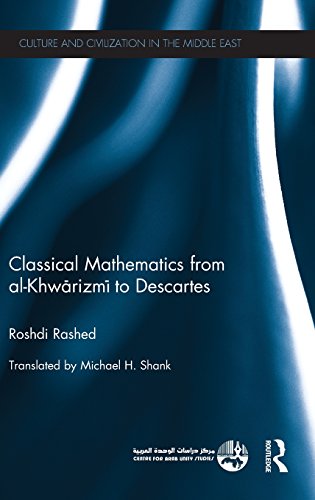
Classical Mathematics from Al Khwarizmi to Descartes 1st Edition by Roshdi Rashed ISBN 0415833884 9780415833882


Original price was: $50.00.$35.00Current price is: $35.00.
Classical Mathematics from Al Khwarizmi to Descartes 1st Edition by Roshdi Rashed – Ebook PDF Instant Download/Delivery: 0415833884, 9780415833882
Full download Classical Mathematics from Al Khwarizmi to Descartes 1st Edition after payment
Product details:
ISBN 10: 0415833884
ISBN 13: 9780415833882
Author: Roshdi Rashed
Classical Mathematics from Al Khwarizmi to Descartes 1st Table of contents:
1. The history of science: between epistemology and history
2. The transmission of Greek heritage into Arabic
1. Transmission and translation: setting up the problem
1. Towards a new approach
2. Cultural transmission, scientific transmission
3. Scholarly transmission: one myth and several truths
3.1. The rebirth of research
3.2. Institution and profession: the age of the Academies
3.3. An ideal type of translator: Ḥunayn ibn Isḥāq’s journey
3.4. Third phase: from translator-scientist to scientist-translator
2. Translation and research: a dialectic with many forms
1. Coexisting and overtaking: optics and catoptrics
2. Translation and recursive reading: the case of Diophantus
3. Translation as a vehicle of research: the Apollonius project
4. Ancient evidence of the translation-research dialectic: the case of the Almagest
3. Prospective conclusion
3. Reading ancient mathematical texts: the fifth book of Apollonius’s Conics
4. The founding acts and main contours of Arabic mathematics
Part I I. Algebra
1. Algebra and its unifying role
1. The beginning of algebra: al-Khwārizmī
2. Al-Khwārizmī’s successors: geometrical interpretation and development of algebraic calculation
3. The arithmetization of algebra: al-Karajī and his successors
4. The geometrization of algebra: al-Khayyām (1048–1131)
5. The transformation of the theory of algebraic equations: Sharaf al-Dīn al-Ṭūsī
6. The destiny of the theory of equations
2. Algebra and linguistics: the beginnings of combinatorial analysis
1. Linguistics and combinatorics
2. Algebraic calculation and combinatorics
3. Arithmetic research and combinatorics
4. Philosophy and combinatorics
5. A treatise on combinatorial analysis
6. On the history of combinatorial analysis
3. The first classifications of curves
1. Introduction
2. Simple curves and mixed curves
3. Geometrical and mechanical: the characterization of conic sections
4. Geometrical transformation and the classification of curves
5. The intervention of the algebraists: the polynomial equation and the algebraic curve
6. The classification of curves as mechanical and geometrical
7. Developments of the Cartesian classification of algebraic curves
8. Conclusion
Appendix: Simplicius: On the Euclidean definition of the straight line and of curved lines
4. Descartes’s Géométrie and the distinction between geometrical and mechanical curves
1. The geometrical theory of algebraic equations: the completion of al-Khayyām’s program
2. From geometry to algebra: the curves and the equations
5. Descartes’s ovals
6. Descartes and the infinitely small
7. Fermat and algebraic geometry
1. The geometrical loci and the pointwise transformations
2. The equations of geometrical loci
3. Solution of equations by the intersection of two curves
4. The solution of algebraic equations and the study of algebraic curves
II. Arithmetic
1. Euclidean, neo-Pythagorean and Diophantine arithmetics: new methods in number theory
1. Classical number theory
1.1. Euclidean and neo-Pythagorean arithmetic
1.2. Amicable numbers and the discovery of elementary arithmetic functions
1.3. Perfect numbers
1.4. Equivalent numbers
1.5. Polygonal numbers and figurate numbers
1.6. The characterization of prime numbers
2. Indeterminate analysis
2.1. Rational Diophantine analysis
2.2. Integer Diophantine analysis
2.3. Arithmetic methods in number theory
2. Algorithmic methods
1. Numerical equations
1.1. The extraction of roots
1.2. The extraction of roots and the invention of decimal fractions
1.3. Numerical polynomial equations
2. Interpolation methods
3. Thābit ibn Qurra and amicable numbers
4. Fibonacci and Arabic mathematics
5. Fibonacci and the Latin extension of Arabic mathematics
7. Fermat and the modern beginnings of Diophantine analysis
Part II: Geometry
1. The Archimedeans and problems with infinitesimals
1. Calculating infinitesimal areas and volumes
1.1. The Pioneers
1.2. The Heirs
1.3. Later developments
2. The quadrature of lunes
3. Equal perimeters and equal surface areas: a problem of extrema
3.1. Al-Khāzin: the mathematics of the Almagest
3.1.1. Isoperimeters
3.1.2. Equal areas
3.2. Ibn al-Haytham: a new theory
3.2.1. Isoperimeters
3.2.2. Equal surface areas
4. The theory of the solid angle
2. The traditions of the Conics and the beginning of research on projections
1. Cylindrical projections
1.1. Al-Bīrūnī’s testimony and his priority claim
1.2. Al-Ḥasan ibn Mūsā’s study of the ellipse
1.3. Thābit’s treatise on the cylinder
1.4. Ibn al-Samḥ’s study of plane sections of a cylinder and the determination of their areas
1.5. The theory of projections: al-Qūhī and Ibn Sahl
2. Conic projections
2.1. Ptolemy’s Planisphere
2.2. Al-Farghānī’s treatise, al-Kāmil fī ṣan‘at al-asṭurlāb
2.3 Al-Qūhī’s treatise and Ibn Sahl’s commentary on it
2.4. Al-Ṣāghānī’s study of the projection of the sphere
2.5. The construction of the sumūt
3. The continuous drawing of conic curves and the classification of curves
1. Introduction
2. Ibn Sahl: a mechanical device to trace conic sections
3. Al-Qūhī: the perfect compass
4. Al-Sijzī: the improved perfect compass
5. Continuous drawing and classification of curves
4. Thābit ibn Qurra on Euclid’s fifth postulate
1. Introduction
2. Thābit ibn Qurra’s first treatise
3. Thābit ibn Qurra’s second treatise
Part III Application of Mathematics: Astronomy and Optics
1. The celestial kinematics of Ibn al-Haytham
1. Introduction
1.1. The astronomical work of Ibn al-Haytham
1.2. The Configuration of the Motions of the Seven Wandering Stars
2. The structure of The Configuration of the Motions
2.1. Research on the variations
2.2. The planetary theory
2. From the geometry of the gaze to the mathematics of the phenomena of light
Conclusion: The philosophy of mathematics
1. Mathematics as conditions and models of philosophical activity: al-Kindī and Maimonides
2. Mathematics in the philosophical synthesis and the ‘formal’ inflection of the ontology: Ibn Sīnā and Naṣīr al-Dīn al-Ṭūsī
3. From ars inveniendi to ars analytica
People also search for Classical Mathematics from Al Khwarizmi to Descartes 1st:
what did al khwarizmi contribution to math
did al khwarizmi invent algebra
why is al khwarizmi the father of algebra
classical mathematics from al-khwarizmi to descartes pdf
mathematician al khwarizmi
Tags: Roshdi Rashed, Classical Mathematics, Al Khwarizmi