

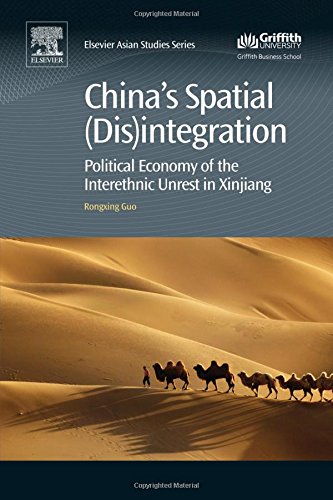
China s Spatial Dis integration Political Economy of the Interethnic Unrest in Xinjiang 1st Edition by Rongxing Guo 0081004036 9780081004036

Original price was: $50.00.$35.00Current price is: $35.00.
China’s Spatial Dis-integration: Political Economy of the Interethnic Unrest in Xinjiang 1st Edition by Rongxing Guo – Ebook PDF Instant Download/Delivery: 0081004036, 9780081004036
Full download China’s Spatial Dis-integration: Political Economy of the Interethnic Unrest in Xinjiang 1st Edition after payment
Product details:
ISBN 10: 0081004036
ISBN 13: 9780081004036
Author: Rongxing Guo
This book is intended to provide the narratives and analytics of China’s spatial (dis)integration. Indeed, the Chinese nation is far too large and spatially complicated and diversified to be misinterpreted. The only feasible approach to analyzing it is, therefore, to divide it into smaller geographical elements through which one can have a better insight into the spatial mechanisms and regional characteristics.
China’s Spatial Dis-integration: Political Economy of the Interethnic Unrest in Xinjiang 1st Table of contents:
1. A brief history of Xinjiang
Xinjiang: New frontier
Rise and fall of Xinjiang
Xinjiang in the People’s Republic of China Era
Annex: Chronology of key events related to Xinjiang
2. Chinese-style development in Xinjiang: Narrative
Quasi-militaristic development zones
Large construction projects
Pairing-aid programs
Inland middle school classes
Unresolved issues
Annex: Major interprovincial events relating to the Pairing-Aid-to-Xinjiang programs
3. Uyghur unrest and Xinjiang: Narrative
Unorganized unrest
Organized unrest
Unrest from dormancy to activation
More unrest and attacks
Further implications
Annex: Timeline of unrest related to Xinjiang
4. Determinants of spatial (dis)integration: A model
Literature review
Analytical framework
Interprovincial variables and data
Statistical estimation
Analytical implications
Annex 4.1. A list of China’s 56 ethnic groups
Annex 4.2. Data on selected interprovincial variables, 2000 and 2010
Annex 4.3. Notes to the regressions
5. Going back to Xinjiang: Analytic narrative
A bird’s-eye view of Xinjiang
Internal economic performance
External economic performance
Probing the Xinjiang problem
Policy implications
Annex 5.1. Regressions for interprovincial export and import, 2000 and 2010
Annex 5.2. Measuring ethnic diversity
6. Spatial efficiency and Xinjiang: Policy options
Administrative divisions in China
Hierarchy, size, and efficiency
Dividing Xinjiang: A proposal
Broader implications
People also search for China’s Spatial Dis-integration: Political Economy of the Interethnic Unrest in Xinjiang 1st:
xinjiang political economy
china ethnic unrest xinjiang
regional inequality china
interethnic conflict china
rongxing guo books
Tags: integration, Political Economy, Interethnic Unrest, Xinjiang, Rongxing Guo