

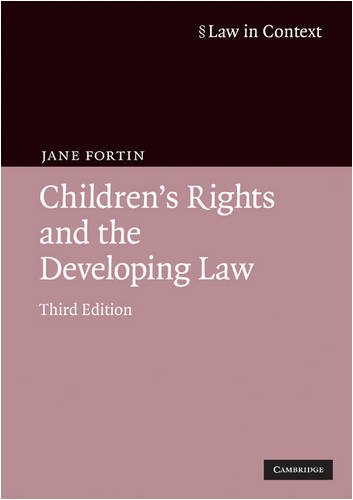
Children s Rights and the Developing Law 3rd Edition by Jane Fortin ISBN 0511651473 9780521698016


Original price was: $50.00.$35.00Current price is: $35.00.
Children s Rights and the Developing Law 3rd Edition by Jane Fortin – Ebook PDF Instant Download/Delivery: 0511651473, 9780521698016
Full download Children s Rights and the Developing Law 3rd Edition after payment
Product details:
ISBN 10: 0511651473
ISBN 13: 9780521698016
Author: Jane Fortin
Children s Rights and the Developing Law 3rd Table of contents:
Part One Theoretical perspectives and international sources
Chapter 1 Theoretical perspectives
(1) Introduction
(2) Rights awareness and rights scepticism
(A) Children’s liberation
(B) Children’s rights and the parental role
(C) The dangers of ‘rights talk’
(3) Do children have any rights and, if so, which ones?
(A) Children as rightsolders
(B) What rights do children have?
(C) International human rights
(D) Children’s rights and the role of paternalism
(i) Children’s ‘autonomy’ and the role of paternalism
(ii) Welfare ‘versus’ rights – restraining paternalism?
(iii) Adolescents and paternalism
(4) Conclusion
Bibliography
Chapter 2 International children’s rights
(1) Introduction
(2) Rights theories and international human rights
(3) The United Nations and the aftermath of the Second World War
(4) The United Nations and children’s rights
(5) The Convention on the Rights of the Child
(A) A broad spectrum of rights
(B) Classifying the Convention rights
(C) Internal inconsistencies
(D) Success or failure?
(E) The reporting mechanism and the United Kingdom
(F) More effective enforcement procedures
(i) Incorporation into domestic law?
(ii) An effective Children’s Commissioner?
(iii) An individual right of petition?
(G) The practical influence of the CRC
(6) The European Convention on Human Rights
(A) The post-ar background
(B) Incorporation of the European Convention on Human Rights into domestic law
(C) The role of the European Court of Human Rights and children’s claims
(D) The European Convention on Human Rights and its interpretation – strengths and weaknesses for
(i) Offsetting the Convention’s narrow focus
(ii) Positive obligations
(iii) Articulating children’s claims?
(a) Differing approaches
(b) State interference
(c) Parental disputes
(d) Children’s own applications
(iv) No ‘welfare or best interests’ formula
(7) The Council of Europe and children’s rights
(8) Conclusion
Bibliography
Part Two Promoting consultation and decision-making
Chapter 3 Adolescent autonomy and parents
(1) Introduction
(2) Child and adolescent developmental capacity for decision-making – the research evidence
(3) Child and adolescent capacity for decision-making – liberalising the law on minority status?
(4) Adolescents and parents – legal boundaries?
(A) Legislative persuasion
(B) Lessons from Gillick
(C) Gillick and the HRA 1998
(5) Adolescents’ right to refuse and parents’ to agree
(6) Conclusion
Bibliography
Chapter 4 Leaving home, rights to support and emancipation
(1) Introduction
(2) Legal age limits
(A) Under 16 – supplementing pocket money?
(B) Over 16 and under 18
(C) Liberalising the law for 16–18-earlds?
(3) Legal rights to leave home
(A) Can parents stop young people leaving?
(B) Can parents force a child or young person to return home?
(i) Under 16s
(ii) Over 16s
(4) Leaving home – state assistance with financial support
(5) Leaving home – assistance with housing
(A) Homelessness provision
(B) Care leavers
(C) Specialised accommodation
(6) Children ‘divorcing’ their parents
(A) The child applicant
(B) Applying for court leave
(C) Effect of a residence order obtained on a child’s application
(7) Children’s right to parental money
(8) Conclusion
Bibliography
Chapter 5 Adolescent decision-making and health care
Introduction
Section A Adolescent decision-making – the general principles
(1) Adolescents’ legal right to consent to medical treatment
(A) Legal competence to consent – adolescents under 16
(B) Legal competence to consent – adolescents over 16
(2) Adolescents’ legal rights to refuse medical treatment
(A) Legal competence to refuse life-aving treatment
(B) Overriding an adolescent’s refusal to be treated
(C) Time for reassessment?
Section B Adolescent decision-making – the difficult cases
(1) The control of fertility
(A) Contraception
(B) Abortion
(C) Confidentiality
(2) Treatment for mentally impaired adolescents
(A) The background
(B) The mental health legislation
(C) Parental authorisation for admission and treatment
(i) Informal admission as a ‘voluntary’ patient
(ii) Treatment
(D) The courts – gaining authority for admission and/or treatment
(i) The inherent jurisdiction – compulsory admission and treatment
(ii) Admission and restraint by secure accommodation orders
Conclusion
Bibliography
Chapter 6 Promoting consultation and decision-making in schools
(1) Introduction
(2) A right to education
(3) School attendance
(A) The merits of compulsory school
(B) Tackling truancy
(i) Criminal sanctions
(ii) Civil remedies
(iii) Non-legal strategies
(4) Pupils and school discipline
(A) Schools’ powers and duties
(i) The background
(ii) Bullying in schools
(iii) Partnership with parents
(iv) Sanctions
(B) Exclusions
(i) The background
(ii) Prevention
(iii) Grounds for permanent exclusion
(iv) Procedural fairness in permanent exclusion
(v) The appeal decision
(vi) The impact of exclusion
(5) School administration
(6) Sex education in schools
(7) Conclusion
Bibliography
Chapter 7 Children’s involvement in family proceedings – rights to representation
(1) Introduction
(2) The requirements of international instruments
(3) Children whose parents split up
(A) The right to consultation
(B) Support for children on separation and divorce
(i) Parental support?
(ii) Mediation
(iii) Support from Cafcass?
(4) Children’s involvement in family proceedings
(A) The background
(B) Private law proceedings
(i) An arbitrary system
(ii) ‘In court-conciliated children’
(iii) Identifying domestic violence?
(iv) The welfare reporting process
(v) Separate representation
(a) The procedural context
(b) No automatic separate representation
(c) Separate representation for some?
(d) Separate representation in international abduction cases?
(vi) Children instructing their own solicitors under rule 9.2A of the Family Proceedings Rules 1991
(a) The background
(b) Competence of children to instruct their own solicitors
(vii) Is private law litigation bad for children?
(C) Public law proceedings
(i) ‘The tandem system of representation’
(ii) Children’s involvement in public law proceedings
(iii) Children instructing their own solicitors in public law proceedings
(a) Competence to instruct a solicitor
(b) The child’s ‘right’ to instruct a solicitor
(c) A good quality system of representation?
(D) Children seeing the judge in private
(5) Conclusion
Bibliography
Chapter 8 Children in court – their welfare, wishes and feelings
(1) Introduction
(2) The welfare principle – a reassessment
(3) The interplay between welfare, wishes and feelings and age
(A) Introduction
(B) Age and its interrelationship with context and risk
(4) A child’s views – some problem areas
(A) Abducted children
(B) Children’s hostility to the non-esident parent
(i) Fear of domestic violence
(ii) Indoctrinated children
(C) Abused children
(5) Conclusion
Bibliography
Part Three Children’s rights and parents’ powers
Chapter 9 Children’s rights versus family privacy – physical punishment and financial support
(1) Introduction
(2) Family privacy and the role of the law
(3) The child’s right to care and control, the parents’ right to discipline the child
(A) Introduction
(B) The current law
(C) Physical punishment – the historical background
(D) Pressure for further reform
(4) Parental duty to support the child
(A) The state’s role of non-intervention
(i) Parents’ primary role
(ii) The battle against child poverty
(iii) ‘Working for children’?
(B) The private maintenance obligation and the role of the state
(i) Privatising child support – the state’s withdrawal
(ii) The child support debacle – round 1
(iii) The child support debacle – round 2
(iv) Children’s rights in reverse – round 3
(C) The private maintenance obligation and the role of the courts
(5) Conclusion
Bibliography
Chapter 10 Parents’ decisions and children’s health rights
(1) Introduction
(2) General principles
(A) Children’s healthcare
(B) Principles of common law
(C) A rightsased approach?
(D) Legal competence to consent and the right to be consulted
(3) A child’s right to life: withholding or withdrawing treatment from desperately ill children
(A) The doctor/parent balance
(B) Treatment for newborn babies
(C) Treatment for infants
(D) Best interests determination
(E) Can parents deny children the right to life?
(i) Attitudes to disability
(ii) A child’s right to life and parents’ objections to life-aving treatment
(4) Caring for a child’s health
(A) Decisions about general healthcare
(B) Organ and tissue donation
(C) Parents’ culture and children’s bodies
(D) Sterilising mentally impaired adolescents
(i) The dilemmas
(ii) The human rights context
(iii) Parents, sterilisations and the common law
(iv) Sterilisations, best interests and the courts
(5) Conclusion
Bibliography
Chapter 11 Educational rights for children in minority groups
(1) Introduction
(2) Separate education – a rights perspective
(A) The international human rights context
(B) Parents’ rights and children’s rights
(C) School uniforms and pupils’ rights
(3) State supervision of separate schools
(4) Collective worship and religious education
(5) Conclusion
Bibliography
Chapter 12 Educational rights for children with disabilities
(1) Introduction
(2) A rights perspective
(3) The impact of disability
(4) Equal access to education free from discrimination
(A) A ‘new’ approach
(B) Difficulties of interpretation – ‘statemented’ and ‘non-tatemented’
(C) The overlap between SEN and disability discrimination protection
(5) Provision of timely and appropriate education
(A) A lack of inter-agency collaboration
(B) Legal accountability
(6) Disabled children and their right to inclusion within mainstream schools
(7) The disabled child’s right to individuality and educational independence
(8) Conclusion
Bibliography
Chapter 13 Children’s right to know their parents – the significance of the blood tie
(1) Introduction
(2) A child’s right to knowledge of origins
(A) Background
(B) International human rights law
(C) The state’s response
(D) The courts’ response
(3) Unmarried fathers – and ‘mothers’
(A) Unmarried fathers
(B) Same-sex parents
(4) Identity and names
(5) Parental contact disputes
(A) A child’s ‘right’ to contact
(i) ‘Rights talk’
(ii) Equal parenting presumption and joint residence orders
(iii) The contact ‘presumption’
(iv) Research evidence on benefits of contact
(v) Enforcement of contact
(B) The exceptional cases
(i) Domestic violence
(ii) Child sexual abuse
(C) The blood tie – promoting or creating attachments through contact?
(6) Conclusion
Bibliography
Chapter 14 Children’s right to know and be brought up by their parents
(1) Introduction
(2) Disputes between birth parents and private foster carers
(A) Differences in approach
(B) No presumption favouring the birth parents
(C) The child’s ‘prima facie right’ to an upbringing by birth parents
(D) The ‘other things being equal’ formula
(E) Convention rights
(F) Private foster carers and ‘social engineering’
(3) The blood tie, birth parents and adoption placements
(A) Introduction
(B) The adoption law context
(i) Adoption law reform
(ii) The child protection context
(C) Vacillating mothers
(D) Unmarried fathers
(E) Children adopted from care
(4) Conclusion
Bibliography
Chapter 15 An abused child’s right to state protection
(1) Introduction
(2) Uncertainty over the state’s role
(3) The rights dimension
(4) The child protection process – what criteria should be used?
(5) Structural reorganisation
(A) Agency integration
(B) Information sharing
(C) Practice issues
(6) The initial referral – child protection or family support?
(A) Family support for children in need
(B) The section 47 enquiry
(C) Section 17 and section 47 – getting the balance right
(7) Emergency intervention
(A) Emergency protection orders
(B) Police protection
(8) Proof of significant harm – children’s rights or justice for parents?
(A) The underlying issues
(B) The standard of proof
(i) The interrelated questions
(ii) Establishing significant harm has occurred in the past
(iii) Establishing the likelihood of significant harm in the future
(iv) Getting the balance right
(9) The child’s own perspectives
(10) Conclusion
Bibliography
Chapter 16 Right to protection in state care and to state accountability
(1) The corporate parent
(2) The courts and local authority planning for looked after children
(A) The background
(B) Accommodated children
(C) Children removed into care
(D) Care planning for permanence – is adoption the only answer?
(E) Care proceedings – at home or away?
(3) Protecting children in residential care
(A) The risk of abuse
(B) The problems linked with ‘control’
(C) Control through secure accommodation orders
(4) The child’s own perspectives
(A) Consulting children
(B) Making complaints
(C) Leaving care
(5) State accountability to children?
(A) The background
(B) Children suing local authorities
(C) Calling local authorities to account for failing to implement care plans
(6) Conclusion
Bibliography
Chapter 17 The right of abused children to protection by the criminal law
(1) Introduction
(2) Background
(3) Joint interviewing and the search for evidence in the investigative stages
(4) The decision to prosecute
(5) Compellability of child witnesses in criminal trials
(6) Protecting child witnesses in criminal trials
(7) Outcomes for children if the abuser is convicted
(8) Conclusion
Bibliography
Chapter 18 Protecting the rights of young offenders
(1) Introduction
(2) Children’s rights versus society’s right to protection
(3) The age of criminal responsibility
(A) The international context
(B) A source of controversy
(C) Abolishing the doli incapax presumption
(D) Reappraising the age of criminal responsibility
(E) Alternative approaches
(4) Using the civil law to criminalise anti-social behaviour – children and parents
(A) Child Safety Orders
(B) Anti-Social Behaviour Orders
(C) Acceptable Behaviour Contracts – a better alternative?
(D) Curfews and group dispersal powers
(E) Children’s anti-social behaviour – parental net-widening
(5) Diversion from court
(6) Separate courts and separate practice
(7) Separate dispositions
(A) Underlying concepts
(B) Incarcerating children
(i) International criticism
(ii) The courts
(iii) The impact of imprisonment
(C) Alternative approaches
(8) Conclusion
Bibliography
Chapter 19 Conclusion – themes and the way ahead
(1) Introduction
(2) The parental factor
(3) The ‘fragmented’ child
(4) The concept of ‘social exclusion’ and negative perceptions of ‘youth’
(5) A rights-based remedy
(6) Postscript
People also search for Children s Rights and the Developing Law 3rd:
fortin’s children’s rights and the developing law
laws about children’s rights
3 examples of children’s rights
children’s rights lawyer
children’s rights to their own body
Tags: Jane Fortin, Children s Rights, Developing Law