

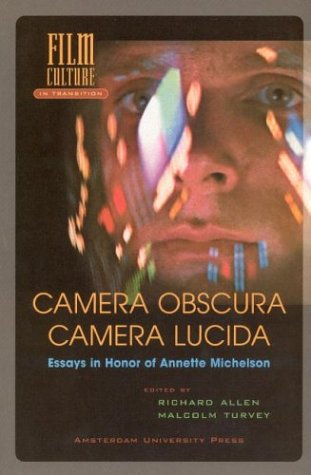
Camera Obscura Camera Lucida Essays in Honor of Annette Michelson 1st Edition by Richard Allen ,Malcolm Turvey ISBN 9053564942 978-9053564943

Original price was: $50.00.$35.00Current price is: $35.00.
Camera Obscura Camera Lucida Essays in Honor of Annette Michelson 1st Edition by Richard Allen ,Malcolm Turvey – Ebook PDF Instant Download/Delivery:9053564942 978-9053564943
Full download Camera Obscura Camera Lucida Essays in Honor of Annette Michelson 1st Edition after payment
Product details:
ISBN 10:9053564942
ISBN 13:978-9053564943
Author:Richard Allen ,Malcolm Turvey
Annette Michelson’s contributions to art and film criticism over the last three decades have been unparalleled. This volume honors her unique legacy with original essays by some of the many scholars who have been influenced by her work. Some continue her efforts to develop theoretical frameworks for understanding modernist art, while others practice her form of interdisciplinary criticism in relation to avant-garde and modernist art works and artists. Still others investigate and evaluate Michelson’s work itself. All in some way pay homage to her extraordinary contribution.
Table of contents:
-
lson, in her multiple roles as critic, editor, translator, and teacher has made a unique contribution to the study of artistic modernism. Her thinking and taste have exerted an enormous influence – both direct and indirect – over several generations of scholars (and in some cases practitioners)¹ of advanced film and art. This volume of essays, written by former students, by colleagues and friends, is intended to honor and build on her singular legacy. For, as I shall argue in this introduction, not only has her work greatly influenced the way modernism in both its elite and popular forms…
OPEN ACCESSIn his influential bookTechniques of the Observer, Jonathan Crary traces the intellectual history of vision, visual technologies, and the interest in illusion. He starts with thecamera obscura. In his analysis of this device, Crary closely follows Richard Rorty, who in his bookPhilosophy and the Mirror of Nature, describes the Cartesian intellect as acamera obscura– an empty, dark space in which images are projected onto a screen:
In the Cartesian model, the intellectinspectsentities modeled on retinal images … In Descartes’ conception – the one which became the basis for modern epistemology – it is…
-
The transformation of the theological notion of demonic possession into scientific concepts of hysteria and psychosis is contemporaneous with the epistemological shifts of early modernism. The emblematic, and historically original, case occurred in Morzine between the years 1857 and 1873, when nearly half of the women (as well as several men) of this Savoyard town succumbed to an epidemic of what they took to be demonic possession, manifesting most of its traditional symptoms: screams, curses, spasms, contortions, convulsions, clairvoyance, superhuman agility, speaking in tongues, blasphemy, and prophesy.¹ Morzine was in the grips of a historical crisis caused by a radical…
-
As we enter the twenty-first century, one of our tasks in recovering the history of cinema in the previous century (and its brief, but crucial, nineteenth century prologue) must be to recover the utopian penumbra cast by cinema’s advent. Like the range of new media appearing today, the emergence and transformation of cinema that took place in its first two decades not only introduced new technologies and modes of representation, but also inspired people to think broadly about the way the invention of motion pictures interacted with new ways of conceiving the world and new ways of making art. Roman…
-
Sometime during late June 1923, in a hotel in Catania, Sicily, the 26-year-old French filmmaker and film theorist Jean Epstein rang for the elevator to the lobby seven floors below. He had come to Sicily to shoot Mt. Etna’s eruption for his fifth film, the documentary La Montagne Infidèle, now unfortunately lost.¹ The plaintive cries of the night concierge trapped between floors in the elevator cabin gave notice that he would need to use the stairs, and Epstein began to walk down a spiral staircase lined with mirrors, what the French call amiroir à vis. He would later recount…
Few episodes in cinema history appear more secure than the genre of the city symphony that emerged in the 1920s and whose best-known examples remain Berlin: Symphony of a Great City (Walther Ruttmann, 1927) and Man with a Movie Camera (Dziga Vertov, 1929). Encompassing around twenty titles, city symphonies rely heavily upon montage to represent a cross-section of life in the modern metropolis.¹ They typically are set in one or more identifiable metropoles whose population, central thoroughfares, and places of residence, employment, and leisure they depict over the course of a day, a temporal structure that has inflected films noir…
-
In an early essay, co-authored with Sergei Yutkevich, Sergei Eisenstein celebrates film as the eighth art.¹ Eisenstein and Yutkevich imagine a gathering of the seven classical muses at a sort of board meeting, when suddenly Charlie Chaplin, representing cinema, bursts in and confidently takes a seat on the ‘Council of Muses.’ This, of course, is an allegory signaling the advent of a powerful new medium, and it expresses a common wish of silent filmmakers and theorists alike: that cinema be accorded the status of art. For it would only be through its recognition as an artform, they thought, that film…
-
‘Experimental film,’ ‘Pure Film,’ ‘Underground film,’ ‘Co-op film,’ ‘Avantgarde film,’ ‘Counter-cinema’… How distant all these terms seem from the vantage point of today – how dated, how nostalgic, how difficult to explain. I am afraid that, to make sense of them, I shall have to be shamelessly autobiographical, to go back over forty years or more in order to puzzle out the complex and confusing ways in which the theory and practice of avant-garde cinema developed and changed. ‘Memory Lane’ is always a treacherous path to follow, but it would be pointless to pretend that I was somehow an outsider…
-
Suspense is a paradigmatic instance of the manner in which a spectator’s emotional responses to narrative can be manipulated, and Hitchcock’s skill as a film director has long been identified with his mastery of suspense. Narrative suspense develops out of a basic and pervasive feature of storytelling – the manner in which stories sustain our interest by encouraging us to anticipate what happens next. However, narrative suspense is more than simply a question of anticipating what happens next; it involves the generation of a state of anxious uncertainty about what happens next. How is this anxious uncertainty engendered? Noël Carroll…
On April 25th of 1939 – designated also as the year XVII, the seventeenth year of the Italian Fascist regime – Michelangelo Antonioni, film critic, publishes in the magazineCinemaan article accompanied by photographic illustrations: ‘For a Film on the River Po.’¹ Though he had previously written for the localCorriere Padanopublished in his native Ferrara, Antonioni’s article in the prestigious Roman film magazine with national circulation can be seen to constitute a first statement of intentions regarding filmmaking. While it has lent itself to association with early writings on Neorealism, the article binds its regionalist-documentary pretext with…
-
Critics most frequently approach Stanley Kubrick’s Dr. Strangelove or: How I Learned to StopWorrying and Love the Bomb (1964) as a comic satire about the conditions and potential consequences of the continuously escalating nuclear arms race between the United States and the USSR within the ColdWar political assumptions of the early 1960s. Such approaches to the film emphasize its ironic and comically hyperbolic representations of military personnel, politicians, and technocrats as well as the Cold War nuclear age mindset that threatens to trigger a nuclear holocaust. Kubrick’s famous explanation of the film’s comic mode – that while attempting a straightforward…
-
Agarment, discarded.Atexture that holds a text. As part of an aesthetic collection that speaks of its wearer’s taste, the discarded garment enacts recollection, recalling for us the person who inhabited its surface – the lively body that ‘animated’ it in motion. A familiar scenario for the artist Christian Boltanski, the material of the discarded garment embodies a projection: the textile surface acts as a screen. The filmic screen is also fiber, a material weave that absorbs and reflects. Such is the screen – the fabric – upon which the stories of history are inscribed.
It is from this narrative of…
-
Time has long passed since you could think there was a choice to be made between digital and analog, between pixel and silver-based. Of course you can still shoot in black and white film, but in the mind of almost everyone, film is now color, and it is digital. The image is now a bitmap made of pixels, and the grains of the silver image of the past can be added on with a simple aftereffect algorithm. Even when generated first by a film camera and not by a digital camera, and viewed principally in the form of a film..
People also search for:
camera obscura camera lucida essays in honor of annette michelson
what is the difference between camera obscura and camera lucida
how camera lucida works
how to build a camera obscura
camera obscura camera lucida essays in honor of annette michelson
Tags:
Richard Allen,Malcolm Turvey,Camera,Obscura,Camera