

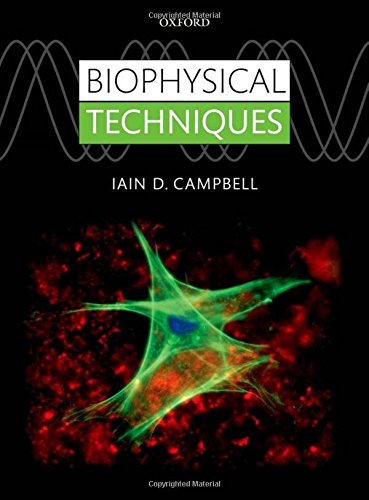
Biophysical techniques 1st Edition by Iain D Campbell ISBN 0199642141 9780199642144

Original price was: $50.00.$35.00Current price is: $35.00.
Biophysical techniques 1st Edition by Iain D Campbell – Ebook PDF Instant Download/Delivery: 0199642141, 9780199642144
Full download Biophysical techniques 1st Edition after payment
Product details:
ISBN 10: 0199642141
ISBN 13: 9780199642144
Author: Iain D Campbell
Biophysical techniques 1st Table of contents:
1. Introduction
-
What are “biophysical techniques”?
-
What questions can biophysical techniques answer?
-
Which technique to use?
-
Organization of this book
2. Molecular Principles
-
2.1 Molecules and interactions
-
Introduction
-
Box 2.1: Atoms and elements
-
Box 2.2: Kinetic model of gases
-
Non-covalent interactions
-
Box 2.3: Electrostatics, dielectrics, and polarity
-
Box 2.4: Molecular biology tools and base pairing
-
Binding
-
3. Transport and Heat
-
3.1 Diffusion, osmosis, viscosity, and friction
-
Introduction
-
Diffusion
-
Osmosis
-
Application of a force to a molecule in solution
-
Viscosity
-
Box 3.1: The frictional coefficient, f, depends on molecular shape
-
-
3.2 Analytical centrifugation
-
Introduction
-
Some basic principles of sedimentation
-
Sedimentation velocity
-
Sedimentation equilibrium
-
Density gradient sedimentation
-
-
3.3 Chromatography
-
Introduction
-
Theory
-
Chromatography techniques
-
Quantitative chromatography
-
-
3.4 Electrophoresis
-
Introduction
-
Theory
-
Experimental
-
Some electrophoresis systems
-
-
3.5 Mass spectrometry
-
Introduction
-
Ionization
-
Ion sorting/analysis
-
Applications of mass spectrometry
-
-
3.6 Electrophysiology
-
Introduction
-
Membrane potential
-
Action potentials
-
Experimental
-
Propagation of an action potential in a neuron
-
-
3.7 Calorimetry
-
Introduction
-
Isothermal titration calorimetry
-
Differential scanning calorimetry
-
Box 3.2: Heat capacity
-
4. Scattering, Refraction, and Diffraction
-
4.1 Scattering of radiation
-
Introduction
-
Scattering theory
-
Box 4.1: Weight average molecular weight
-
Turbidity
-
Solution scattering and molecular shape
-
Box 4.2: Radii of gyration, RGR_GRG, and hydration, RHR_HRH
-
Dynamic light scattering
-
Box 4.3: Correlation functions
-
-
4.2 Refraction, evanescent waves, and plasmons
-
Introduction
-
Box 4.4: Classical optics
-
Evanescent waves
-
Surface plasmon resonance
-
Box 4.5: The streptavidin/biotin complex
-
-
4.3 Diffraction
-
Introduction
-
Principles of diffraction
-
Box 4.6: Single particle imaging with X-ray laser
-
Diffraction experiments
-
Interpretation of diffraction data
-
Other crystallography techniques
-
Achievements of crystallography
-
5. Electronic and Vibrational Spectroscopy
-
5.1 Introduction to absorption and emission spectra
-
Introduction
-
Energy states
-
Absorption
-
Box 5.1: Transition dipole moments and transition probability
-
Emission
-
Box 5.2: The laser
-
-
5.2 Infrared and Raman spectroscopy
-
Introduction
-
IR spectra and applications
-
Raman scattering
-
Applications of Raman spectroscopy
-
-
5.3 Ultraviolet/visible spectroscopy
-
Introduction
-
Measurement of electronic spectra
-
Electronic energy levels and transitions
-
Absorption properties of some key chromophores
-
Applications of UV/visible spectra
-
Box 5.3: Isosbestic points
-
Properties associated with the direction of the transition dipole moment
-
Monitoring rapid reactions
-
-
5.4 Optical activity
-
Introduction
-
The phenomenon
-
Measurement
-
Applications of CD spectra
-
-
5.5 Fluorescence
-
Introduction
-
Physical basis of fluorescence
-
Measurement
-
Fluorophores
-
Environmental effects on fluorescence
-
Fluorescence anisotropy
-
Förster resonance energy transfer (FRET)
-
Exploitation of fluorescence sensitivity
-
Box 5.4: Immunofluorescence
-
Box 5.5: Fluorescence in situ hybridization (FISH)
-
Phosphorescence
-
-
5.6 X-ray spectroscopy
-
Introduction
-
Theory
-
Measurement
-
Edge spectra
-
EXAFS
-
Analytical uses of X-ray emission
-
6. Magnetic Resonance
-
6.1 Nuclear magnetic resonance
-
Introduction
-
Box 6.1: Magnetism
-
The NMR phenomenon
-
Measurement
-
The spectral parameters in NMR
-
Applications of NMR
-
Other NMR applications
-
-
6.2 Electron paramagnetic resonance
-
Introduction
-
Measurement
-
Spectral parameters
-
Box 6.2: Spin labels
-
Spectral anisotropy
-
Applications of EPR
-
7. Microscopy and Single Molecule Studies
-
7.1 Microscopy
-
Introduction
-
Factors that influence resolution
-
Box 7.1: Diffraction at a slit
-
The optical microscope
-
The fluorescence microscope
-
Electron microscopy
-
Box 7.2: X-ray tomography
-
Box 7.3: The contrast transfer function (CTF)
-
The scanning electron microscope
-
Scanning probe microscopy
-
-
7.2 Manipulation and observation of single molecules
-
Introduction
-
Manipulation by force
-
Fluorescence methods
-
8. Computational Biology
-
8.1 Computational biology
-
Introduction
-
Mathematical modeling of systems
-
Bioinformatics
-
Molecular modeling
-
Box 8.1: Force and potential energy
-
9. Tutorials
-
1. Biological molecules
-
2. Thermodynamics
-
3. Motion and energy of particles in different force fields
-
4. Electrical circuits
-
5. Mathematical representation of waves
-
6. Fourier series, Fourier transforms, and convolution
-
7. Oscillators and simple harmonic motion
-
8. Electromagnetic radiation
-
9. Quantum theory and the Schrödinger wave equation
-
10. Atomic and molecular orbitals, their energy states, and transitions
-
11. Dipoles, dipole–dipole interactions, and spectral effects
People also search for Biophysical techniques 1st:
list of biophysical techniques
advanced biophysical techniques in biosciences
advanced biophysical techniques for polysaccharides characterization
pathfinder biophysical techniques
campbell biophysical techniques