

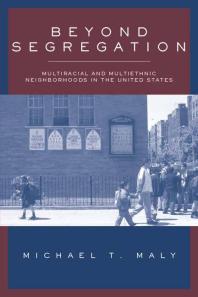
Beyond Segregation Multiracial and Multiethnic Neighborhoods 1st Edition by Michael Maly ISBN 1592131352 978-1592131358

Original price was: $50.00.$35.00Current price is: $35.00.
Beyond Segregation Multiracial and Multiethnic Neighborhoods 1st Edition by Michael Maly – Ebook PDF Instant Download/Delivery:1592131352 ,978-1592131358
Full download Beyond Segregation Multiracial and Multiethnic Neighborhoods 1st Edition after payment
Product details:
ISBN 10:1592131352
ISBN 13:978-1592131358
Author:Michael Maly
At a time when cities appear to be fragmenting mosaics of ethnic enclaves, it is reassuring to know there are still stable multicultural neighborhoods. Beyond Segregation offers a tour of some of America’s best known multiethnic neighborhoods: Uptown in Chicago, Jackson Heights (Queens), and San Antonio-Fruitvale in Oakland. Readers will learn the history of the neighborhoods and develop an understanding of the people that reside in them, the reasons they stay, and the work it takes to maintain each neighborhood as an affordable, integrated place to live.
Table of contents:
-
As I began this research, ten years ago, a chorus of scholarly and political voices proclaimed the inevitable decline of the city. The cries rang out about the plethora of problems that threatened urban centers. Claims of cities in the midst of crisis and collapse have continued. The consensus, at least among some scholars, is that older cities, beset by a myriad of social problems, have lost their luster and no longer serve their function as areas of entry for newcomers who seek economic opportunity. Indeed, while there is substantial evidence that the death knell has not rung for cities,…
-
“Segregation then, segregation tomorrow, and segregation forever,” shouted George Wallace on a chilly Inauguration Day in 1963 in Montgomery, Alabama. While Wallace’s insistent cry was a broad rejection of integration in general, he may as well have been talking about how Americans organize residential space. Even after the Fair Housing Act of 1968, U.S. urban areas remain tremendously segregated. This should come as no surprise; a look around any metropolitan area in the United States reveals the familiar pattern—a sizable number of blacks concentrated in central cities (usually impoverished) and whites living in the suburbs or, as George Clinton…
In 1968, the National Advisory Commission on Civil Disorders, headed by Illinois Governor Otto Kerner, studied the race riots that had scorched U.S. cities the previous summer and reached a powerful conclusion. “Our nation is moving toward two societies, one black, one white—separate and unequal” (National Advisory Commission on Civil Disorders 1968). Segregation by race had persisted and intensified in urban residential areas over the decade. The Kerner Commission’s report succinctly summarized what scholars had known for some time: racial segregation was extensive in U.S. urban areas and it was maintained by white racism. Pro-integrative leaders and groups had…
In 1992, I moved to the Wicker Park—East Village neighborhood, a rapidly gentrifying neighborhood that was once largely Puerto Rican and Latino.¹ I found a small two-bedroom for four hundred dollars a month and lived there alone till August 1997. Around this time, I switched jobs and returned to school full time. As rents increased and my income decreased, I was quickly priced out of the area and had to look elsewhere. I found a roommate and went in search of a two-bedroom apartment that was close to seven hundred dollars per month and not too far north and…
-
Prior to moving to Jackson Heights I lived in various NY neighborhoods.¹ I lived in Brooklyn’s Park Slope from 1980 to ’82, then the Upper West Side (103rd Street and West End Avenue) from 1982 to ’84, and finally Riverside Drive from 1984 to ’86. During most of this time, I worked during the day and went to graduate school at night. I and most people I knew were forced to live in “emerging” or gentrifying neighborhoods. These neighborhoods were in beautiful old sections that had fallen out of favor and into disarray/disrepair in the 1960s and 1970s. These neighborhoods…
I was familiar with Fruitvale long before moving there.¹ It was where the Latino community lived. I had been to Fruitvale several times in my youth. I am from Los Angeles and was involved in the Free Angela Davis campaign, so we came up to Oakland because Angela lived there. The Latinos and African Americans involved in her campaign would meet in her Fruitvale house. I just loved it there.
In the 1980s I was working in Sacramento for a health-planning organization when the Reagan administration blue-penciled health planning off the national map. At the time, a doctor friend accepted…
Discerning residential settlement patterns by race is not an easy process. Research and news accounts on race and housing tend to focus on the problem of segregation and the failure of integration. This focus has been seen as legitimate, given that thirty-five years after the passage of Title VIII of the 1968 Civil Rights Act it is difficult to say that at the residential level we have moved to a more integrated society. Although levels of segregation have declined and racial change has become more complex, there does not seem to be a widespread movement to create integrated living patterns…
People also search for:
multiracial background
beyond segregation multiracial and multiethnic neighborhoods
biracial and multiracial identity development
multiracial/multiethnic
multiracial neighborhood
Tags:
Michael Maly,Beyond,Multiethnic