

Sale!
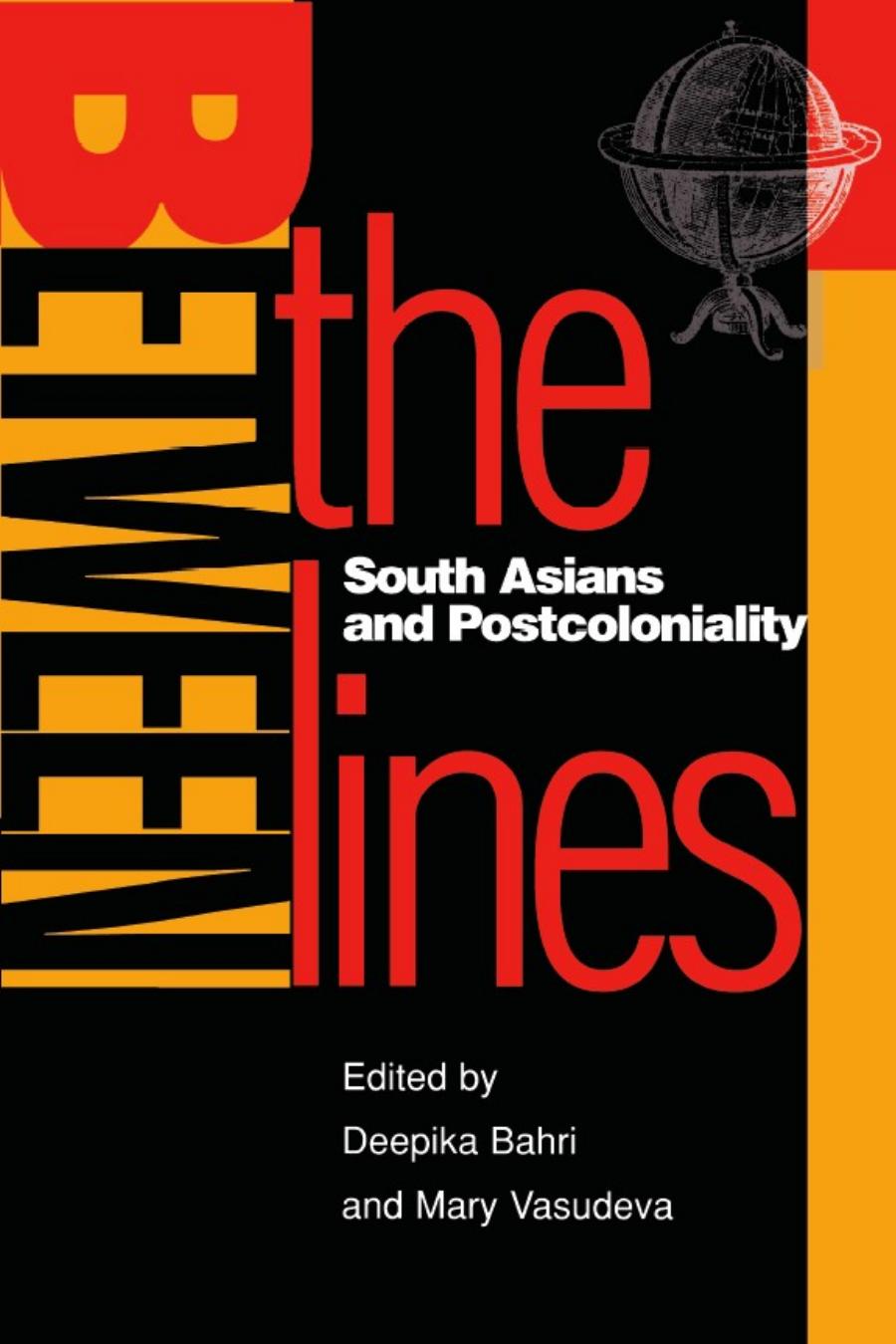
Between the Lines South Asians and Postcoloniality Asian American History & Cultu 1st Edition by Deepika Bahri ISBN 1566394686 978-1566394680


Original price was: $50.00.$35.00Current price is: $35.00.
Between the Lines 1st Edition Deepika Bahri Digital Instant Download
ISBN(s): 9781439901083, 1439901082
Edition: 1
File Details: PDF, 27.71 MB
Year: 2009
Language: english
Between the Lines South Asians and Postcoloniality Asian American History & Cultu 1st Edition by Deepika Bahri – Ebook PDF Instant Download/Delivery:1566394686 ,978-1566394680
Full download Between the Lines South Asians and Postcoloniality Asian American History & Cultu 1st Edition after payment
Product details:
ISBN 10:1566394686
ISBN 13:978-1566394680
Author:Deepika Bahri
Features interviews, critical essays, and commentary that explores South Asian identity and culture. By examining the social, economic, and historical particularities of people who live ‘between the lines’ on and between borders, this book reinstates questions of power and privilege, agency and resistance.
Table of contents:
- Introduction
Deepika Bahri and Mary Vasudeva
This volume brings together the voices of South Asians in the Anglo-American academy on the construction and representation of the “postcolonial.”¹ Combining interviews, literary criticism, commentaries, and cultural studies, Between the Lines: South Asians and Postcoloniality suggests the diversity and complexity of what one might designate the “postcolonial” subject. Further, even within the narrower parameters of specifically South Asian postcolonial subjectivities and their representation in the language and framework of the academy, the quest for a stable South Asian identity is a daunting venture; hence, the varied articulations presented here offer an understanding of identity as the product of complex… - Observing Ourselves among Others
Deepika Bahri, Mary Vasudeva, and Meena Alexander
This interview was conducted at Meena Alexander’s home in New York City on 12 November 1993. Settled in front of the picture window in her apartment, we began our discussion over chai (tea) and cookies. We sat on the edge of a covered futon (no American sofa or La-Z-Boy here), surrounded by Wordsworth, Anita Desai, Gunter Grass, works by Alexander herself, and other books too numerous to count. We felt for a moment as if we had stumbled into a library in a home in Delhi, but the view from a window overlooking the Hudson River provided a reminder that… - Pedagogical Alternatives: Issues in Postcolonial Studies
Deepika Bahri, Mary Vasudeva, and Gauri Viswanathan
This interview was conducted in segments, by mail and through telephone conversations in March and May 1994, between Viswanathan’s busy schedule and repeated trips to India. - DB/MV: Given the current proliferation of work done in the name of the “postcolonial,” it seems imperative that we work toward developing a definition. Much of the work done under this label seems to suggest very different notions of what “Postcolonial” Studies should entail. How would you define the term?
GV: “Postcolonial” is a misleading term because it assumes, first of all, a body of knowledge or a specifiable period of time after colonialism…. - Transnationality and Multiculturalist Ideology
Deepika Bahri, Mary Vasudeva, and Gayatri Chakravorty Spivak
This interview took place at Gayatri Chakravorty Spivak’s office at Columbia University on 12 November 1993. We had caught Spivak at an obviously busy time, since she was preparing to leave the country in less than a month. Meanwhile, she had two days to complete her compilation of materials for a course on theorizing women. As we settled into her office, cluttered with the accumulations of a long academic career—including literally hundreds of books, neatly alphabetized—she told us about the enormous amounts of primary material she had gathered for the course and the task of sifting out the… - African Americans and the New Immigrants
Amritjit Singh
People of South Asian origin in the United States number about two million now and may be regarded as an “imagined community” within the broad framework of Benedict Anderson’s definitions. Although American conceptions of “race” play a significant role in how all immigrants of color are perceived (more on this later), their assimilation into American life parallels in many ways what earlier European immigrant groups have undergone. The replication in North America of homeland attitudes and hierarchies or even of subcontinental conflicts is not unique to our ethnic group, nor is the feeling of despair at the fragmented sense of community… - Life at the Margins: In the Thick of Multiplicity
M.G. Vassanji
The condition of the world today brings home to us—those of us who had forgotten—the pervasiveness of smaller ethnic, communal, or sectarian identities and the tenacity with which they survive. We have seen pluralism-based national identities—built on the idea that human equality and fraternity should ultimately override ethnic or other communal differences—disintegrate and these smaller components reasserting themselves, shaking off the old idealism and taking up apparently where they last left off. Neighbors turn against neighbors, communities that once joined forces to fight colonial domination and conquest take up arms against each other to settle scores… - Mullahs, Sex, and Bureaucrats: Pakistan’s Confrontations with the Modern World
Sohail Inayatullah
Pakistan’s attempts to enter modernity on its own terms have been fraught with obstacles and contradictions. Caught between East and West by globalization, undone by leakages through the tenuous membrane of national sovereignty (the rise of ethnic nationalism and sectarianism), and yet vulnerable to the reemergence of Islamic and pre-Islamic myths long forgotten, Pakistan remains both traditional and modern. For Pakistanis there is an obvious dissonance between the claims of the West that civilization means Western civilization and Pakistani claims that Pakistan represents the land of the pure, the home of Muslims, with Islam representing the alternative to amoral capitalism… - Coming to Terms with the “Postcolonial”
Deepika Bahri
Some fifteen years after the term “postcolonial” began to circulate in the Western academy, the question “What is the postcolonial?”—raised by Vijay Mishra and Bob Hodge in 1991—continues to tax the imagination of academicians. Essays interrogating the term, its use and abuse, its pitfalls and diffuseness, abound in journals and conference meetings. Discontent in and about the field has not, however, limited the scholarship in this area. Through an exploration of the term’s history, usage, and definition in light of multiple criticisms and inadequacies, I attempt to evaluate what is lost and what might yet be gained by… - An Explosion of Difference: The Margins of Perception in Sammy and Rosie Get Laid
Ranita Chatterjee
Framed with sound bites from Margaret Thatcher, Stephen Frears and Hanif Kureishi’s second collaborative film, Sammy and Rosie Get Laid (1987, U.K.), firmly situates itself not only in the British but specifically in the London scene of race, class, and sexual politics. While focusing on the infidelities and complexities of the lives of Sammy, an accountant of South Asian descent, and his wife, Rosie, a white social worker, Frears and Kureishi also attempt to portray a landscape of exuberant intermingling between people from different ethnicities, sexualities, and classes. Thus, we see Sammy’s affair with Anna (a white American photojournalist) and… - Emigrants Twice Displaced: Race, Color, and Identity in Mira Nair’s Mississippi Masala
Binita Mehta
The relationship between nonwhite minority groups in the United States today is an issue that requires our immediate attention. To recognize the gravity of the situation, one has only to look at such disputes in Brooklyn as the 1990 black boycott of two Korean grocery stores, and the clashes between the Hasidic and African American communities in the Crown Heights neighborhood. The much-publicized April 1992 riot in South Central Los Angeles following the Rodney King verdict was not simply a black versus white incident but one that involved members of African American, Korean American, and Latino communities. Peter Kwong… - From Ritual Drama to National Prime Time: Mahabharata, India’s Televisual Obsession
Sanjoy Majumder
The Mahabharata has recently been introduced to Western audiences via Peter Brook’s elaborate, international, and multiethnic theatrical production. Between 1987 and 1988 the English-language version, produced by Brook’s International Center of Theatre Research (CIRT), traveled around the world, opening in Zurich and moving on to Los Angeles, New York, Perth, Adelaide, Copenhagen, Glasgow, and Tokyo. Brook attempts to present the epic as a cultural text that is able to stand independent of any one history or social reality, as a universal tale of “all humanity.” This is significant when we examine the Mahabharata as a cultural text, for in his use… - Television, Politics, and the Epic Heroine: Case Study, Sita
Mahasveta Barua
On a Sunday morning in January 1987 Indians all across the nation sat down, or stood around, to participate in yet another telling of the two-millennia-old Ramayana. The epic, the primary text of which has been attributed to the poet Valmiki, has been retold hundreds of times in major and minor regional languages, through folk tales, ritualized readings, pageantry, and even film. The telling referred to here took the Ramayana into yet another genre—the television series. Produced and directed by Ramanand Sagar, a Bombay filmmaker, the serial continued for a year and a half amid devotional frenzy on the… - Replacing the Colonial Gaze: Gender as Strategy in Salman Rushdie’s Fiction
Sukeshi Kamra
The fictional author in Shame, in one of the many metatextual moments in the novel, asserts somewhat disingenuously that his “fairy tale” has escaped his control, that the women have taken over what was, he believed, a story primarily about males:
“I had thought, before I began, that what I had on my hands was an almost excessively masculine tale, a saga of sexual rivalry, ambition, power, patronage, betrayal, death, revenge. But the women seem to have taken over; they marched in from the peripheries of the story to demand the inclusion of their own tragedies, histories and comedies, obliging…” - Style Is (Not) the Woman: Sara Suleri’s Meatless Days
Samir Dayal
In an interview, Gayatri Chakravorty Spivak has replaced an old question about female identity (particularly Third World female identity)—namely “What is woman?”—with another question: “What is man that the itinerary of his desire creates such a text?” In rehabilitating the position of the questioning subject she intends
People also search for:
equation of bisector of acute angle between the lines
christopher martin between the lines
difference between the lines of latitude and longitude
beauty between the lines arthur erickson
all the money is made between the lines
Tags: Deepika Bahri, Between, Postcoloniality