

Sale!
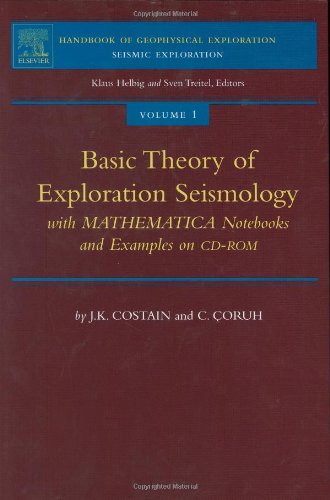
Basic Theory in Reflection Seismology Volume 1 with MATHEMATICA Notebooks and Examples on CD ROM 1st Edition by Costain JK, Coruh C ISBN 0080370195 9780080370194

Original price was: $50.00.$35.00Current price is: $35.00.
Basic Theory in Reflection Seismology Volume 1 with MATHEMATICA Notebooks and Examples on CD ROM 1st Edition Costain J.K. Digital Instant Download
ISBN(s): 9780080370194, 0080370195
Edition: 1st
File Details: PDF, 30.16 MB
Year: 2004
Language: english
Basic Theory in Reflection Seismology Volume 1 with MATHEMATICA Notebooks and Examples on CD ROM 1st Edition by Costain JK, Coruh C – Ebook PDF Instant Download/Delivery: 0080370195, 9780080370194
Full download Basic Theory in Reflection Seismology Volume 1 with MATHEMATICA Notebooks and Examples on CD ROM 1st Edition after payment
Product details:
ISBN 10: 0080370195
ISBN 13: 9780080370194
Author: Costain JK, Coruh C
Basic Theory in Reflection Seismology Volume 1 with MATHEMATICA Notebooks and Examples on CD ROM 1st Table of contents:
- Complex Numbers
- Manipulation of Complex Numbers
- Real and Complex Exponentials and Trigonometric Functions
- Powers and Roots of a Complex Number
- Logarithm of a Complex Number
- Functions of a Complex Variable
- Representation of Signals by Phasors
- Linear Equations
- Fourier Transforms
- Introduction
- Signal Nomenclature
- FT—Continuous Time, Continuous Frequency
- DFS—Continuous Time, Discrete Frequency
- DTFT—Discrete Time, Continuous Frequency
- DFT—Discrete Time, Discrete Frequency
- Subroutine FT
- The Fourier Coefficients
- Sign Convention
- Determination of the Fourier Coefficients
- Fourier Coefficients from Linear Equations
- Numerical Example
- Fourier Coefficients from Orthogonality
- The Average Value of a Function
- Useful Integrals
- The Average Values of Sine and Cosine Functions, and Products of Sine and Cosine Functions over a Pe
- Numerical Example
- Dirichlet Conditions
- Summary
- Examples
- Sign Convention Revisited
- Seismogram from the Atlantic Coastal Plain
- Independence of the Fourier coefficients
- From Fourier Series to Fourier Integrals
- Complex Forms and Fourier Integral
- Computer Implementation of the Fourier Series and Fourier Integral
- Fast Fourier Transform
- Applications of Fourier Transforms
- Time-Shifting Theorem
- Implications
- Phase Spectrum Versus Phase Lag Spectrum
- Time Differentiation of the Fourier Transform
- Time Integration of the Fourier Transform
- Introduction to the Unit-Impulse Function
- The Sinc Function
- Definition of a Llinear System
- Impulse Response
- The Time-Convolution Theorem
- An Application of the Time-Convolution Theorem
- Autocorrelation and Crosscorrelation
- The Frequency-Convolution Theorem
- The Effect of the Analysis Window Revisited
- Hilbert Transforms
- Summary
- Hilbert Transform of a Sinusoid
- Fourier Sign Convention
- Properties of Euler Functions
- The Analytic Signal
- Mathematical Definition of Hilbert Transformation in the Time and Frequency Domains. The “Quadrature
- Hilbert Transform of a Seismic Trace
- Minimum-Phase Spectrum of a Wavelet Determined from its Known Amplitude Spectrum
- Mathematical Derivation of a Hilbert Transform Pair in the Frequency Domain using Continuous Functio
- z-Transform
- Factors of a Finite, Discrete Function
- Phase of Minimum and Maximum Delay Couplets
- Amplitude and Phase of a z-Transform
- Introduction to Filters
- Numerical Example
- Introduction to the Pole-Zero Design of Digital Filters
- A Notch Filter Element
- A Bandpass Filter
- Filters in Parallel
- Example of a Low-Pass Filter—Butterworth
- Computational Considerations
- Effect of Analysis Window on Fourier Spectrum
- Aliasing
- Sampling in the Time Domain – Aliasing in the Frequency Domain
- Example
- How to Determine if Aliasing is Present
- Synthetics and Velocity Functions
- Normal-Incidence Reflection Coefficient
- Example
- Values of Reflection Coefficients
- The Zoeppritz Equations
- Physical Significance of a Complex Reflection Coefficient
- AVO and Zoeppritz Equations in T-X Domain
- Conversion of the Zoeppritz Equations to the Time-Offset Domain
- Synthetic Seismograms
- The Reflectivity Function
- Velocity Functions
- Impulse (Thin Bed)
- Step
- Ramp
- Wavelet Tuning
- Summary of Velocity Functions
- Seismic Trace Attributes
- Traveltime Curves and Velocity
- Snell’s Law
- The Ray Parameter p
- Reflection Traveltime Curves
- Average Velocity
- Traveltime Equations using Lagrangian Multipliers
- The Root-Mean-Square Velocity
- Determination of Interval Velocities using Dix Equation
- Effect of Dip on Reflection Traveltime Curves
- The Normal Moveout Correction
- Refraction Traveltime Curves
- Refractions from a Single Horizontal Interface
- Delay Time
- General Expression for Delay Time
- Two-Layer Model
- General Expression for Multilayer Refraction Traveltime Curves from Horizontal Layers
- Reflection and Refraction Traveltime Curves Combined —Comments
- Effect of Dip on Refraction Traveltime Curves
- The Principle of Reciprocity
- Refraction Traveltime Curves over Various Geologic Models
- Dipping Plane Interfaces
- Linear Increase in Velocity with Depth
- Turning Waves
- Composite Refraction-Reflection Stacks
- Refraction Stack
- Composite Stack Sections
- Seismic Source Wavelets
- Energy Sources
- Dynamite
- Vibroseis
- DinoSeis, Thumper, and others
- Marine
- Mathematical Descriptions of Wavelets
- Ricker Wavelet
- Klauder Wavelet
- Comments
- Wavelet z—Transform Representation
- Physical Requirements for Real Wavelets
- A Simple 2-Point Wavelet
- Generation of Wavelets
- Partial Energy of a Wavelet
- Roots Plotted in the z-Plane
- Root on the Unit Circle
- Wavelet Shaping and Deconvolution
- Inverse Infinite Filters, Finite Input
- Inverse Filtering of a Minimum-Delay 2-Term Wavelet using z-Transforms
- Examples
- Inverse Filtering of a Maximum-Delay 2-Term Wavelet using z-Transforms
- Examples
- Inverse Filtering of a Seismic Trace using z-Transforms
- Inverse Finite Filters, Infinite Input
- Exact Filters for Wave Guides
- z-Transform Notation
- Design of General Inverse Filters using z-Transforms and Partial Fractions
- Inverse Filters and Input each of Finite Length
- General Shaping and Least-Squares Method
- Wavelet Shaping
- Examples
- Figure 6-2 (a) from Robinson and Treitel
- Figure 6-2 (b) from Robinson and Treitel
- Figure 6-2 (c) from Robinson and Treitel
- Figure 6-2 (d) from Robinson and Treitel
- Maximum-Delay Examples
- Shaping Mixed-Delay Wavelets
- Conclusions
- What about Fourier Theory?
- Inverse Filtering of a Vibroseis Wavelet
- Summary
- Predictive Deconvolution
- Design of the Predictive Deconvolution Filter
- Non-Spiking Deconvolution
- What does Predictive Deconvolution do?
- Predictive Deconvolution and Mixed-Delay Wavelets
- Deconvolution of a Seismic Trace
- Removal of Trace Energy After Predictive Deconvolution
- Effect of Design Window on Deconvolution
- Minimum Number of Points in the Design Window for a Non-Reverberation Trace
- What are the Observable Effects of Wavelet Truncation?
- An Alternative to Spiking Deconvolution?
- Thin Beds
- Effect of Noise on Predictive Deconvolution
- Reverberations
- Choosing the Autocorrelation Window for Removal of Reverberations by Predictive Deconvolution
- Long-Period Multiples
- Summary Guidelines for Predictive Deconvolution
- Predictive Deconvolution—Conclusion
- Spectral Whitening
- Stretched Automatic Gain Control
- Discussion
- Further Applications of Hilbert Transforms
- Relationship between the Amplitude and Phase Spectrum of a Causal Function
- Q
- Introduction
- Definitions
- Dispersion
- Comparison of Dispersive Phase Velocity Values of Ecevitoglu and Costain [68] with Futterman [72]
- Absorption
- Normalized Dispersion D
- Comparison of Dispersion D Values with Real Data
- A Time-Domain Method for Determination of Q
People also search for Basic Theory in Reflection Seismology Volume 1 with MATHEMATICA Notebooks and Examples on CD ROM 1st:
basic theory of relativity
reflection seismology pdf
basic theoretical physics pdf
basic science lights the way
reflection seismology
Tags: Costain JK, Coruh C, Reflection Seismology