

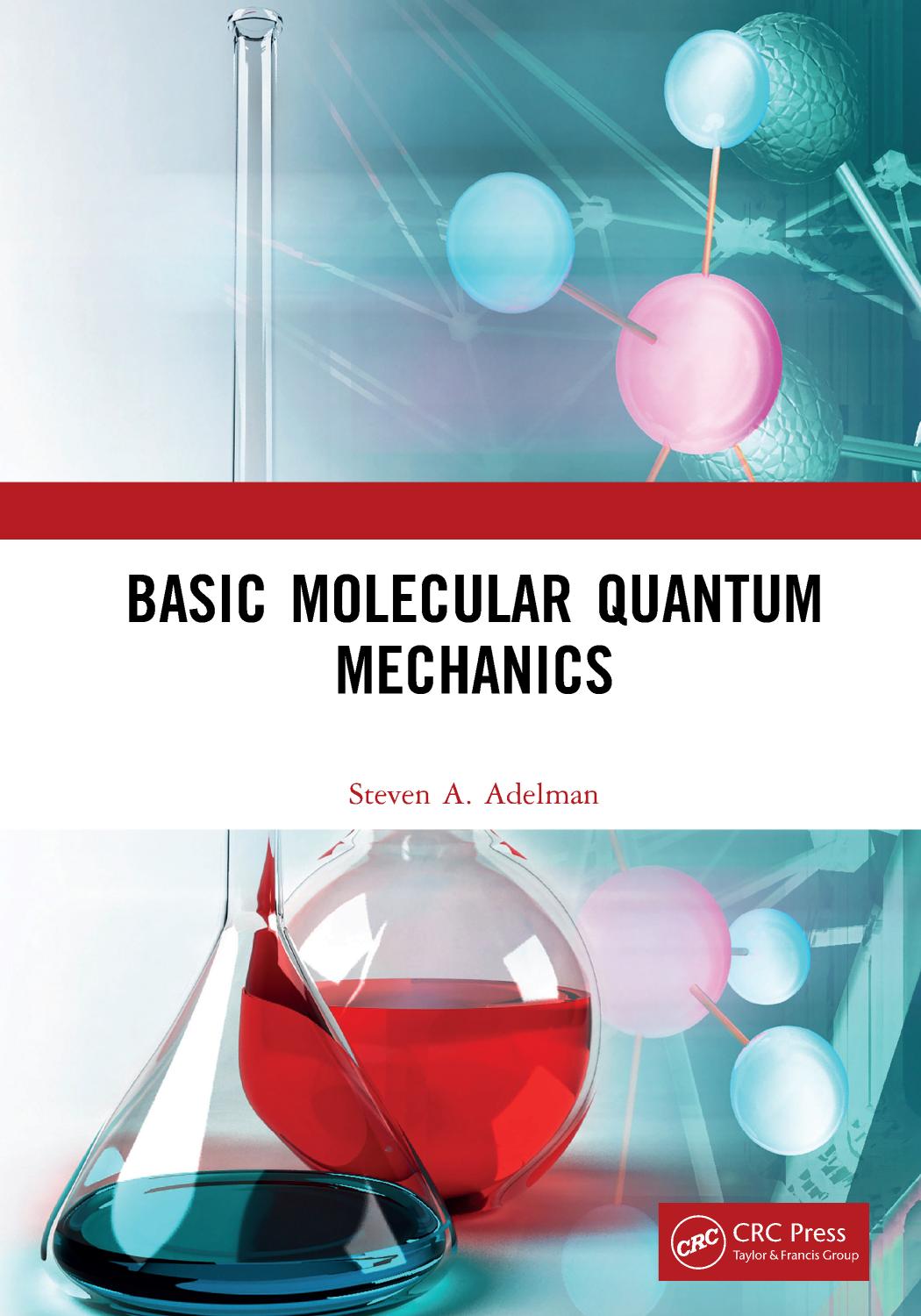
Basic Molecular Quantum Mechanics 1st Edition by Steven A Adelman ISBN 0429155743 9780429155741

Original price was: $50.00.$35.00Current price is: $35.00.
Basic Molecular Quantum Mechanics 1st Edition by Steven A Adelman – Ebook PDF Instant Download/Delivery: 0429155743, 9780429155741
Full download Basic Molecular Quantum Mechanics 1st Edition after payment
Product details:
ISBN 10: 0429155743
ISBN 13: 9780429155741
Author: Steven A Adelman
Basic Molecular Quantum Mechanics 1st Table of contents:
Chapter 1 Toward Quantum Mechanics
1.1 Energy Quanta
1.2 Classical versus Line Spectra
1.3 The Bohr Theory of the Hydrogen-Like Atoms
1.4 From the Bohr Theory to Modern Quantum Mechanics
1.5 A Preview of Modern Quantum Mechanics
Further Readings
Problems
Solutions to Selected Problems
Chapter 2 Mathematics for Quantum Mechanics
2.1 Complex Functions
2.2 Operators
2.3 Operator Eigenvalue Problems
2.4 Orthonormal Sets and the Gram–Schmidt Method
2.5 Hermitian Operators
2.6 Hermitian Eigenvalue Problems
2.7 Complete Orthonormal Expansions
2.8 Wave Motion on a Stretched String: A Prototype Problem for Quantum Mechanics
Further Readings
Problems
Solutions to Selected Problems
Chapter 3 The Schrödinger Equation and the Particle-in-a-Box
3.1 A Heuristic “Derivation” of the Time-Dependent Schrödinger Equation
3.2 Stationary State Wave Functions and the Time-Independent Schrödinger Equation
3.3 The Probability Interpretation of the Wave Function and the Determination of Average Values of Observables
3.4 The Stationary States of the One-Dimensional Particle-in-a-Box System
3.5 Uncertainties and the Heisenberg Uncertainty Relation for the Particle-in-a-Box System
Further Readings
Problems
Solutions to Selected Problems
Chapter 4 Wave Functions and Experimental Outcomes
4.1 The Wave Function and Its Equation of Motion
4.2 The Hermitian Operator Representatives of Observables
4.3 Random Variables and the Born Probability Rule for the Position Observable r
4.4 The Quantum Rules for the Probability Distributions of Arbitrary Observables
4.5 The Special Quantum States for Which an Observable A Has a Definite Value
4.6 The Quantum Formula for the Expected Value of an Arbitrary Observable A
Further Readings
Problems
Solutions to Selected Problems
Chapter 5 Commutation Rules and Uncertainty Relations
5.1 Commuting and Non-Commuting Operators
5.2 Common Eigenfunctions for Compatible Observables and the Lack of Common Eigenfunctions for Incompatible Observables
5.3 Heisenberg Uncertainty Relations for Incompatible Observables
Further Readings
Problems
Solutions to Selected Problems
Chapter 6 Stationary and Non-stationary Quantum States
6.1 Bohr versus Modern Quantum Stationary States
6.2 The Time-Dependent Schrödinger Equation for a Single Particle Moving in Three Dimensions
6.3 Derivation of the Form of Stationary State Waves Functions
6.4 Two Properties of Stationary States
6.5 The Normalization of Non-stationary State Wave Functions and the Dirac δ− Function.
6.6 The Probability Distributions P(A,t) Associated with Ordinary Time-Dependent Classical Observables A(t)
6.7 The Probability Distributions P(A,t) Associated with Classical Observables A(t) Which Are Constants of the Motion
Further Readings
Problems
Solutions to Selected Problems
Chapter 7 The Harmonic Oscillator
7.1 The Time-Independent Schrödinger Equation of the One-Dimensional Harmonic Oscillator
7.2 Particle-in-a-Box versus Harmonic Oscillator Stationary States
7.3 Summary of the Results of the Solution of the Harmonic Oscillator Schrödinger Equation
7.4 The Zero Point Energy
7.5 The Ground State Born Rule Probability Distribution P0(y) and Classically Forbidden Behavior
7.6 The Wave Functions and Born Rule Probability Distributions for the v = 0 − 2 States
7.7 The Born Rule Probability Distribution P12 (y) and the Emergence of Classical Behavior
7.8 Even or Odd Property of Ψv(y) and the Vanishing of Certain Harmonic Oscillator Integrals
7.9 The Gaussian Integrals
7.10 Virial Theorem and Heisenberg Uncertainty Relation for the Harmonic Oscillator
7.11 Additional Relations for the Hermite Polynomials from the Generating Function
7.12 Derivation of the Form of ⟨y2⟩v from the Recursion Relation
7.13 The Harmonic Oscillator Approximation For the Vibrational Motions And IR Spectrum Of A Diatomic Molecule
7.14 Derivation of the Harmonic Oscillator Selection Rules for IR Transitions of Diatomic Molecules
7.15 The Vibrational properties and IR Spectra of Polyatomic Molecules
Further Readings
Problems
Solutions to Selected Problems
Chapter 8 Rigid Rotations and Rotational Angular Momentum
8.1 Overview of the Stationary States of Rotating and Vibrating Diatomic Molecules
8.2 The Rigid Rotor Stationary States and the Rotational Angular Momentum Eigenvalue Problem
8.3 The Rotational Angular Momentum Operators and Their Commutation Rules
8.4 The Commutation Rules and the Simultaneous Eigenvalue Problem for J^2 and J^z
8.5 The Simultaneous Eigenvalue Problem for J^2 and J^z in Spherical Polar Coordinates
8.6 Separation of Variables for the Spherical Harmonics
8.7 Solution of the of ΦM(ϕ) Problem
8.8 Solution of the ΘJM(θ) Problem
8.9 The Legendre Polynomials and the Associated Legendre Functions
8.10 The Spherical Harmonics and the Rigid Rotor Stationary State Wave Functions
8.11 The Rigid Rotor Pure Rotational Spectra of Diatomic Molecules
8.12 Derivation of the Rigid Rotor Selection Rules for Diatomic Pure Rotational Spectra
Further Readings
Problems
Solutions to Selected Problems
Chapter 9 Diatomic Rotational–Vibrational Spectroscopy
9.1 The Vibrational Time-Independent Schrödinger Equation
9.2 The Harmonic Oscillator Rigid Rotor Approximation to the Rotational–Vibrational Energy Levels of a Diatomic Molecule
9.3 The IR Absorption Spectrum of a Diatomic Molecule within the Harmonic Oscillator Rigid Rotor Approximation
9.4 Intensities of the Lines in the IR Absorption Spectrum of a Diatomic Molecule
9.5 Overtone Bands in the IR Spectra of Diatomic Molecules
9.6 Centrifugal Distortion and the Kratzner Equation
9.7 Effects of Centrifugal Distortion on the Pure Rotational Spectrum of a Diatomic Molecule
9.8 The High-Resolution IR Absorption Spectrum of a Diatomic Molecule and the Method of Combinations and Differences
9.9 Evaluation of Bv from Table 9.1
9.10 The Morse Potential
Further Readings
Problems
Solutions to Selected Problems
Chapter 10 The Hydrogen-Like Atoms
10.1 The Radial Schrödinger Equation
10.2 An Overview of the Quantum Theory of Hydrogen-Like Atoms
10.3 The Spectra of Hydrogen-Like Atoms
10.4 The Radial Distribution Functions Pnl(r)
10.5 The Real Forms of the Hydrogen-Like Atom Wave Functions
10.6 Orbital Magnetism and the Zeeman Effect
10.7 Electron Spin
10.8 Spin–Orbit Coupling
Further Readings
Problems
Solutions to Selected Problems
Chapter 11 Approximation Methods
11.1 Perturbation Theory
11.2 Simple Applications of Perturbation Theory
11.3 The Variational Method
11.4 The Linear Variational Method
Further Readings
Problems
Solutions to Selected Problems
Chapter 12 Electrons in Atoms
12.1 Atomic Units
12.2 The Helium-Like Atoms
12.3 The Hartree–Fock Equations for the Helium-Like Atoms
12.4 The Indistinguishability of Electrons and the Pauli Principle
12.5 The Pauli Principle and the 1s2 Ground State and the 1s2s Excited States of Helium
12.6 Slater Determinants
12.7 The Hartree–Fock Equations for Closed Shell Atoms and Koopmans’ Theorem
12.8 The Correlation Energy
12.9 The Determination of Electron Configurations of Atoms and the Periodic Table
12.10 The Electronic States of Atoms and Term Symbols
Further Readings
Problems
Solutions to Selected Problems
Chapter 13 Molecular Electronic Structure and Chemical Bonding
13.1 The Born–Oppenheimer Approximation and the Electronic and Nuclear Schrödinger Equations
13.2 Molecular Orbitals and the Hydrogen Molecular Ion H2+
13.3 The Electronic Structure of Ground State Molecular Hydrogen H2
13.4 A Synopsis of Qualitative Molecular Orbital Theory
13.5 Ab Initio Molecular Quantum Mechanics
Further Readings
People also search for Basic Molecular Quantum Mechanics 1st:
basic quantum mechanics equations
basic quantum physics pdf
basic quantum theory
basic quantum physics
molecular quantum mechanics atkins