

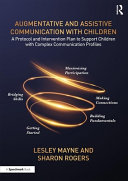
Augmentative and Assistive Communication with Children A Protocol and Intervention Plan to Support Children with Complex Communication Profiles 1st Edition by Lesley Mayne, Sharon Rogers ISBN 0429317778 9780429317774

Original price was: $50.00.$35.00Current price is: $35.00.
Augmentative and Assistive Communication with Children A Protocol and Intervention Plan to Support Children with Complex Communication Profiles 1st Edition by Lesley Mayne, Sharon Rogers – Ebook PDF Instant Download/Delivery: 0429317778, 9780429317774
Full download Augmentative and Assistive Communication with Children A Protocol and Intervention Plan to Support Children with Complex Communication Profiles 1st Edition after payment
Product details:
ISBN 10: 0429317778
ISBN 13: 9780429317774
Author: Lesley Mayne, Sharon Rogers
Augmentative and Assistive Communication with Children A Protocol and Intervention Plan to Support Children with Complex Communication Profiles 1st Table of contents:
PART I: HEAR ME INTO VOICE
1. Beginnings: Why the protocol Hear Me into Voice, the case studies, and the intervention plan matter
Defining augmentative and assistive communication (AAC)
The protocol rationale
The case studies rationale
Case study theoretical development
The intervention plan
Developing participation: describing five stages
The six sections of developing participation
Section 1: Social interaction
Section 2: Communication skills and activities
Section 3: Facilitator strategies
Section 4: Literacy
Section 5: Vocabulary
Section 6: Tools and access
An AAC architectural plan with purpose
The four purposes of communication
AAC communication competencies
Terms of AAC trade
Forms of communication
The use of AAC supports verbal speech production
Symbolizing relations in AAC
Time to begin with Hear Me into Voice
Hear Me into Voice: An AAC Protocol for Children with Complex Communication Profiles
Section I: My social interaction
I am playful
However, when I am done
I take responsibility
My social graces
My forms of negation – when things aren’t quite right
My emotions
Section II: My communication activities
People I like to be with
I show I am thinking
My family follows these communication rules
How I take care of myself
I know how my timing works best
Section III: How I express my vocabulary
Section IV: My literacy
My reading
My writing
Section V: AAC options that work for me!
How I use my head for unaided and aided communication
How I use my body for unaided or aided communication
Assistive technology for communication by tools and devices
Assistive technology access methods
Symbolic communication representation
My visual scanning and auditory memory
Summary of my assistive technologies for learning
Section VI: Summary of my communication
Section VII: About me … from people who know me best
AAC report shell template
An AAC teaching report
How I use my head for nonverbal communication
How I use my body for nonverbal communication
Assistive technology for communication by tools and devices
Communication access methods
Sample narrative format for communication access methods
Modes of communication and topic choice by partner type
Ways communication symbols are represented
Purposes of communication
Intervention planning: a way to structure an AAC session
AAC intervention session structure
References
PART II: AAC INTERVENTION PLAN WITH CASE STUDIES
2. Getting Started with social interaction: Building intentional communication
Intentionality starts with joint attention
My intentional communication tool box
What am I doing? I am going to use my tool box!
What is my child doing? I will define my child’s tool box!
Using my tool box: joint interaction success
Joint interaction success
A case study in Getting Started: meet Diego
Section 1 Social interaction: How does Diego demonstrate his communication strengths and motivations in interacting with others?
Section 3 Facilitator strategies: What strategies were used to support Diego’s communication at home and school?
Section 4 Literacy: How was Diego’s team equipped with strategies and ideology to support his strengths in accessing literacy?
Section 5 Vocabulary: What vocabulary does Diego need for participation?
Section 6 Tools and access: What assistive communication tools have helped Diego get started with participating at school?
Case Study Closing Thoughts
Getting Started with communication activities
Motivation
Communication activities
Getting Started with facilitator strategies
Grab and Go Coaches’ Corner
Facilitator decision making tips and steps in Getting Started with communication
Getting Started with developing literacy
Opportunities in your environment
Writing
Activities for Getting Started with literacy
Getting Started with vocabulary
Supporting families and professionals in building vocabulary
Getting Started with tools and access
Mind and body at work
A summary for Getting Started
It’s time!
Before we go: let’s make a communication board, card, or ring
References
3. Building Fundamentals with social interaction: Expanding communication
Defining key concepts in Building Fundamentals
Ideas at work: communication, next steps, and goal planning
A place to start with Building Fundamentals
Social language communication skills
Building Fundamentals case study: meet Moses
Section 1 Social interaction: What are Moses’ communication strengths and preferences? How does he interact socially with others?
Section 2 Communication activities: In what communication activities does Moses participate in frequently?
Section 3 Facilitator strategies: What strategies do Moses’ communication facilitators and partners use at home and at school?
Section 4 What were Moses’ reading and writing experiences?
Section 5 Vocabulary: What vocabulary does Moses comprehend and use to participate?
Section 6 Tools: What AAC tools and devices help Moses with Building Fundamentals in his participation at home and school?
Case study closing thoughts
Building Fundamentals with communication activities
Core words and quick phrases
Building Fundamentals communication activities
Building Fundamentals with facilitator strategies
Grab and Go Coaches’ Corner
Facilitator tips for Building Fundamentals with communication
Building Fundamentals
Reading and writing my way
Building Fundamentals with vocabulary
Words and word images that are important to me
Building Fundamentals with tools and access
I have AAC options!
A summary for Building Fundamentals
Ideas in action!
Before we go: troubleshooting the environment, nonverbal communication, and device use
Tips for troubleshooting the environment
Tips for troubleshooting nonverbal communication
Tips for troubleshooting interaction
References
4. Making Connections with social interaction: Communication counts
Making Connections: intervention plan: concepts, goals and strategies
Concept #1 Developing friendships – purposeful play
Concept #2 Expressing feelings and emotions
Concept #3 Using language to contribute to others socially
Concept #4 Understanding implications
Concept #5 Following directions
Making Connections case study: meet Alexa
Section 1 Social interaction: What does Alexa want us to know about her communication strengths and needs?
Section 2 Communication activities: What activities did Alexa participate in with her family and others at home and in the community?
Section 3 Facilitator strategies: What strategies do facilitators and communication partners use to promote participation with Alexa?
Section 4 Literacy: What literacy experiences did Alexa have with reading and writing?
Section 5 Vocabulary: What vocabulary does Alexa need for participation?
Section 6 Tools and access: One word and the AAC tools that help Alexa communicate?
Case study closing thoughts
Making Connections with communication activities
Implications of communication on interaction
Activities page – stepping into the purposes of communication
Making Connections with facilitator strategies
Grab and Go Coaches’ Corner
Facilitator tips and steps in Making Connections with communication
Making Connections with literacy
Reading, story telling, and writing
Making Connections with vocabulary
Words and word combinations that are important to me!
Making Connections with tools and access
I have AAC options!
A summary of Making Connections
Making a difference with others
Before we go: a topic book titled, The Chronicle of Me
References
5. Bridging Skills with social interaction: Purposeful expression
Components of bridging social and linguistic/language skills: My Friend’s Cat
Bridging Skills playbook
Adding emphases built upon purposes and joint attention
A case study in Bridging Skills: meet Jada
Section 1 Social interaction: How does Jada express herself in social interactions?
Section 2 Communication activities: What communication activities does Jada participate in?
Section 3 Facilitator strategies: What strategies do facilitators and communication partners use to support her communication and participation?
Section 4 Literacy: How does Jada’s access to technology change her communication participation with reading and writing?
Section 5 Vocabulary: What vocabulary did Jada need for participation?
Section 6 Tools and access: What were Jada’s important multimodal communication tools?
Summary
Bridging Skills with communication activities
Supporting independence
Bridging Skills
Bridging Skills with facilitator strategies
Grab and Go Coaches’ Corner
Facilitator tips and steps for Bridging Skills with communication
Bridging Skills with literacy
The power of words
Bridging Skills with vocabulary
Quality vocabulary with meaningful quantity
Tips for building sentences: add words, phrases, and clauses…
Bridging Skills with tools and access
My child’s multimodal communication plan
Feature matching children’s communication skills with high tech AAC displays
Let’s not forget support and funding
A summary of Bridging Skills
Supported independence in inclusive settings
Before we go: a communication wallet
wallet insert page ideas
References
6. Maximizing Participation: Responsive interaction
Environments and examples of success
A case study in Maximizing Participation: meet Joy (In loving memory of Joy’s 16 years of maximizing life)
Section 1 Social interaction: How did Joy expect others to interact with her?
Section 2 Communication activities: In what communication activities did Joy participate?
Section 3 Facilitator strategies: Who are Joy’s facilitators and communication partners? What strategies do they use to support Joy’s communication?
Section 4 Literacy: What reading and writing experience did Joy have and need?
Section 5 Vocabulary: What vocabulary maximizes Joy’s participation?
Section 6 Tools and access: What augmentative and assistive communication tools access methods were tried and are now used to maximize Joy’s participation?
Summary
Maximizing Participation with communication activities
Maximizing Participation
Emergency preparedness: a plan for communication; a plan for action
My child’s action plan
That is not okay: standing up for yourself and others
My AAC book club
Maximizing Participation with facilitator strategies
Grab and Go Coaches’ Corner
Facilitator tips for maximizing communication with communication
Maximizing Participation with language literacy
Language is never out of the picture (Ehren, 2018)
Literacy comprehension strategies
The moving parts of writing
Maximizing Participation with vocabulary
Maximizing Participation with tools and access
My multimodal AAC plan
A summary of Maximizing Participation
Ideas in action
Before we go: Let’s Chat: An easy way to talk with me
People also search for Augmentative and Assistive Communication with Children A Protocol and Intervention Plan to Support Children with Complex Communication Profiles 1st:
augmentative and assistive communication devices
augmentative and assistive communication aac
augmentative and assistive communication systems (aacs)
augmentative and assistive communication systems
augmentative and assistive communication aac devices
Tags: Lesley Mayne, Sharon Rogers, Children, Support Children