

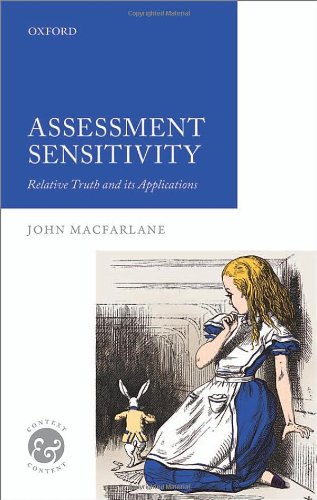
Assessment Sensitivity Relative Truth and its Applications 1st Edition by John Macfarlane ISBN 9780199682751 0199682755


Original price was: $50.00.$35.00Current price is: $35.00.
Assessment Sensitivity Relative Truth and its Applications 1st Edition by John Macfarlane – Ebook PDF Instant Download/Delivery: 9780199682751 ,0199682755
Full download Assessment Sensitivity Relative Truth and its Applications 1st Edition after payment
Product details:
ISBN 10: 0199682755
ISBN 13: 9780199682751
Author: John Macfarlane
Assessment Sensitivity Relative Truth and its Applications 1st Edition Table of contents:
1 A Taste of Relativism
1.1 Objectivism
1.2 Contextualism
1.2.1 Agreement and disagreement
1.2.2 Retraction
1.3 Expressivism
1.3.1 Disagreement and retraction
1.3.2 Force and content
1.4 A relativist approach
I FOUNDATIONS
2 The Standard Objections
2.1 Self-refutation
2.1.1 Pragmatic inconsistency?
2.1.2 Regress of formulation?
2.1.3 Belief and the possibility of error
2.1.4 Is local relativism immune?
2.2 Disagreement
2.3 What are the bearers of relative truth?
2.4 The equivalence schema
2.5 What does it mean?
2.6 Conclusion
3 Assessment Sensitivity
3.1 Characterizing relativism
3.1.1 Sentences
3.1.2 Utterances
3.1.3 Propositions
3.2 Assessment Sensitivity
3.2.1 Truth at a context of use
3.2.2 Truth at an index and context
3.2.3 Contexts of assessment
3.3 Truth relativism as assessment sensitivity
3.4 Generalizing the logical notions
4 Propositions
4.1 What are propositions?
4.2 Content relativism
4.3 Context and circumstance
4.4 Two kinds of context sensitivity
4.5 Coordinates of circumstances
4.5.1 Operator arguments
4.5.2 Incompleteness
4.6 Nonindexical contextualism
4.7 Truth-value relativism
4.8 Monadic “true” and the Equivalence Schema
4.9 Newton-Smith’s argument
5 Making Sense of Relative Truth
5.1 A strategy
5.2 The Truth Rule
5.3 Relativism and the Truth Rule
5.4 Retraction
5.5 Rejection
5.6 Relativism and the Knowledge Rule
5.7 Believing relative truths
5.8 Conclusion
6 Disagreement
6.1 Clarifying the target
6.2 Noncotenability
6.3 Preclusion of joint satisfaction
6.4 Preclusion of joint accuracy
6.5 Preclusion of joint reflexive accuracy
6.6 Disagreement in disputes of taste
6.7 On “faultless disagreement”
6.8 Conclusion
II APPLICATIONS
7 Tasty
7.1 A relativist account
7.1.1 Tastes
7.1.2 A relativist account
7.1.3 Can an epicure be a relativist about taste?
7.2 Compositional semantics
7.2.1 Atomic formulas
7.2.2 Postsemantics
7.2.3 Contents and circumstances
7.2.4 Boolean connectives
7.2.5 Explicit relativizations
7.2.6 Implicit relativizations
7.2.7 Attitude verbs
7.2.8 Factive attitude verbs
7.2.9 Quantifiers and binding
7.2.10 Tense
7.2.11 Alethic modals and counterfactuals
7.3 Relativism and expressivism
7.3.1 Modern expressivism
7.3.2 Gibbard’s two insights
7.3.3 How do the views differ?
7.3.4 Retraction and disagreement
8 Knows
8.1 Contextualism
8.2 Subject-sensitive invariantism
8.3 Relativism
8.4 Other alternatives
8.4.1 Nonindexical contextualism
8.4.2 Expressivism
8.5 Factivity
8.6 Speaker error
9 Tomorrow
9.1 Metaphysical background
9.1.1 Times
9.1.2 Worlds
9.1.3 Accessibility and branching structure
9.1.4 Determinism and indeterminism
9.2 Ockhamist semantics
9.3 Propositions
9.4 The postsemantic problem
9.4.1 The Thin Red Line
9.4.2 Against a Thin Red Line
9.4.3 Undermining Thin Red Line intuitions
9.5 Peircean semantics
9.6 Three-valued semantics
9.7 Supervaluationism
9.7.1 Supervaluational postsemantics
9.7.2 The retraction problem
9.8 Relativism
9.8.1 A relativist postsemantics
9.8.2 Explaining the pull of the Thin Red Line
9.8.3 Some logical subtleties
9.9 Asserting future contingents
9.10 Future-directed attitudes
9.11 Conclusion
10 Might
10.1 Against Solipsistic Contextualism
10.2 Flexible Contextualism
10.2.1 Widening the relevant community
10.2.2 Objective factors
10.2.3 The puzzle
10.3 Expressivism
10.3.1 Force modifiers
10.3.2 Embeddings
10.3.3 Hare’s gambit
10.4 Relativism
10.4.1 Explaining Warrant, Rejection, and Retraction
10.4.2 Hacking’s lottery
10.4.3 Resisting retraction
10.4.4 Ignorant assessors
10.5 Compositional Semantics
10.5.1 The framework
10.5.2 Epistemic modals
10.5.3 Boolean connectives
10.5.4 For all I know
10.5.5 Conditionals
10.5.6 Tense
10.5.7 Attitude verbs
10.6 Yalcin’s nonfactualism
11 Ought
11.1 Objective and subjective oughts
11.1.1 Subjectivism
11.1.2 Objectivism
11.1.3 Ambiguity
11.2 Contextualism
11.3 A relativist account
11.4 Compositional Semantics
11.5 Ifs and oughts
11.5.1 The miner paradox
11.5.2 Gibbard on truth and correct belief
11.6 Evaluative uses of “ought”
11.7 Modal ignorance
12 The Rationality of Relativism
12.1 Rationality and reflection
12.2 Assessment sensitivity: an engineer’s perspective
12.3 The evolution of assessment sensitivity
12.3.1 The upward path
12.3.2 The downward path
References
Index
People also search for Assessment Sensitivity Relative Truth and its Applications 1st Edition:
sensitivity and response
t-test reliability and validity
t-tess self assessment
understanding and using sensitivity specificity and predictive values
understanding sensitivity and specificity
Tags: John Macfarlane, Assessment Sensitivity, Relative Truth, Applications