

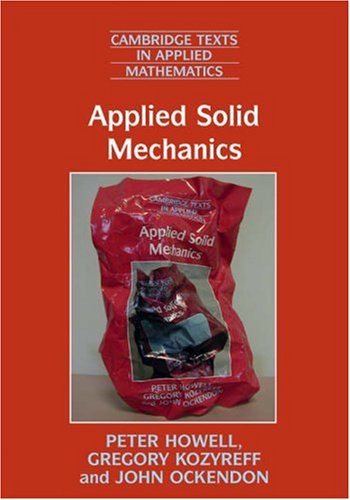
Applied solid mechanics 1st Edition by Peter Howell, Gregory Kozyreff, John Ockendon ISBN 052185489X 9780521854894


Original price was: $50.00.$35.00Current price is: $35.00.
Applied solid mechanics 1st Edition by Peter Howell, Gregory Kozyreff, John Ockendon – Ebook PDF Instant Download/Delivery: 052185489X, 9780521854894
Full download Applied solid mechanics 1st Edition after payment
Product details:
ISBN 10: 052185489X
ISBN 13: 9780521854894
Author: Peter Howell, Gregory Kozyreff, John Ockendon
Applied solid mechanics 1st Table of contents:
1. Modelling solids
1.1 Introduction
1.2 Hooke’s law
1.3 Lagrangian and Eulerian coordinates
1.4 Strain
1.5 Stress
1.6 Conservation of momentum
1.7 Linear elasticity
1.8 The incompressibility approximation
1.9 Energy
1.10 Boundary conditions and well-posedness
1.11 Coordinate systems
1.11.1 Cartesian coordinates
1.11.2 Cylindrical polar coordinates
1.11.3 Spherical polar coordinates
Exercises
2. Linear elastostatics
2.1 Introduction
2.2 Linear displacements
2.2.1 Isotropic expansion
2.2.2 Simple shear
2.2.3 Uniaxial stretching
2.2.4 Biaxial strain
2.2.5 General linear displacements
2.3 Antiplane strain
2.4 Torsion
2.5 Multiply-connected domains
2.6 Plane strain
2.6.1 Definition
2.6.2 The Airy stress function
2.6.3 Boundary conditions
2.6.4 Plane strain in a disc
2.6.5 Plane strain in an annulus
2.6.6 Plane strain in a rectangle
2.6.7 Plane strain in a semi-infinite strip
2.6.8 Plane strain in a half-space
2.6.9 Plane strain with a body force
2.7 Compatibility
2.8 Generalised stress functions
2.8.1 General observations
2.8.2 Plane strain revisited
2.8.3 Plane stress
2.8.4 Axisymmetric geometry
2.8.5 The Galerkin representation
2.8.6 Papkovich–Neuber potentials
2.8.7 Maxwell and Morera potentials
2.9 Singular solutions in elastostatics
2.9.1 The delta-function
2.9.2 Point and line forces
2.9.3 The Green’s tensor
2.9.4 Point incompatibility
2.10 Concluding remark
Exercises
3. Linear elastodynamics
3.1 Introduction
3.2 Normal modes and plane waves
3.2.1 Normal modes
3.2.2 Plane waves
3.2.3 Scattering
3.2.4 P-waves and S-waves
3.2.5 Mode conversion in plane strain
3.2.6 Love waves
3.2.7 Rayleigh waves
3.3 Dynamic stress functions
3.4 Waves in cylinders and spheres
3.4.1 Waves in a circular cylinder
3.4.2 Waves in a sphere
3.5 Initial-value problems
3.5.1 Solutions in the time domain
3.5.2 Fundamental solutions
3.5.3 Characteristics
3.6 Moving singularities
3.7 Concluding remarks
Exercises
4. Approximate theories
4.1 Introduction
4.2 Longitudinal displacement of a bar
4.3 Transverse displacements of a string
4.4 Transverse displacements of a beam
4.4.1 Derivation of the beam equation
4.4.2 Boundary conditions
4.4.3 Compression of a beam
4.4.4 Waves on a beam
4.5 Linear rod theory
4.6 Linear plate theory
4.6.1 Derivation of the plate equation
4.6.2 Boundary conditions
4.6.3 Simple solutions of the plate equation
4.6.4 An inverse plate problem
4.6.5 More general in-plane stresses
4.7 Von Karman plate theory
4.7.1 Assumptions underlying the theory
4.7.2 The strain components
4.7.3 The von Karman equations
4.8 Weakly curved shell theory
4.8.1 Strain in a weakly curved shell
4.8.2 Linearised equations for a weakly curved shell
4.8.3 Solutions for a thin shell
4.9 Nonlinear beam theory
4.9.1 Derivation of the model
4.9.2 Example: deflection of a diving board
4.9.3 Weakly nonlinear theory and buckling
4.10 Nonlinear rod theory
4.11 Geometrically nonlinear wave propagation
4.11.1 Gravity-torsional waves
4.11.2 Travelling waves on a beam
4.11.3 Weakly nonlinear waves on a beam
4.12 Concluding remarks
Exercises
5. Nonlinear elasticity
5.1 Introduction
5.2 Stress and strain revisited
5.2.1 Deformation and strain
5.2.2 The Piola–Kirchhoff stress tensors
5.2.3 The momentum equation
5.2.4 Example: one-dimensional nonlinear elasticity
5.3 The constitutive relation
5.3.1 Polar decomposition
5.3.2 Strain invariants
5.3.3 Frame indifference and isotropy
5.3.4 The energy equation
5.3.5 Hyperelasticity
5.3.6 Linear elasticity
5.3.7 Incompressibility
5.3.8 Examples of constitutive relations
5.4 Examples
5.4.1 Principal stresses and strains
5.4.2 Biaxial loading of a square membrane
5.4.3 Blowing up a balloon
5.4.4 Cavitation
5.5 Concluding remarks
Exercises
6. Asymptotic analysis
6.1 Introduction
6.2 Antiplane strain in a thin plate
6.3 The linear plate equation
6.3.1 Non-dimensionalisation and scaling
6.3.2 Dimensionless equations
6.3.3 Leading-order equations
6.4 Boundary conditions and Saint-Venant’s principle
6.4.1 Boundary layer scalings
6.4.2 Equations and boundary conditions
6.4.3 Asymptotic expansions
6.5 The von Karman plate equations
6.5.1 Background
6.5.2 Scalings
6.5.3 Leading-order equations
6.6 The Euler–Bernoulli plate equations
6.6.1 Dimensionless equations
6.6.2 Asymptotic structure of the solution
6.6.3 Leading-order equations
6.6.4 Longitudinal stretching
6.7 The linear rod equations
6.7.1 Dimensionless equations
6.7.2 Constitutive relations
6.8 Linear shell theory
6.8.1 Geometry of the shell
6.8.2 Dimensionless equations
6.8.3 Leading-order equations
6.9 Concluding remarks
Exercises
7. Fracture and contact
7.1 Introduction
7.2 Static brittle fracture
7.2.1 Physical background
7.2.2 Mode III cracks
(i) Rounding the tip
(ii) Plastic zone
(iii) Tip cohesion
7.2.3 Mathematical methodologies for crack problems
7.2.4 Mode II cracks
7.2.5 Mode I cracks
7.2.6 Dynamic fracture
7.3 Contact
7.3.1 Contact of elastic strings
7.3.2 Other thin solids
7.3.3 Smooth contact in plane strain
7.4 Concluding remarks
Exercises
8. Plasticity
8.1 Introduction
8.2 Models for granular material
8.2.1 Static behaviour
8.2.2 Granular flow
8.2.3 Example: a tunnel in granular rock
8.3 Dislocation theory
8.4 Perfect plasticity theory for metals
8.4.1 Torsion problems
8.4.2 Plane strain
8.4.3 Three-dimensional yield conditions
8.5 Kinematics
8.6 Conservation of momentum
8.7 Conservation of energy
8.8 The flow rule
8.9 Simultaneous elasticity and plasticity
8.10 Examples
8.10.1 Torsion revisited
8.10.2 Gun barrel revisited
8.10.3 Luders bands
8.11 Concluding remarks
Exercises
9. More general theories
9.1 Introduction
9.2 Viscoelasticity
9.2.1 Introduction
9.2.2 Springs and dashpots
9.2.3 Three-dimensional linear viscoelasticity
9.2.4 Large-strain viscoelasticity
9.3 Thermoelasticity
9.4 Composite materials and homogenisation
9.4.1 One-dimensional homogenisation
9.4.2 Two-dimensional homogenisation
9.4.3 Three-dimensional homogenisation
9.4.4 Waves in periodic media
9.5 Poroelasticity
9.6 Anisotropy
9.7 Concluding remarks
People also search for Applied solid mechanics 1st:
applied mechanics vs solid mechanics
applied mechanics syllabus
applied mechanics deals with
what is applied mechanics
applied mechanics topics
Tags: Peter Howell, Gregory Kozyreff, John Ockendon, solid mechanics