

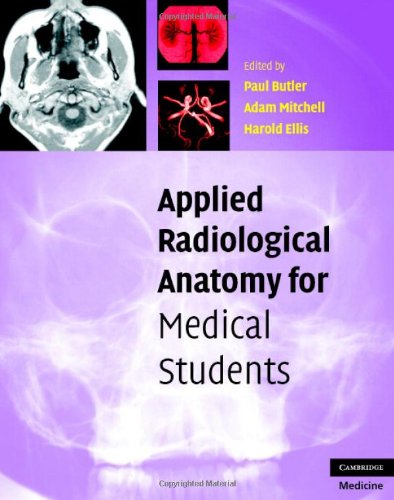
Applied Radiological Anatomy for Medical Students 1st Edition by Paul Butler, Adam Mitchell, Harold Ellis ISBN 0521819393 9780521819398

Original price was: $50.00.$35.00Current price is: $35.00.
Applied Radiological Anatomy for Medical Students 1st Edition by Paul Butler, Adam Mitchell, Harold Ellis – Ebook PDF Instant Download/Delivery: 0521819393, 9780521819398
Full download Applied Radiological Anatomy for Medical Students 1st Edition after payment
Product details:
ISBN 10: 0521819393
ISBN 13: 9780521819398
Author: Paul Butler, Adam Mitchell, Harold Ellis
Applied Radiological Anatomy for Medical Students 1st Table of contents:
Section 1 The basics
Chapter 1 An introduction to the technology of imaging
Introduction
X-rays
X-ray generation
How X-rays produce an image
X-ray interactions
Detection of X-rays
Film
Computed radiology (CR)
Digital radiology (DR)
Fluoroscopy – image intensifier
Advantages and limitations of plain X-ray
Conventional tomography
Contrast enhancing agents
Barium studies
Intravenous urography
Angiography
Radiation dose
Ultrasound
General principles
Ultrasound transducers
Image formation
Attenuation
Re.ection
Tissue harmonics
Image display
Doppler ultrasound
Ultrasound contrast agents
Ultrasound artifacts
Acoustic shadowing
Acoustic enhancement
Reverberation artifact
Mirror image artifact
“Ring down” artifact
Advantages and limitations of ultrasound
Computed tomography
Basic principles
Image reconstruction
Window and level
Spiral CT and pitch
Multi-detector CT
Advanced image reconstructions
HRCT
Volume averaging
Beam hardening artifact
Motion artifact
Streak artifact
Advantages and limitations of CT
Magnetic resonance imaging (MRI)
Basic principles
T1 and T2 weighting and proton density
Inversion recovery (IR) sequences
Turbo (fast) spin echo and echo-planar imaging
Gradient recalled echo or gradient echo sequences
Fat suppression
Diffusion-weighted imaging (DWI)
MR angiography
Magnetic resonance cholangiopancreaticogram
MR artifacts
Ferromagnetic artifact
Susceptibility artifact
Motion artifact
Chemical shift artifact
MRI safety
Advantages of MR
Nuclear medicine
Radiopharmaceuticals
The gamma camera
The gamma camera
Single photon emission computed tomography (SPECT)
Positron emission tomography (PET)
PETCT
Advantages of nuclear medicine
Chapter 2 How to interpret an image
Plain radiography
The chest radiograph
The abdominal radiograph
Plain .lms of the musculoskeletal system
Contrast studies of the gastrointestinal tract
Contrast studies of the kidney and urinary tract
Computed tomography
Magnetic resonance imaging
Nuclear medicine imaging
Section 2 The thorax
Chapter 3 The chest wall and ribs
Introduction
Commonly used techniques for imaging the chest
Chest radiography
Computed tomography (CT)
Anatomy of the chest
The lungs and airways
The mediastinum
The esophagus
The thymus
The hilum
The heart
The aorta
Pulmonary arteries
The thoracic duct
Ribs, sternum and vertebrae
Muscles of the chest wall
Nerve supply of the chest wall
The diaphragm
Chapter 4 The breast
Embryology
Breast anatomy
Arterial supply
Nerve supply
Lymphatics
Imaging
Normal mammographic patterns
Viewing a mammogram
Ultrasound
Magnetic resonance imaging (Fig. 4.9)
Further reading
Section 3 The abdomen and pelvis
Chapter 5 The abdomen
The gastrointestinal tract
Esophagus
Stomach
Duodenum
Jejunum and ileum
Colon (including rectum)
Anal canal
Liver
Anatomy
Gall bladder
Spleen
Pancreas
Peritoneum and peritoneal spaces
The most clinically important recesses of peritoneum
Subphrenic spaces
Lesser sac
Subhepatic space
Pelvic recesses
The most important ligaments and omenta
Greater omentum
Lesser omentum
Falciform ligament
Coronary ligaments
Transverse mesocolon and small bowel mesentery
Chapter 6 The renal tract, retroperitoneum and pelvis
Imaging methods
The renal tract and retroperitoneum
The kidneys
Gross anatomy of the kidneys
Structure of the kidney
Renal arteries, veins and lymphatic drainage
Nerve supply
Fascial spaces around the kidney
Relations of the right kidney
Relations of the left kidney
Ureters
Anatomy of the ureters
Blood supply and lymphatic drainage of the ureters
Nerve supply to the ureters
Relations of the ureters
Anatomical variants of the renal tract (Figs. 6.2(c), 6.5)
Imaging the kidneys and ureters
The suprarenal glands (Figs. 6.1, 6.7)
The pelvic viscera
The bladder and urethra
The bladder
The male urethra
The female urethra
The female genital tract
The male genital tract
The prostate gland
The seminal vesicles and ejaculatory ducts
The penis
The female genital tract
The labia majora
The ovaries
The posterior abdominal wall
Muscles and fascia (Fig. 6.19)
Muscles of the pelvis
The blood and lymph supply to the abdomen and pelvis
The abdominal aorta
Imaging the aorta
Inferior vena cava (IVC) (Figs. 6.2, 6.7)
Imaging the inferior vena cava
The pelvic vasculature
Lymphatics of the abdomen and pelvis
Imaging the abdominal lymphatic system
Lumbosacral plexus
Abdominal sympathetic trunk and sympathetic plexus
Section 4 The head, neck, and vertebral column
Chapter 7 The skull and brain
Anatomical Overview
Imaging overview
MRI
Advantages
Disadvantages
CT
Advantages
Disadvantages
CT and MRI interpretation
The skull (Fig. 7.4)
The skull radiograph
Skull radiograph interpretation
The brainstem (Fig. 7.7)
The cerebellum
The cranial nerves
The pituitary gland and perisellar region
The motor and sensory tracts
The cerebral hemispheres
The limbic system
The outer limbic gyrus (the larger arc)
The inner limbic gyrus (the smaller arc)
The cerebral envelope (Fig. 7.27)
The cerebral blood circulation
Cerebral arteries
The internal carotid artery
Vascular territories
Cerebral venous drainage
Chapter 8 The eye
Imaging considerations
Anatomy of the bony orbit
Soft tissues of the orbit
The optic nerve
The extraocular muscles
The nerves of the orbit
The lacrimal gland
The orbital vasculature
The optic pathways
Section 4 The head, neck, and vertebral column
Chapter 9 The ear
The external ear
The middle ear
The inner ear
The internal auditory canal
The facial nerve
The cerebellopontine angle cistern
Chapter 10 The extracranial head and neck
The facial skeleton and musculature
The mandible and temporomandibular joint
Nasal cavity
The paranasal sinuses and ostiomeatal complex
The oral cavity tongue and salivary glands
The pharynx
The fascial layers of the neck and the parapharyngeal space
The larynx
Thyroid and parathyroid glands
The craniocervical lymphatic system
The cervical vasculature
Brachial plexus
Section 4 The head, neck, and vertebral column
Chapter 11 The vertebral column and spinal cord
General overview
Imaging methods
Plain radiography
Computed tomogaphy (CT)
Magnetic resonance imaging (MRI)
The vertebral canal
The intervertebral canal (the neural foramen)
The ligaments of the vertebral column
The craniocervical junction and cervical vertebral column
The thoracic vertebral column
The lumbar vertebral column
The spinal cord
The spinal nerves
Meninges
The blood supply to the spinal cord
Chapter 12 The upper limb
The shoulder and upper arm
The shoulder girdle
The scapula
The clavicle
The sternoclavicular joint
The acromioclavicular joint
The humerus
The glenohumeral joint
Musculature of the shoulder
Bursae of the shoulder
Imaging of the shoulder
The axilla
The musculature of the arm
The forearm
The radius
The ulna
The elbow joint
Imaging of the elbow joint
Musculature of the forearm
The wrist and hand
The hand
Bone age
The wrist
Imaging of the wrist and hand
Vascular supply of the upper limb
Arterial supply
Venous drainage
Nerve supply of the upper limb
Radial nerve
Musculocutaneous nerve
Median nerve
Ulnar nerve
Lymphatic drainage of the upper limb
Section 5 The limbs
Chapter 13 The lower limb
Imaging methods
Plain radiography
Computed tomography (CT)
Magnetic resonance imaging (MRI)
Ultrasound
Nuclear medicine
Angiography
The bony pelvis and hip joint
The sacroiliac joints
The symphysis pubis
The hip joint
Imaging of the pelvis and hips
Pelvimetry
The thigh
The femur
The muscles of the thigh (Fig. 13.10)
Anterior femoral muscles
The adductor muscles
The adductor muscles
The hamstrings
The knee joint
Movements
Imaging of the knee
The lower leg
The tibia and fibula (Fig. 13.17)
The tibiofibular joints
The muscles of the lower leg (Figs. 13.19, 13.20)
Anterior compartment
The lateral (peroneal) compartment
The posterior compartment.
The ankle joint
The foot
The talus
The calcaneum
The navicular
The cuneiform bones
The cuboid
The metatarsal bones
The phalanges
The subtalar joint
Imaging of the foot and ankle
Vascular supply of the lower limb
Arterial supply
Venous drainage
Nerve supply of the lower limb
Chapter 14 Obstetric imaging
Determination of gestational age
The 20-week (Level 2) scan
Head and spine
Heart and thorax
Abdomen
Umbilical cord and placenta
Section 6 Developmental anatomy
Chapter 15 Pediatric imaging
Introduction
Neuroanatomy
Spinal anatomy
Thoracic anatomy
Gastrointestinal and hepatobiliary anatomy
Genitourinary anatomy
Musculoskeletal anatomy
People also search for Applied Radiological Anatomy for Medical Students 1st:
applied radiological anatomy pdf
radiology applied anatomy
applied radiology anatomy
applied anatomy in radiography
e-anatomy radiology
Tags:
Paul Butler,Adam Mitchell,Harold Ellis,Radiological Anatomy,Medical Students