

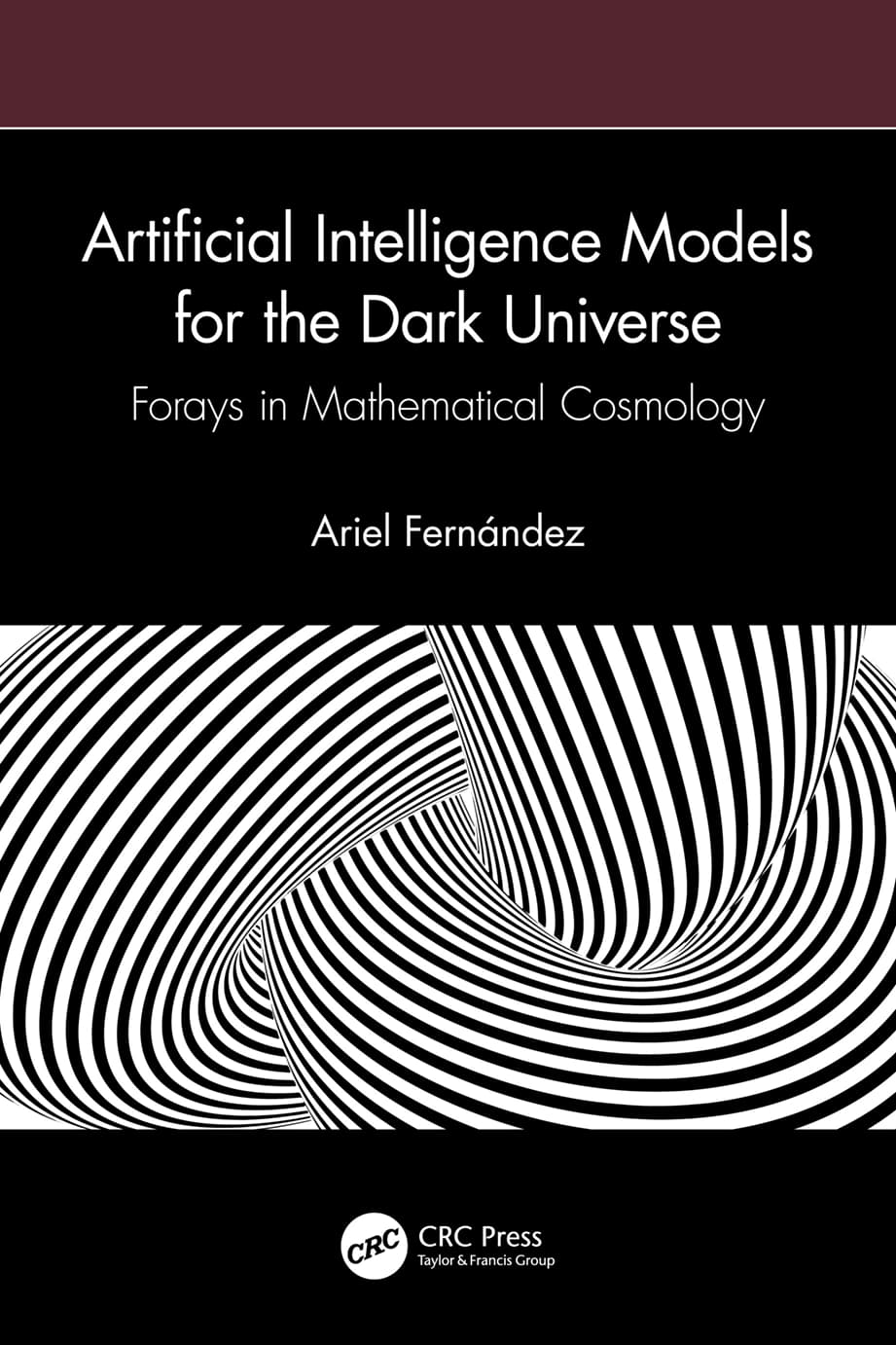
Applications Of Artificial Intelligence To The Dark Universe 1st Edition by Ariel FernaNdez ISBN 1003501532 9781003501534

Original price was: $50.00.$35.00Current price is: $35.00.
Applications Of Artificial Intelligence To The Dark Universe 1st Edition by Ariel FernaNdez – Ebook PDF Instant Download/Delivery: 1003501532, 9781003501534
Full download Applications Of Artificial Intelligence To The Dark Universe 1st Edition after payment
Product details:
ISBN 10: 1003501532
ISBN 13: 9781003501534
Author: Ariel FernaNdez
Applications Of Artificial Intelligence To The Dark Universe 1st Table of contents:
Chapter 1: The Dark Universe — Metamodel and Foundational Evidence
1.1 Introduction
1.2 Metamodel of the dark universe
1.3 The dark universe: a naïve perspective
1.4 Leveraging AI to explore the dark universe
1.5 Dark matter in deep space
1.6 Gravitational lensing by dark matter
-
1.6.1 Gravity deviates light: the power of thought experiments
-
1.6.2 Gravitational lensing as a dark matter detector
1.7 Validity of the dark matter hypothesis
1.8 The Hubble constant in the Newtonian and relativistic universe
1.9 The expanding universe revisited
1.10 Autocatalytic universe in runaway mode
1.11 The universe runaway fueled by dark energy
1.12 Quantum vacuum fluctuations fuel a runaway universe
1.13 Dark physics on extra dimensions
1.14 The Dirac equation: a first glimpse at vacuum energy
1.15 Navigating the Dirac sea toward dark energy
References
Chapter 2: Quintessential Extension of Space-Time Yielding Mediators between Visible and Dark Sectors
2.1 Dark matter storage requires an extra dimension
2.2 Topology steers the incorporation of an extra dimension
2.3 Elementary particles as excitations of quantum fields
2.4 Big Bang scenario in a relativistic universe: a Russell-type paradox
2.5 The 4-torus topological model of the universe admits a compact extra dimension
2.6 Topological metamodel of the universe in the AI quest for dark matter
2.7 Amalgamated Higgs boson as dark-matter portal
References
Chapter 3: Methods — Quintessential Autoencoders
3.1 Primer on neural networks for model and metamodel discovery
3.2 Neural networks as dynamical systems
3.3 Deep learning and convolutional neural networks for feature extraction
3.4 Autoencoders simplify the dynamics in latent manifolds and quotient spaces
3.5 Reverse engineering of the Standard Model with an autodecoder
3.6 AI-based model building for dynamical systems
3.7 AI-based simplification of a dynamical system
3.8 Model discovery with deep learning
3.9 AI empowers molecular dynamics
3.10 Physics on latent manifolds
3.11 Dynamics in quotient space
3.12 Encoding hierarchical systems with AI
3.13 Quantum autoencoding of gravity
3.14 AI encodes quantum gravity
3.15 Relativistic strings in a physical realization of the quantum gravity autoencoder
3.16 The universe as a holographic autoencoder
3.17 Cosmic reproduction by quantum tunneling across coupled quantum gravity autoencoders
3.18 Cosmic reproduction as a physical impossibility
References
Chapter 4: Dark Matter in a Quintessential Extension of the Standard Model
4.1 AI decodes the Standard Model
4.2 Reverse engineering of the Standard Model into a quintessential model including dark matter
4.3 Experimental validation of the quintessential decoding of the Standard Model
4.4 Geometric dilution parameter as a proxy for extrinsic time in the evolution of the universe
4.5 Dark matter identified by quintessential decoding of the Standard Model
4.6 Dark matter and dark energy holographically decoded by adopting geometric dilution as a proxy for time
4.7 Dark matter and dark energy are not identified in standard extensions of the Standard Model
4.8 The universe was created by geometric dilution of dark matter
References
Chapter 5: Portal to the Dark Universe
5.1 Topology of the universe and the sustainable primeval wormhole
5.2 Deconstructing quantum entanglement in the quintessential topological blueprint of space-time
5.3 AI probes the equivalence between wormhole and quantum entanglement
5.4 Primeval wormhole as a two-stroke entangle/disentangle engine fueled by dark matter: a provisional solution to the cosmological constant problem
5.5 A holistic quintessentially entangled universe admits no observer
5.6 Preservation of the topology and quantum fabric of space-time in a multiverse scenario
5.7 Chirality in the dark universe
5.8 Primeval nonorientable wormhole as portal to the dark universe
5.9 Constructing a portal to the dark universe in a quantum computer
5.10 The portal to the dark universe couples dark energy expenditure with a dynamic equilibrium between dark and detectable matter
References
Chapter 6: Physical Footprints of a Computer-Simulated Universe — The Artifactual Nature of the Dark Universe
6.1 The simulation hypothesis
6.2 Is the universe amenable to be simulated?
6.3 The dark universe as a computational artifact in the simulation of the universe
6.4 Physical footprints of a simulated universe
6.5 AI architectures to encode the Standard Model: pixelation of deep reality
People also search for Applications Of Artificial Intelligence To The Dark Universe 1st:
applications of artificial intelligence ai
applications of artificial intelligence & associated technologies
applications of artificial intelligence and technology
application of artificial intelligence ai in educational management
applications of artificial intelligence in agriculture
Tags: Ariel FernaNdez, Artificial Intelligence, Dark Universe