

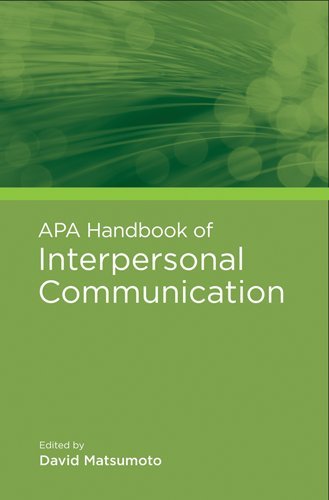
APA Handbook of Interpersonal Communication 1st Edition by David Matsumoto ISBN 1433807807 9781433807800


Original price was: $50.00.$35.00Current price is: $35.00.
APA Handbook of Interpersonal Communication 1st Edition by David Matsumoto – Ebook PDF Instant Download/Delivery: 1433807807, 9781433807800
Full download APA Handbook of Interpersonal Communication 1st Edition after payment
Product details:
ISBN 10: 1433807807
ISBN 13: 9781433807800
Author: David Matsumoto
What can be more important in today’s world than communication? Communication is the fundamental process by which humans live as social animals. Because of communication we can come together to build families, social networks, and professional associations. Because of communication we can work with very different others toward a common goal. Because of communication we can organize sports, leisure, and recreational activities. And unfortunately, because of (mis)communication we can argue, fight, and wage war. Thus, it is fitting that the study of communication is a field of active scientific and scholarly endeavor, and equally fitting that much of the state-of-theart knowledge in this area be brought together in handbooks such as this one and its companion handbook, the APA Handbook of Intercultural Communication. Communication has been studied from many different perspectives (e.g., basic and applied sciences) and disciplines (e.g., sociology, linguistics, psychology), and indeed today these efforts have amassed a wealth of information about communication. The purpose of these two handbooks is to compile, organize, and synthesize much of this knowledge. It’s important to have a working definition of communication, and as the reader will readily see, each of the chapters present a common yet unique perspective on what such a definition may entail, either explicitly or implicitly. It may be impossible to arrive at a definition of communication with which all will agree. At the same time, I strongly believe that it is important for authors to make explicit their working definitions, and for readers to be able to know what those working definitions are (and of course to have their own working definitions). For me, a common thread among all definitions of communication involves some degree of message or information exchange between two or more interactants. Indeed, the encoding and decoding of such messages forms the foundation of any communication episode. And because this information exchange occurs through multiple channels and multiple signals, and through both verbal and nonverbal behaviors, communication is a rich, complex process. I believe that one very important function of communication is the conveyance of intent (and, indeed, this is a perspective that is echoed by most of the authors in these volumes). One of the reasons why humans can produce and live very successfully in highly complex, layered social networks is because we can communicate intent and share intentions with others. Some scholars believe, in fact, that shared intentionality is an ability unique to humans (Tomasello, Carpenter, Call, Behne and Moll 2005). In my view, shared intentionality is one of the major reasons why human cultures have survived and thrived. While there are many definitions of culture (as there are of communication), I define culture as a meaning and information system that is transmitted across generations (Matsumoto and Juang 2007). Shared intentionality allows for human cultures to evolve and have ix
APA Handbook of Interpersonal Communication 1st Table of contents:
Chapter 1 Social Psychology and Personal Relationships: Accommodation and Relational Influence Across Time and Contexts
Chapter 2
Face-to-Face Communication and Body Language
Chapter 3
Technically-Mediated Interpersonal Communication
Chapter 4
Feeling Space: Interpersonal Communication and Spatial Semiotics
Chapter 5
Relational Work, Politeness, and Identity Construction
Chapter 6
Humor, Jokes, and Irony Versus Mocking, Gossip, and Black Humor
Chapter 7 Praising and Blaming, Applauding, and Disparaging—Solidarity, Audience Positioning, and the Linguistics of Evaluative Disposition
Part II
Applied Interpersonal Communication
Chapter 8
Everyday Communication and Socializing
Chapter 9
Counseling, Diagnostics, and Therapy
Chapter 10
Youth, Discourse, and Interpersonal Management
Chapter 11
Language and Discourse Skills of Elderly People
Chapter 12
Nonverbal Communicative Competence
Chapter 13
Media Competence