

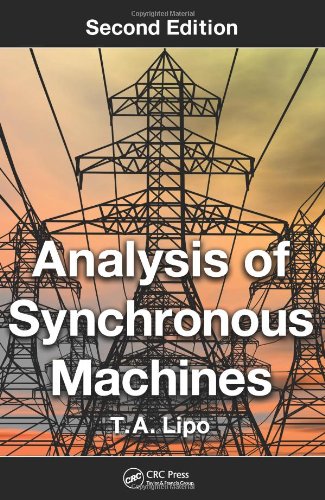
Analysis of Synchronous Machines 2nd Edition by TA Lipo ISBN 1439880670 9781439880678


Original price was: $50.00.$35.00Current price is: $35.00.
Analysis of Synchronous Machines 2nd Edition by TA Lipo – Ebook PDF Instant Download/Delivery: 1439880670, 9781439880678
Full download Analysis of Synchronous Machines 2nd Edition after payment
Product details:
ISBN 10: 1439880670
ISBN 13: 9781439880678
Author: TA Lipo
Analysis of Synchronous Machines 2nd Table of contents:
Chapter 1 Winding Distribution in an Ideal Machine
1.1 Introduction
1.2 The Winding Function
1.3 Calculation of the Winding Function
1.4 Multipole Winding Configurations
1.5 Inductances of an Ideal Doubly Cylindrical Machine
1.6 Calculation of Winding Inductances
1.7 Mutual Inductance Calculation – An Example
1.8 Winding Functions for Multiple Circuits
1.9 Analysis of a Shorted Coil – An Example
1.10 General Case for C Circuits
1.11 Winding Function Modifications for Salient-Pole Machines
1.12 Leakage Inductances of Synchronous Machines
1.12.1 The Synchronous Machine Stator
1.12.2 The Synchronous Machine Rotor
1.13 Practical Winding Design
1.14 Conclusion
1.15 References
Chapter 2 Reference Frame Theory
2.1 Introduction
2.2 Rotating Reference Frames
2.3 Transformation of Three-Phase Circuit Variables to a Rotating Reference Frame
2.3.1 Vector Approach Applied to r–L Circuits
2.3.2 Transformation Equations
2.3.3 System Equations in the d–q–n Coordinate System
2.3.4 Power Flow in the d–q–n Equivalent Circuits
2.4 Stationary Three-Phase r–L Circuits Observed in a d–q–n Reference Frame
2.4.1 Example
2.5 Matrix Approach to the d–q–n Transformation
2.5.1 Example
2.6 The d–q–n Transformation Applied to a Simple Three-Phase Cylindrical Inductor
2.7 Winding Functions in a d–q–n Reference Frame
2.8 Direct Computation of d–q–n Inductances of a Cylindrical Three-Phase Inductor
2.9 Conclusion
2.10 References
Chapter 3 The d–q Equations of a Synchronous Machine
3.1 Introduction
3.2 Physical Description
3.3 Synchronous Machine Equations in the Phase Variable or as-, bs-, cs- Reference Frame
3.3.1 Voltage Equations
3.3.2 Flux Linkage Equations
3.4 Transformation of the Stator Voltage Equations to a Rotating Reference Frame
3.5 Transformation of Stator Flux Linkages to a Rotating Reference Frame
3.6 Winding Functions of the Three-Phase Stator Windings in a d–q–n Reference Frame
3.7 Winding Functions of the Rotor Windings
3.7.1 The d-Axis Amortisseur Winding Function
3.7.2 The q-Axis Amortisseur Circuit Winding Function
3.7.3 The Field Circuit Winding Function
3.8 Calculation of Stator Magnetizing Inductances
3.9 Mutual Inductances Between Stator and Rotor Circuits
3.10 d–q Transformation of the Rotor Flux Linkage Equation
3.11 Power Input
3.12 Torque Equation
3.13 Summary of Synchronous Machine Equations Expressed in Physical Units
3.14 Turns Ratio Transformation of the Flux Linkage Equations
3.15 System Equations in Physical Units Using Hybrid Flux Linkages
3.16 Synchronous Machine Equations in Per Unit
3.16.1 Base Quantities
3.16.2 Voltage Equations
3.16.3 Flux Linkage Equations
3.16.4 Electromagnetic Torque Equation
3.16.5 Motional Equation
3.16.6 Power Equation
3.16.7 Summary
3.17 Conclusion
3.18 References
Chapter 4 Steady State Behavior of Synchronous Machines
4.1 Introduction
4.2 d–q Axes Orientation
4.3 Steady State Form of Park’s Equations
4.4 Steady State Torque Equation
4.5 Steady State Power Equation
4.6 Steady State Reactive Power
4.7 Graphical Interpretation of the Steady State Equations
4.8 Steady State Vector Diagram
4.9 Vector Interpretation of Power and Torque
4.10 Phasor Form of the Steady State Equations
4.11 Equivalent Circuits of a Synchronous Machine
4.12 Solutions of the Phasor Equations
4.13 Solution of the Steady State Synchronous Machine Equations Using MathCAD
4.14 Open-Circuit and Short-Circuit Characteristics
4.15 Saturation Modeling of Synchronous Machines Under Load
4.16 Construction of the Phasor Diagram for a Saturated Round-Rotor Machine
4.17 Calculation of the Phasor Diagram for a Saturated Salient-Pole Synchronous Machine
4.18 The Zero Power Factor Characteristic and the Potier Triangle
4.19 Other Reactance Measurements
4.20 Steady State Operating Characteristics
4.21 Calculation of Pulsating and Average Torque During Starting of Synchronous Motors
4.22 Conclusion
4.23 References
Chapter 5 Transient Analysis of Synchronous Machines
5.1 Introduction
5.2 Theorem of Constant Flux Linkages
5.3 Behavior of Stator Flux Linkages on Short Circuit
5.4 Three-Phase Short Circuit, No Damper Circuits, Resistances Neglected
5.5 Three-Phase Short Circuit from Open Circuit, Resistances and Damper Windings Neglected
5.6 Short Circuit From Loaded Condition, Stator Resistance and Damper Winding Neglected
5.7 Three-Phase Short Circuit from Open Circuit, Effect of Resistances Included, No Dampers
5.8 Extension of the Theory to Machines with Damper Windings
5.9 Short Circuit of a Loaded Generator, Dampers Included
5.10 Vector Diagrams for Sudden Voltage Changes
5.11 Effect of Exciter Response
5.12 Transient Solutions Utilizing Modal Analysis
5.13 Comparison of Modal Analysis Solution with Conventional Methods
5.14 Unsymmetrical Short Circuits
5.15 Conclusion
5.16 References
Chapter 6 Power System Transient Stability
6.1 Introduction
6.2 Assumptions
6.3 Torque Angle Curves
6.4 Mechanical Acceleration Equation in Per Unit
6.5 Equal Area Criterion for Transient Stability
6.6 Transient Stability Analysis
6.7 Transient Stability of a Two Machine System
6.8 Multi-Machine Transient Stability Analysis
6.9 Types of Faults and Effect on Stability
6.10 Step-by-Step Solution Methods Including Saturation
6.11 Machine Model Including Saturation
6.12 Summary-Step-by-Step Method for Calculating Synchronous Machine Transients
6.13 Conclusion
6.14 References
Chapter 7 Excitation Systems and Dynamic Stability
7.1 Introduction
7.2 Generator Response to System Disturbances
7.3 Sources of System Damping
7.4 Excitation System Hardware Implementations
7.4.1 Basic Excitation System
7.4.2 Basic DC Exciter
7.4.3 Modeling of Saturation
7.4.4 AC Excitation Systems
7.4.5 Static Excitation Systems
7.5 IEEE Type 1 Excitation System
7.6 Excitation Design Principles
7.7 Effect of the Excitation System on Dynamic Stability
7.7.1 Generator Operating with Constant Field Flux Linkages
7.7.2 Generator with Variable Field Flux Linkages
7.7.3 Closed Loop Representation
7.7.4 Excitation Control of Other Terminal Quantities
7.8 Conclusion
7.9 References
Chapter 8 Naturally Commutated Synchronous Motor Drives
8.1 Introduction
8.2 Load Commutated Inverter (LCI) Synchronous Motor Drives
8.3 Principle of Inverter Operation
8.4 Fundamental Component Representation
8.4.1 Phasor Diagram
8.4.2 Inverter Operation
8.4.3 Expression for Power and Torque
8.5 Control Considerations
8.5.1 Firing Angle Controller
8.6 Starting Considerations
8.7 Detailed Steady State Analysis
8.7.1 Modes of Converter Operation
8.7.2 State Equations
8.7.3 Conduction Mode 1 State Equations
8.7.4 Commutation Mode 2 State Equations
8.7.5 Calculation of Initial Conditions
8.8 Time Step Solution
8.9 Sample Calculations
8.10 Torque Capability Curves
8.11 Constant Speed Performance
8.12 Comparison of State Space and Phasor Diagram Solutions
8.13 Conclusion
8.14 References
Chapter 9 Extension of d–q Theory to Unbalanced Operation
9.1 Introduction
9.2 Source Voltage Formulation
9.3 System Equations to Be Solved
9.4 System Formulation with Non-Sinusoidal Stator Voltages
9.5 Solution for Currents
9.6 Solution for Electromagnetic Torque
9.7 Example Solutions
9.8 Conclusion
Chapter 10 Linearization of the Synchronous Machine Equations
10.1 Introduction
10.2 Park’s Equations in Physical Units
10.3 Linearization Process
10.4 Transfer Functions of a Synchronous Machine
10.4.1 Transfer Function Inputs
10.4.2 Transfer Function Outputs
10.5 Solution of the State Space and Measurement Equations
10.6 Design of a Terminal Voltage Controller
10.7 Design of a Classical Regulator
10.8 Conclusion
10.9 References
Chapter 11 Computer Simulation of Synchronous Machines
11.1 Introduction
11.2 Simulation Equations
11.3 MATLAB Simulation of Park’s Equations
11.4 Steady State Check of Simulation
11.5 Simulation of the Equations of Transformation
11.6 Simulation Study
11.7 Consideration of Saturation Effects
11.8 Air Gap Saturation
11.9 Field Saturation
11.10 Approximate Models of Synchronous Machines
11.11 Conclusion
Appendix 1 Identities Useful in AC Machine Analysis
Appendix 2 Time Domain Solution of the State Equation
A2.1 Reduction to Explicit Form
A2.2 Complex Eigenvalues
A2.3 References
Appendix 3 Three-Phase Fault
Appendix 4 TrafunSM
Appendix 5 SMHB Synchronous Machine Harmonic Balance
People also search for Analysis of Synchronous Machines 2nd:
synchronous machine examples
synchronous machine advantages and disadvantages
synchronous machine simulink
analysis of synchronous machines pdf
analysis of synchronous sequential machines
Tags:
TA Lipo,Analysis,Synchronous Machines