

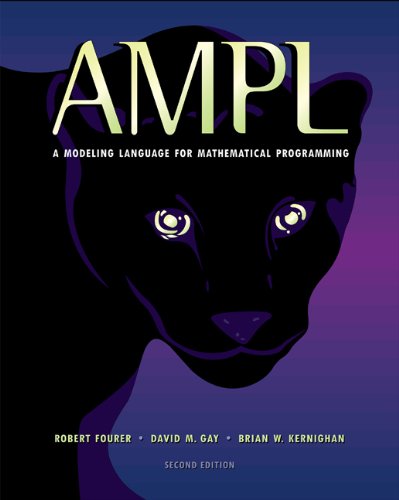
Ampl A Modeling Language for Mathematical Programming 2nd Edition by Robert Fourer ,David M Gay ,Brian W Kernighan ISBN 0534388094 978-0534388096


Original price was: $50.00.$35.00Current price is: $35.00.
Ampl A Modeling Language for Mathematical Programming 2nd Edition by Robert Fourer ,David M.Gay ,Brian W.Kernighan – Ebook PDF Instant Download/Delivery:0534388094 ,978-0534388096
Full download Ampl A Modeling Language for Mathematical Programming 2nd Edition after payment
Product details:
ISBN 10:0534388094
ISBN 13:978-0534388096
Author:Robert Fourer ,David M.Gay ,Brian W.Kernighan
AMPL is a language for large-scale optimization and mathematical programming problems in production, distribution, blending, scheduling, and many other applications. Combining familiar algebraic notation and a powerful interactive command environment, AMPL makes it easy to create models, use a wide variety of solvers, and examine solutions. Though flexible and convenient for rapid prototyping and development of models, AMPL also offers the speed and generality needed for repeated large-scale production runs. This book, written by the creators of AMPL, is a complete guide for modelers at all levels of experience. It begins with a tutorial on widely used linear programming models, and presents all of AMPL’s features for linear programming with extensive examples. Additional chapters cover network, nonlinear, piecewise-linear, and integer programming; database and spreadsheet interactions; and command scripts. Most chapters include exercises. Download free versions of AMPL and several solvers from www.ampl.com for experimentation, evaluation, and education. The Web site also lists vendors of the commercial version of AMPL and numerous solvers.
Table of contents:
Chapter 1. Production Models: Maximizing Profits
1.1 A two-variable linear program
1.2 The two-variable linear program in AMPL
1.3 A linear programming model
1.4 The linear programming model in AMPL
-
The basic model
-
An improved model
-
Catching errors
1.5 Adding lower bounds to the model
1.6 Adding resource constraints to the model
1.7 AMPL interfaces
Chapter 2. Diet and Other Input Models: Minimizing Costs
2.1 A linear program for the diet problem
2.2 An AMPL model for the diet problem
2.3 Using the AMPL diet model
2.4 Generalizations to blending, economics, and scheduling
Chapter 3. Transportation and Assignment Models
3.1 A linear program for the transportation problem
3.2 An AMPL model for the transportation problem
3.3 Other interpretations of the transportation model
Chapter 4. Building Larger Models
4.1 A multicommodity transportation model
4.2 A multiperiod production model
4.3 A model of production and transportation
Chapter 5. Simple Sets and Indexing
5.1 Unordered sets
5.2 Sets of numbers
5.3 Set operations
5.4 Set membership operations and functions
5.5 Indexing expressions
5.6 Ordered sets
5.7 Predefined setsand interval expressions
Chapter 6. Compound Sets and Indexing
6.1 Sets of ordered pairs
6.2 Subsets and slices of ordered pairs
6.3 Sets of longer tuples
6.4 Operations on sets of tuples
6.5 Indexed collections of sets
Chapter 7. Parameters and Expressions
7.1 Parameter declarations
7.2 Arithmetic expressions
7.3 Logical and conditional expressions
7.4 Restrictions on parameters
7.5 Computed parameters
7.6 Randomly generated parameters
7.7 Logical parameters
7.8 Symbolic parameters
Chapter 8. Linear Programs: Variables, Objectives, and Constraints
8.1 Variables
8.2 Linear expressions
8.3 Objectives
8.4 Constraints
Chapter 9. Specifying Data
9.1 Formatted data: the data command
9.2 Data in lists
-
Lists of one-dimensional sets and parameters
-
Lists of two-dimensional sets and parameters
-
Lists of higher-dimensional sets and parameters
-
Combined lists of sets and parameters
9.3 Data in tables -
Two-dimensional tables
-
Two-dimensional slices of higher-dimensional data
-
Higher-dimensional tables
-
Choice of format
9.4 Other features of data statements -
Default values
-
Indexed collections of sets
-
Initial values for variables
Chapter 10. Database Access
10.1 General principles of data correspondence
10.2 Examples of table-handling statements
10.3 Reading data from relational tables
-
Reading parameters only
-
Reading a set and parameters
-
Establishing correspondences
-
Reading other values
10.4 Writing data to relational tables -
Writing rows inferred from the data specifications
-
Writing rows inferred from a key specification
10.5 Reading and writing the same table -
Reading and writing using two table declarations
-
Reading and writing using the same table declaration
10.6 Indexed collections of tables and columns -
Indexed collections of tables
-
Indexed collections of data columns
10.7 Standard and built-in table handlers -
Using the standard ODBC table handler
-
Using the standard ODBC table handler with Access and Excel
-
Built-in table handlers for text and binary files
Chapter 11. Modeling Commands
11.1 General principles of commands and options
-
Commands
-
Options
11.2 Setting up and solving models and data -
Entering models and data
-
Solving a model
11.3 Modifying data -
Resetting
-
Resampling
-
The let command
11.4 Modifying models -
Removing or redefining model components
-
Changing the model: fix, unfix; drop, restore
-
Relaxing integrality
Chapter 12. Display Commands
12.1 Browsing through results: the display command
-
Displaying sets
-
Displaying parameters and variables
-
Displaying indexed expressions
12.2 Formatting options for display
12.3 Arrangement of lists and tables
12.4 Control of line width
12.5 Suppression of zeros
12.6 Numeric options for display
12.7 Appearance of numeric values -
Rounding of solution values
-
Other output commands: print and printf
-
The print command
-
The printf command
-
Related solution values
-
Objective functions
-
Bounds and slacks
-
Dual values and reduced costs
-
Other display features for models and instances
-
Displaying model components: the show command
-
Displaying model dependencies: the xref command
-
Displaying model instances: the expand command
-
Generic synonyms for variables, constraints, and objectives
-
Resource listings
-
General facilities for manipulating output
-
Redirection of output
-
Output logs
-
Limits on messages
Chapter 13. Command Scripts
13.1 Running scripts: include and commands
13.2 Iterating over a set: the for statement
13.3 Iterating subject to a condition: the repeat statement
13.4 Testing a condition: the if-then-else statement
13.5 Terminating a loop: break and continue
13.6 Stepping through a script
13.7 Manipulating character strings
-
String functions and operators
-
String expressions in AMPL commands
Chapter 14. Interactions with Solvers
14.1 Presolve
-
Activities of the presolve phase
-
Controlling the effects of presolve
-
Detecting infeasibility in presolve
14.2 Retrieving results from solvers -
Solve results
-
Solver statuses of objectives and problems
-
Solver statuses of variables
-
Solver statuses of constraints
-
AMPL statuses
14.3 Exchanging information with solvers via suffixes -
User-defined suffixes: integer programming directives
-
Solver-defined suffixes: sensitivity analysis
-
Solver-defined suffixes: infeasibility diagnosis
-
Solver-defined suffixes: direction of unboundedness
-
Defining and using suffixes
14.4 Alternating between models
14.5 Named problems -
Defining named problems
-
Using named problems
-
Displaying named problems
-
Defining and using named environments
Chapter 15. Network Linear Programs
15.1 Minimum-cost transshipment models
-
A general transshipment model
-
Specialized transshipment models
-
Variations on transshipment models
15.2 Other network models -
Maximum flow models
-
Shortest path models
-
Transportation and assignment models
15.3 Declaring network models by node and arc -
A general transshipment model
-
A specialized transshipment model
-
Variations on transshipment models
-
Maximum flow models
15.4 Rules for node and arc declarations -
node declarations
-
arc declarations
-
Interaction with objective declarations
-
Interaction with constraint declarations
-
Interaction with variable declarations
15.5 Solving network linear programs
Chapter 16. Columnwise Formulations
16.1 An input-output model
-
Formulation by constraints
-
A columnwise formulation
-
Refinements of the columnwise formulation
16.2 A scheduling model
16.3 Rules for columnwise formulations
Chapter 17. Piecewise-Linear Programs
17.1 Cost terms
-
Fixed numbers of pieces
-
Varying numbers of pieces
17.2 Common two-piece and three-piece terms -
Penalty terms for ‘‘soft’’ constraints
-
Dealing with infeasibility
-
Reversible activities
17.3 Other piecewise-linear functions
17.4 Guidelines for piecewise-linear optimization -
Forms for piecewise-linear expressions
-
Suggestions for piecewise-linear models
Chapter 18. Nonlinear Programs
18.1 Sources of nonlinearity
-
Dropping a linearity assumption
-
Achieving a nonlinear effect
-
Modeling an inherently nonlinear process
18.2 Nonlinear variables -
Initial values of variables
-
Automatic substitution of variables
18.3 Nonlinear expressions
18.4 Pitfalls of nonlinear programming -
Function range violations
-
Multiple local optima
-
Other pitfalls
Chapter 19. Complementarity Problems
19.1 Sources of complementarity
-
A complementarity model of production economics
-
Complementarity for bounded variables
-
Complementarity for price-dependent demands
-
Other complementarity models and applications
19.2 Forms of complementarity constraints
19.3 Working with complementarity constraints -
Related solution values
-
Presolve
-
Generic synonyms
Chapter 20. Integer Linear Programs
20.1 Integer variables
20.2 Zero-one variables and logical conditions
-
Fixed costs
-
Zero-or-minimum restrictions
-
Cardinality restrictions
20.3 Practical considerations in integer programming
People also search for:
programming in modula-2
mathematical modelling language
a modeling language for mathematical optimization
what is mathematical modelling
modeling language for mathematical programming
Tags: Robert Foure , David M Gay, Brian W Kernighan, Ampl, Mathematical