

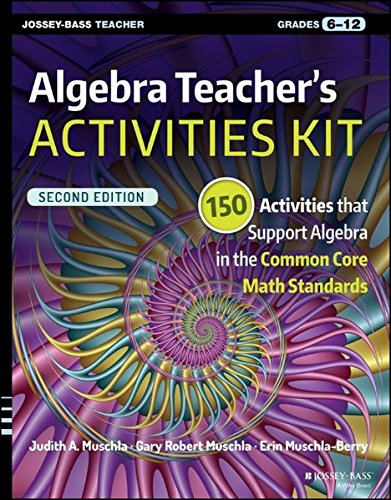
Algebra Teacher s Activities Kit 150 Activities that Support Algebra in the Common Core Math Standards Grades 6 12 2nd Edition by Judith A Muschla, Gary Robert Muschla, Erin Muschla Berry ISBN 1119045746 9781119045748
Original price was: $50.00.$35.00Current price is: $35.00.
Algebra Teacher s Activities Kit 150 Activities that Support Algebra in the Common Core Math Standards Grades 6 12 2nd Edition by Judith A Muschla, Gary Robert Muschla, Erin Muschla Berry – Ebook PDF Instant Download/Delivery: 1119045746, 9781119045748
Full download Algebra Teacher s Activities Kit 150 Activities that Support Algebra in the Common Core Math Standards Grades 6 12 2nd Edition after payment
Product details:
ISBN 10: 1119045746
ISBN 13: 9781119045748
Author: Judith A Muschla, Gary Robert Muschla, Erin Muschla Berry
Algebra Teacher s Activities Kit 150 Activities that Support Algebra in the Common Core Math Standards Grades 6 12 2nd Table of contents:
Section 1:Ratios and Proportional Relationships
Teaching Notes for the Activities of Section 1
1-1: (6.RP.1) Understanding Ratios
1-2: (6.RP.2) Unit Rates and Ratios
1-3: (6.RP.3) Equivalent Ratios and the Coordinate Plane
1-4: (6.RP.3) Finding the Percent of a Number and Finding the Whole
1-5: (7.RP.1) Finding Unit Rates
1-6: (7.RP.2) Graphing Proportional Relationships
1-7: (7.RP.2) Representing Proportional Relationships
1-8: (7.RP.3) Solving Word Problems Involving Percents
Reproducibles for Section 1
Section 2:The Number System and Number and Quantity
Teaching Notes for the Activities of Section 2
2-1: (6.NS.5) Representing Positive and Negative Numbers
2-2: (6.NS.6) Graphing Rational Numbers on a Number Line
2-3: (6.NS.6) Graphing Points in the Coordinate Plane
2-4: (6.NS.7) The Absolute Value and Order of Rational Numbers
2-5: (6.NS.8) Using the Coordinate Plane to Solve Problems
2-6: (7.NS.1) Using the Number Line to Add and Subtract Rational Numbers
2-7: (7.NS.1) Using Properties to Add and Subtract Rational Numbers
2-8: (7.NS.2) Multiplying and Dividing Rational Numbers
2-9: (7.NS.2) Converting Rational Numbers to Decimals
2-10: (7.NS.3) Solving Word Problems Involving Rational Numbers
2-11: (8.NS.1) Expressing Fractions as Repeating Decimals and Repeating Decimals as Fractions
2-12: (8.NS.2) Using Rational Approximations of Irrational Numbers
2-13: (N-RN.1) Using the Properties of Exponents
2-14: (N-RN.2) Rewriting Expressions Involving Radicals and Rational Exponents
2-15: (N-RN.3) Sums and Products of Rational and Irrational Numbers
2-16: (N-Q.1) Interpreting and Using Units
2-17: (N-Q.2) Defining Appropriate Quantities
2-18: (N-Q.3) Choosing Appropriate Levels of Accuracy for Measurement
2-19: (N-CN.1) Writing Complex Numbers
2-20: (N-CN.2) Adding, Subtracting, and Multiplying Complex Numbers
2-21: (N-CN.7) Solving Quadratic Equations That Have Complex Solutions
Reproducibles for Section 2
Section 3:Basic Expressions, Equations, and Inequalities
Teaching Notes for the Activities of Section 3
3-1: (6.EE.1) Writing and Evaluating Numerical Expressions with Whole-Number Exponents
3-2: (6.EE.2) Writing and Reading Algebraic Expressions
3-3: (6.EE.2) Evaluating Algebraic Expressions
3-4: (6.EE.3) Applying Properties of Operations to Generate Equivalent Expressions
3-5: (6.EE.4) Identifying Equivalent Expressions
3-6: (6.EE.5) Identifying Solutions of Equations and Inequalities
3-7: (6.EE.6) Writing Expressions in Which Variables Represent Numbers
3-8: (6.EE.7) Writing and Solving Equations
3-9: (6.EE.8) Using Inequalities
3-10: (6.EE.9) Using Variables to Represent Two Quantities
3-11: (7.EE.1) Adding, Subtracting, Factoring, and Expanding Linear Expressions
3-12: (7.EE.2) Rewriting Expressions in Different Forms
3-13: (7.EE.3) Solving Multi-Step Problems
3-14: (7.EE.4) Solving Equations and Inequalities
3-15: (8.EE.1) Applying Properties of Integer Exponents
3-16: (8.EE.2) Using Square Roots and Cube Roots
3-17: (8.EE.3) Using Numbers Expressed in Scientific Notation
3-18: (8.EE.4) Operations with Scientific Notation
3-19: (8.EE.5) Graphing Proportional Relationships
3-20: (8.EE.6) Deriving the Equation y = mx
3-21: (8.EE.7) Identifying Equations That Have One Solution, No Solutions, or Infinitely Many Soluti
3-22: (8.EE.7) Solving Equations with Variables on Both Sides
3-23: (8.EE.8) Solving Systems of Linear Equations Algebraically
3-24: (8.EE.8) Solving Systems of Equations by Graphing
Reproducibles for Section 3
Section 4:Polynomial, Rational, Exponential, and Radical Expressions, Equations, and Inequalities
Teaching Notes for the Activities of Section 4
4-1: (A-SSE.1) Interpreting Expressions
4-2: (A-SSE.2) Using the Structure of an Expression to Identify Ways to Rewrite It
4-3: (A-SSE.3) Factoring Quadratic Expressions to Reveal Zeroes
4-4: (A-SSE.3) Completing the Square to Reveal Maximum or Minimum Values
4-5: (A-SSE.4) Finding Sums of Finite Geometric Series
4-6: (A-APR.1) Adding, Subtracting, and Multiplying Polynomials
4-7: (A-APR.2) Applying the Remainder Theorem
4-8: (A-APR.3) Using Zeroes to Construct a Rough Graph of a Polynomial Function
4-9: (A-APR.4) Proving Polynomial Identities
4-10: (A-APR.6) Rewriting Rational Expressions
4-11: (A-CED.1) Writing and Solving Equations and Inequalities in One Variable
4-12: (A-CED.2) Writing and Graphing Equations in Two Variables
4-13: (A-CED.3) Representing Constraints and Interpreting Solutions
4-14: (A-CED.4) Highlighting Quantities of Interest in Formulas
4-15: (A-REI.1) Justifying Solutions to Equations
4-16: (A-REI.2) Solving Rational and Radical Equations
4-17: (A-REI.3) Solving Multi-Step Linear Equations in One Variable
4-18: (A-REI.3) Solving Multi-Step Linear Inequalities in One Variable
4-19: (A-REI.4) Solving a Quadratic Equation by Completing the Square
4-20: (A-REI.4) Solving Quadratic Equations in a Variety of Ways
4-21: (A-REI.5) Solving Systems of Equations
4-22: (A-REI.6) Solving Systems of Linear Equations
4-23: (A.REI.7) Solving a System of a Linear and a Quadratic Equation
4-24: (A-REI.10) Relating Graphs to the Solutions of Equations
4-25: (A-REI.11) Using Graphs and Tables to Find Solutions to Systems of Equations
4-26: (A-REI.12) Solving Systems of Inequalities by Graphing
Reproducibles for Section 4
Section 5:Functions
Teaching Notes for the Activities of Section 5
5-1: (8.F.1) Identifying Functions
5-2: (8.F.2) Comparing Functions
5-3: (8.F.3) Determining Whether Data Lies on a Line
5-4: (8.F.4) Finding the Slope and Y-Intercept of a Line
5-5: (8.F.5) Analyzing and Graphing Functions
5-6: (F-IF.1) Understanding Functions
5-7: (F-IF.2) Finding the Values of Functions
5-8: (F-IF.3) Defining Sequences Recursively
5-9: (F-IF.4) Identifying Key Features of Graphs
5-10: (F-IF.5) Relating the Domain of a Function to Its Graph or Description
5-11: (F-IF.6) Finding the Average Rate of Change over Specified Intervals
5-12: (F-IF.7) Graphing Linear and Quadratic Functions
5-13: (F-IF.7) Graphing Polynomial Functions
5-14: (F-IF.8) Rewriting Quadratic Equations
5-15: (F-IF.9) Comparing Properties of Functions
5-16: (F-BF.1) Writing Functions
5-17: (F-BF.2) Writing Arithmetic and Geometric Sequences
5-18: (F-BF.3) Transforming a Function
5-19: (F-BF.4) Finding the Inverses of Functions
5-20: (F-LE.1) Proving Linear Functions Grow by Equal Differences over Equal Intervals
5-21: (F-LE.1) Proving Exponential Functions Grow by Equal Factors over Equal Intervals
5-22: (F-LE.2) Constructing Linear and Exponential Functions
5-23: (F-LE.3) Observing the Behavior of Quantities That Increase Exponentially
5-24: (F-LE.4) Writing and Solving Exponential Equations
5-25: (F-LE.5) Interpreting Parameters in a Linear or Exponential Function
5-26: (F-TF.1) Using Radian and Degree Measures
5-27: (F-TF.2) Using the Unit Circle
5-28: (F-TF.5) Modeling Periodic Phenomena
5-29: (F-TF.8) Finding the Values of the Sine, Cosine, and Tangent Functions
Reproducibles for Section 5
Section 6:Statistics and Probability
Teaching Notes for the Activities of Section 6
6-1: (6.SP.1) Identifying Statistical Questions
6-2: (6.SP.2) Describing Data Distributions
6-3: (6.SP.3) Finding the Mean, Median, Mode, and Range
6-4: (6.SP.4) Using Dot Plots to Display Data
6-5: (6.SP.4) Constructing a Box Plot
6-6: (6.SP.5) Summarizing and Describing Data
6-7: (7.SP.1) Drawing Inferences from Samples
6-8: (7.SP.2) Drawing Inferences about a Population Using Random Samples
6-9: (7.SP.3) Comparing Two Data Sets
6-10: (7.SP.4) Drawing Inferences about Populations
6-11: (7.SP.5) Understanding the Probability of Events
6-12: (7.SP.6) Probabilities and Predictions
6-13: (7.SP.7) Using Probability Models to Find Probabilities of Events
6-14: (7.SP.8) Understanding the Probability of Compound Events
6-15: (7.SP.8) Finding Probabilities of Compound Events Using Tables, Lists, and Tree Diagrams
6-16: (8.SP.1) Constructing and Interpreting Scatter Plots
6-17: (8.SP.2) Fitting Lines to Data
6-18: (8.SP.3) Using Equations of Linear Models
6-19: (8.SP.4) Constructing and Interpreting Two-Way Tables
6-20: (S-ID.1) Representing Data with Plots on the Real Number Line
6-21: (S-ID.2) Comparing Two Data Sets
6-22: (S-ID.3) Interpreting Differences in Shape, Center, and Spread of Data Distributions
6-23: (S-ID.4) Recognizing Characteristics of Normal Distributions
6-24: (S-ID.5) Summarizing Categorical Data in Two-Way Frequency Tables
6-25: (S-ID.6) Finding the Equation of the Line of Best Fit
6-26: (S-ID.6) Using Linear and Quadratic Models
6-27: (S-ID.7) Interpreting the Slope and Y-Intercept of a Linear Model
6-28: (S-ID.8) Computing and Interpreting the Correlation Coefficient
6-29: (S-ID.9) Distinguishing between Correlation and Causation
6-30: (S-IC.1) Understanding the Terminology of Statistical Experiments
6-31: (S-IC.2) Evaluating Probability Models through Simulations
6-32: (S-IC.3) Recognizing Surveys, Experiments, and Observational Studies
6-33: (S-IC.4) Using Simulations with Random Sampling
6-34: (S-IC.5) Comparing Two Treatments Using Simulations
6-35: (S-IC.6) Evaluating Data in Reports
6-36: (S-CP.1) Describing Events as Subsets of a Sample Space
6-37: (S-CP.2) Identifying Independent Events
6-38: (S-CP.3) Interpreting Conditional Probability
6-39: (S-CP.4) Understanding Two-Way Frequency Tables
6-40: (S-CP.5) Exploring Concepts of Conditional Probability
6-41: (S-CP.6) Finding Conditional Probabilities as a Fraction of Outcomes
6-42: (S-CP.7) Applying the Addition Rule
People also search for Algebra Teacher s Activities Kit 150 Activities that Support Algebra in the Common Core Math Standards Grades 6 12 2nd:
algebra teachers activity kit
algebra teacher’s activities kit
algebra activities instructor’s resource binder answers
algebra 1 unit 4 teacher guide
z activity
Tags: Judith A Muschla, Gary Robert Muschla, Erin Muschla Berry, Algebra Teacher, Algebra, Math Standards