

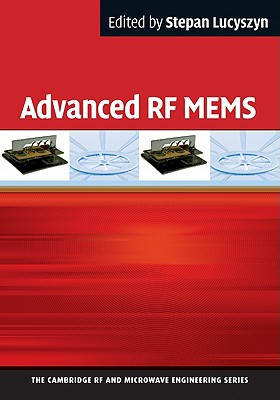
Advanced RF MEMS 1st Edition by Stepan Lucyszyn ISBN 0511914741 9780511916557


Original price was: $50.00.$35.00Current price is: $35.00.
Advanced RF MEMS 1st Edition by Stepan Lucyszyn – Ebook PDF Instant Download/Delivery: 0511914741, 9780511916557
Full download Advanced RF MEMS 1st Edition after payment
Product details:
ISBN 10: 0511914741
ISBN 13: 9780511916557
Author: Stepan Lucyszyn
Advanced RF MEMS 1st Table of contents:
1 Introduction
1.1 Introduction
1.1.1 Defining terms
1.1.2 Enabling technology roadmap
1.2 Fabrication technologies
1.3 Electromechanical actuation
1.4 Generic RF MEMS components
1.4.1 Switches
1.4.2 Variable capacitors
1.4.3 Antennas
1.5 Circuits and subsystems
1.6 Conclusions
References
2 Electromechanical modelling of electrostatic actuators
2.1 Introduction
2.2 Energy methods and the equilibrium/momentum equation
2.3 Static equilibrium and stability
2.3.1 Actuators with one degree of freedom
2.3.2 Actuators with several degrees of freedom
2.3.3 Distributed systems
2.3.4 Numerical methods
2.4 Dynamic response of electrostatic actuators
2.4.1 Dynamic pull-in of a one-DOF system
2.4.2 Dynamic pull-in of the clamped-clamped beam actuator
2.4.3 Switching time of electrostatic actuators
2.5 Conclusions
References
3 Switches and their fabrication technologies
3.1 Introduction
3.2 Substrate materials and fabrication technologies
3.3 Actuation principles
3.3.1 Capacitive switches with electrostatic actuation
3.3.2 Ohmic switches with electrostatic actuation
3.3.3 Switches with piezoelectric actuation
3.3.4 Switches with electrothermal and electromagnetic actuation
3.4 Switch building blocks
3.4.1 Metallisation
3.4.2 Capacitive switch dielectrics
3.4.3 Ohmic switch contacts
3.4.4 Sacrificial layers
3.4.5 Moveable structures
References
4 Niche switch technologies
4.1 Introduction
4.2 Latching switches
4.2.1 Magnetically actuated bistable switches
4.2.2 Electrothermally actuated bistable switches
4.2.3 Electrostatic bistable switch
4.2.4 Mechanically latching switches
4.3 Multiway switches
4.3.1 SPDT switches
4.3.2 SP4T switches
4.3.3 SP6T switches
4.3.4 SP8T switches
4.3.5 SP9T switches and SP48T modules
4.3.6 DPDT switches
4.3.7 Switch matrices
4.4 High-power switches
4.4.1 Additional hold electrodes
4.4.2 Beam cross section
4.4.3 Switching arrays
4.4.4 Contact force
4.4.5 Materials
4.4.6 Non-beam architectures
4.4.7 Unconventional 3D power switch
4.4.8 RF power measurements
References
5 Reliability
5.1 Introduction
5.1.1 Terminology
5.1.2 Failure- and application-driven reliability methodology
5.2 Failure mechanisms in RF MEMS
5.2.1 Creep/stress relaxation
5.2.2 Temperature- and stress-induced plastic deformation
5.2.3 Temperature-induced elastic deformation
5.2.4 Fatigue
5.2.5 Stiction
5.2.5.1 Introduction
5.2.5.2 Microwelding
5.2.5.3 Dielectric charging
5.2.6 Electromigration
5.2.7 Self-actuation
5.2.7.1 Lorentz forces
5.2.7.2 Self-biasing due to RF power
5.2.7.3 Self-actuation due to drop or shock
5.2.8 Fly-catching effect
5.2.9 Outgassing and adsorption
5.2.10 Mechanical and acoustic coupling
5.3 Conclusions
5.4 Acknowledgments
References
6 Dielectric charging
6.1 Introduction
6.2 Dielectric charging in MEMS
6.2.1 Capacitance-voltage characteristic
6.2.2 Switch-ON and switch-OFF capacitance transients
6.2.3 Shift in pull-in and pull-out voltages
6.2.4 Lifetime tests, material and environmental effects
6.2.5 Dielectric charging in MIM capacitors
6.2.6 Kelvin probe force microscopy
6.3 Dielectric polarisation
6.3.1 Dipolar polarisation
6.3.2 Space-charge polarisation
6.3.3 Interfacial polarisation
6.4 Charge injection mechanisms
6.4.1 Trap-assisted tunnelling
6.4.2 Poole-frenkel process
6.4.3 Schottky injection
6.5 Conclusions
References
7 Stress and thermal characterisation
7.1 Introduction
7.2 Theoretical background
7.2.1 Stress tensor
7.2.2 Strain tensor
7.2.3 Thermal transfer
7.2.4 Origin of stress and temperature
7.3 Stress and temperature effects
7.3.1 Temperature dependence of resonance frequency in BAW resonators
7.3.2 Thermoelastic deformations in tuneable capacitors
7.4 Stress and temperature measurement
7.4.1 X-ray diffraction for stress determination
7.4.2 Infrared thermography for temperature determination
7.4.3 Other methods
7.5 Conclusions
References
8 High-power handling
8.1 Introduction
8.2 RF power handling related phenomena
8.2.1 Electromigration
8.2.2 Self-biasing and RF latching
8.2.3 Electromagnetic-induced thermoelectromechanical effects
8.2.3.1 Experimental investigation of self-heating due to RF power
8.2.3.2 Numerical investigation of self-heating due to RF power
8.3 Overview of power handling RF MEMS components
8.3.1 Capacitive switches and varactors
8.3.2 Ohmic contact switches
8.4 Conclusions
References
9 Packaging
9.1 Introduction
9.2 Zero-level packaging
9.2.1 Design considerations and performance
9.2.2 Technologies and materials for the zero-level package
9.2.2.1 Thin-film encapsulation
9.2.2.2 Chip capping
9.3 Package integration
9.3.1 Multiple MEMS in a single package
9.3.2 Integrated RF MEMS
9.3.2.1 System-on-chip versus system-in-package
9.3.2.2 RF MEMS planar system-in-package
9.3.2.3 RF MEMS 3D system-in-package
9.4 Conclusions
References
10 Impedance tuners and
10.1 Introduction
10.2 Impedance tuners
10.2.1 Stub-tuner design
10.2.1.1 Stub topologies
10.2.1.2 Tuning methods
10.2.2 Stub-based impedance tuners and matching networks
10.2.3 Distributed impedance tuners and matching networks
10.2.3.1 Slug tuners
10.2.3.2 DMTL tuners
10.2.3.3 DGS-based tuners
10.2.3.4 Other switchable tuner architectures
10.2.4 Discussion on impedance tuners and matching networks
10.3 Tuneable filters
10.3.1 Tuning technologies for filters
10.3.2 RF MEMS-based filters
10.3.2.1 Reconfigurable filter design basics
10.3.2.2 Analogue versus digital tuning
10.3.2.3 Discussion on future challenges for filter designers
10.4 Conclusions
References
11 Phase shifters and tuneable
11.1 Introduction
11.1.1 Definition and applications
11.1.2 Technologies
11.1.3 Specifications
11.2 Reflection-type phase shifters
11.2.1 Theoretical analysis
11.2.1.1 Capacitive load
11.2.1.2 Series LC load
11.2.2 Directional couplers
11.2.3 Analogue implementations
11.2.4 Digital implementations
11.2.5 Phase variation and bandwidth
11.2.6 State of the art
11.3 Phase shifters based on LC networks
11.3.1 Low/high-pass networks
11.3.2 All-pass networks
11.3.3 State of the art
11.4 Loaded-line phase shifters
11.4.1 Theoretical analysis
11.4.2 Practical implementation and state of the art
11.5 Switched delay-line phase shifters
11.5.1 Principle and design issues
11.5.2 State of the art
11.6 Distributed loaded-line phase shifters
11.6.1 Theoretical analysis
11.6.2 Practical implementation
11.6.3 State of the art
11.7 General issues
11.7.1 Power handling
11.7.2 Noise and linearity
11.8 Conclusions
References
12 Reconfigurable architectures
12.1 Introduction
12.2 Reconfigurable radios
12.2.1 General architectures
12.2.2 Handset front-ends
12.2.3 Base stations
12.2.4 Multiband and tracking receivers
12.3 Reconfigurable antennas
12.3.1 Beam-steering antennas
12.3.1.1 Phased-array antennas
12.3.1.2 Reflectarray antennas
12.3.1.3 Lenses, grids and frequency-selective surfaces
12.3.1.4 Switched-diversity antenna arrays
12.3.2 Handset antennas
12.4 Measurement applications
12.4.1 Multifunctional RFOW probes
12.5 Conclusions
References
13 Industry roadmap for RF MEMS
13.1 Introduction
13.2 Roadmap of RF MEMS components
13.2.1 RF MEMS switches
13.2.1.1 Current state of the art and potential improvements
13.2.1.2 RF MEMS switches versus alternative technologies
13.2.1.3 Switch applications roadmap
13.2.2 Tuneable capacitors
13.2.2.1 Current state of the art and potential for improvements
13.2.2.2 Alternative technologies
13.2.2.3 Capacitor applications roadmap
13.2.3 Emerging RF MEMS and RF NEMS components
13.2.3.1 Tuneable inductors
13.2.3.2 CNT-based RF NEMS
13.3 Applications roadmap
13.3.1 RF MEMS for mobile and wireless systems
13.3.1.1 Mobile handsets
13.3.1.1.1 Impedance matching
13.3.1.1.2 Filtering applications
13.3.1.1.3 Voltage-controlled oscillators
13.3.1.1.4 Comprehensive RF MEMS roadmap
13.3.1.2 Base stations
13.3.1.2.1 Reconfigurable impedance-matching networks
13.3.1.2.2 Reconfigurable or tuneable filters
13.3.1.2.3 Multiband synthesisers
13.3.1.3 Wireless interconnections
13.3.1.3.1 60 GHz WLAN
13.3.1.3.2 Cognitive radio
13.3.1.3.3 Wireless sensor networks and RFID
13.3.2 RF MEMS for road transport applications
13.3.2.1 Automotive radar
13.3.2.2 Roof antennas
13.3.3 RF MEMS for aeronautics
13.3.4 RF MEMS for satellites
13.3.4.1 Potential applications of RF MEMS in satellites
13.3.4.1.1 RF MEMS switches
13.3.4.1.2 Analogue tuneable capacitors
13.3.4.2 Roadmap of RF MEMS for satellites
13.4 Implementation of the roadmap
13.4.1 Modelling and design
13.4.2 Materials and processes
13.4.3 Heterogeneous integration, assembly and packaging
13.4.4 Testing, characterisation and reliability
People also search for Advanced RF MEMS 1st:
rf-mems
the advanced multifunction rf concept
rf-mems technology for high-performance passives
advanced energy rf
rf advance
Tags: Stepan Lucyszyn, RF MEMS