

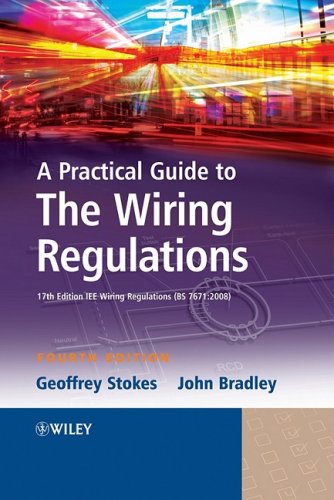

A practical guide to the wiring regulations 17th Edition by Geoffrey Stokes, John Bradley – Ebook PDF Instant Download/Delivery: 1405177012, 9781405177016
Full download A practical guide to the wiring regulations 17th Edition after payment

Product details:
ISBN 10: 1405177012
ISBN 13: 9781405177016
Author: Geoffrey Stokes, John Bradley
It includes essential information on the new rules applied to special installations or locations, such as bathrooms, swimming pool locations, camping/caravan sites, marinas, exhibition and show locations, solar photovoltaic power supply systems, and floor and ceiling heating systems, amongst others. It presents clear explanations on inspection, testing, certification and reporting, test instruments and test methods, as well as covering:
- electricity, the law, standards and codes of practice;
- assessment of general characteristics;
- protection against electric shock, thermal effects, overcurrent, undervoltage and overvoltage;
- isolation and switching;
- the common rules of equipment selection;
- switchgear, protective devices and other equipment;
- wiring systems (including the external influences on them and cable installation methods);
- protective conductors, earthing and protective bonding;
- supplies for safety services;
- the smaller installation, and;
- specialised installations, such as outdoor lighting, installations in churches, multi-occupancy blocks of flats.
These topics are addressed with pertinent regulation numbers, and a useful appendix lists the relevant Standards. Background guidance and worked examples are provided where appropriate.
Like the earlier editions of this text, this new edition will be a useful aid for designers, installers and verifiers of electrical installations, students of the industry wishing to gain better understanding of the many facets of electrical safety, and ‘duty holders’ as defined by the Electricity at Work Regulations 1989.
A practical guide to the wiring regulations 17th Table of contents:
1. Plan and Terminology of BS 7671:2008 and Supporting Publications
1.1 Plan of BS 7671:2008
1.2 Terminology of BS 7671:2008
1.3 Supporting Publications
2. Electricity, the Law, Standards and Codes of Practice
2.1 General
2.2 Electricity: The Hazards
2.3 The Law
2.4 Standards and Codes of Practice
3. Scope, Object and Fundamental Principles
3.1 General
3.2 Scope
3.3 Object and Effects
3.4 Fundamental Principles
4. Assessment of General Characteristics
4.1 General
4.2 Loading, Maximum Demand and Diversity
4.3 Arrangement of Live Conductors and Type of Earthing
4.4 Nature of Supply
4.5 Supplies for Safety Services and Standby Purposes
4.6 Installation Circuit Arrangements
4.7 External Influences
4.8 Compatibility
4.9 Maintainability
5. Protection Against Electric Shock
5.1 General
5.2 Provisions for Basic Protection
5.3 Protective Measure: Automatic Disconnection of Supply
5.4 Protective Measure: Double or Reinforced Insulation
5.5 Protective Measure: Electrical Separation
5.6 Protective Measure: Extra-Low Voltage Provided by SELV or PELV
5.7 Additional Protection
5.8 Obstacles and Placing Out of Reach
5.9 Protective Measures for Controlled or Supervised Installations
6. Protection Against Thermal Effects
6.1 General
6.2 Fire Caused by Electrical Equipment
6.3 Precautions Where Particular Risks of Fire Exist
6.4 Burns
7. Protection Against Overcurrent, Undervoltage and Overvoltage
7.1 General
7.2 Nature of Protective Devices
7.3 Protection Against Overload
7.4 Protection Against Fault Current
7.5 Determination of Prospective Fault Current
7.6 Characteristics of Protective Devices
7.7 Overcurrent Protection of Conductors in Parallel
7.8 Coordination of Overload and Fault Current Protection
7.9 Protection According to Nature of Circuits and Distribution Systems
7.10 Protection Against Undervoltage
7.11 Protection Against Overvoltage
8. Isolation and Switching
8.1 General
8.2 Main Switch
8.3 Isolation
8.4 Switching Off for Mechanical Maintenance
8.5 Emergency Switching and Other Forms of Safety Switching
8.6 Emergency Stopping
8.7 Functional Switching
8.8 Identification and Notices
9. Equipment Selection: Common Rules
9.1 General
9.2 Compliance with Standards
9.3 Operational Conditions, External Influences and Accessibility
9.4 Identification and Notices
9.5 Mutual Detrimental Influences
9.6 Compatibility
9.7 Operation and Maintenance Manual
10. Wiring Systems
10.1 Wiring Systems
10.2 External Influences
10.3 Proximity to Other Services: General
10.4 Methods of Installation of Cables
10.5 Resistances of Copper Conductors
10.6 Electrical Connections
10.7 Cable Supports and Cable Management Systems
10.8 Minimizing the Risk of Fire
10.9 Electromagnetic and Electromechanical Effects
10.10 Conduit and Trunking Cable Capacities
10.11 Maintainability
11. Switchgear, Protective Devices and Other Equipment
11.1 Switchgear and Protective Devices: General
11.2 Switchgear and Controlgear
11.3 Selection of Devices for Overload and Fault Current Protection
11.4 Overcurrent Protective Devices
11.5 Residual Current Devices
11.6 Identification of Overcurrent Protective Devices
11.7 Discrimination
11.8 Other Equipment
12. Protective Conductors, Earthing and Equipotential Bonding
12.1 Protective Conductors
12.2 Earthing
12.3 Earthing Requirements for Equipment with High Protective Conductor Currents
12.4 Protective Bonding
13. Specialized Installations
13.1 General
13.2 Emergency Lighting
13.3 Fire Detection and Alarm Systems
13.4 Petrol Filling and LPG Stations
13.5 Installations in Dusty Environments
13.6 Underground and Multistorey Car Parks
13.7 Multi-Occupancy Blocks of Flats
13.8 Section 20 Buildings
13.9 Churches
13.10 Thatched Properties
13.11 Extra-Low Voltage Lighting
13.12 Outdoor Lighting, Highway Power Supplies and Street Furniture
13.13 Security Lighting
13.14 Welding Equipment
13.15 Entertainers’ Equipment
13.16 Generator Sets
14. Safety Services
14.1 Safety Services: General
14.2 Common Sources
14.3 Parallel and Nonparallel Sources
14.4 Circuit and Equipment Requirements
14.5 Protection Against Overcurrent and Electric Shock Under Fault Conditions
15. The Smaller Installation
15.1 Scope
15.2 IEE On-Site Guide and NICEIC Domestic Electrical Installation Guide
15.3 User’s Requirements
15.4 Wiring Systems
15.5 Electricity Distributor’s Requirements
15.6 Assessment of Supply Characteristics
15.7 Meter Tails
15.8 System Earthing Arrangements
15.9 Main Protective Bonding
15.10 Minimum Cross-Sectional Area of Earthing and Main Bonding Conductors
15.11 Supplementary Bonding
15.12 Devices for Overcurrent and Fault Protection
15.13 Devices for Isolation and Switching
15.14 Final Circuit Design
15.15 Remote Buildings
15.16 Minimum Number of Socket-Outlets in Domestic Premises
15.17 Modifications to Existing Installations
15.18 Inspection, Testing, Verification and Certification
16. Special Installations and Locations
16.1 General
16.2 Locations Containing a Bath or Shower
16.3 Swimming Pools and Basins
16.4 Sauna Rooms and Cabins
16.5 Construction-Site Installations
16.6 Agricultural and Horticultural Premises
16.7 Conducting Locations with Restricted Movement
16.8 Caravan and Camping Parks
16.9 Marinas and Similar Locations
16.10 Exhibition Shows and Stands
16.11 Solar Photovoltaic Systems
16.12 Mobile or Transportable Units
16.13 Caravans and Motor Caravans
16.14 Temporary Installations for Fairs, Amusement Parks and Circuses
16.15 Floor and Ceiling Heating Systems
17. Inspection, Testing, Certification and Reporting
17.1 General
17.2 Test Instruments
17.3 Safety in Electrical Testing
17.4 Test Methods
17.5 Initial Verification
17.6 Periodic Inspection and Testing
17.7 Alterations and Additions
17.8 Specialized Installations
People also search for A practical guide to the wiring regulations 17th:
a practical guide to the wiring regulations 17th
a practical guide to connecticut school law
a practical guide to
a practical guide to the wiring regulations – pdf
a practical guide to the wiring


