

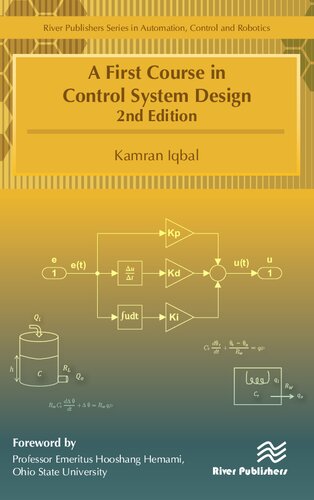
A First Course in Control System Design Book 2nd Edition by Kamran Iqbal ISBN 8770043280 978-8770043281


Original price was: $50.00.$35.00Current price is: $35.00.
A First Course in Control System Design Book 2nd Edition by Kamran Iqbal – Ebook PDF Instant Download/Delivery: 8770043280 , 978-8770043281
Full download A First Course in Control System Design Book 2nd edition after payment
Product details:
ISBN 10: 8770043280
ISBN 13: 978-8770043281
Author: Kamran Iqbal
Control systems are pervasive in our lives. Our homes have environmental controls. The appliances we use, such as the washing machine, microwave, etc. carry embedded controllers in them. We fly in airplanes and drive automobiles that extensively use control systems. The industrial plants that produce consumer goods run on process control systems. The recent drive toward automation has increased our reliance on control systems technology.This book discusses control systems design from a model-based perspective for dynamic system models of single-input single-output type. The emphasis in this book is on understanding and applying the techniques that enable the design of effective control systems in multiple engineering disciplines. The book covers both time-domain and the frequency-domain design methods, as well as controller design for both continuous-time and discrete-time systems. MATLAB© and its Control Systems Toolbox are extensively used for design.
A First Course in Control System Design Book 2nd Table of contents:
1 Mathematical Models of Physical Systems
1.1 Modeling of Physical Systems
1.1.1 Model Variables and Element Types
1.1.2 First-Order ODE Models
1.1.3 Solving First-Order ODE Models with Step Input
1.1.4 Second-Order ODE Models
1.1.5 Solving Second-Order ODE Models
1.2 Transfer Function Models
1.2.1 DC Motor Model
1.2.2 Industrial Process Models
1.3 State Variable Models
1.4 Linearization of Nonlinear Models
1.4.1 Linearization About an Operating Point
1.4.2 Linearization of a General Nonlinear Model
Skill Assessment Questions
2 Analysis of Transfer Function Models
2.1 Characterization of Transfer Function Models
2.1.1 System Poles and Zeros
2.1.2 System Natural Response
2.2 System Response to Inputs
2.2.1 The Impulse Response
2.2.2 The Step Response
2.2.3 Characterizing the System Transient Response
2.2.4 System Stability
2.3 Sinusoidal Response of a System
2.3.1 Sinusoidal Response of Low-Order Systems
2.3.2 Visualizing the Frequency Response
Skill Assessment Questions
3 Analysis of State Variable Models
3.1 State Variable Models
3.1.1 Solution to the State Equations
3.1.2 Laplace Transform Solution and Transfer Function
3.1.3 The State-Transition Matrix
3.1.4 Homogenous State Equation and Asymptotic Stability
3.1.5 System Response for State Variable Models
3.2 State Variable Realization of Transfer Function Models
3.2.1 Simulation Diagrams
3.2.2 Controller Form Realization
3.2.3 Dual (Observer Form) Realization
3.2.4 Modal Realization
3.2.5 Diagonalization and Decoupling
3.3 Linear Transformation of State Variables
3.3.1 Transformation into Controller Form
3.3.2 Transformation into Modal Form
Skill Assessment Questions
4 Feedback Control Systems
4.1 Static Gain Controller
4.2 Dynamic Controllers
4.2.1 First-Order Phase-Lead and Phase-Lag Controllers
4.2.2 The PID Controller
4.2.3 Rate Feedback Controllers
Skill Assessment Questions
5 Control System Design Objectives
5.1 Stability of the Closed-Loop System
5.1.1 Closed-Loop Characteristic Polynomial
5.1.2 Stability Determination by Algebraic Methods
5.1.3 Stability Determination from the Bode Plot
5.2 Transient Response Improvement
5.2.1 System Design Specifications
5.2.2 The Desired Characteristic Polynomial
5.2.3 Optimal Performance Indices
5.3 Steady-State Error Improvement
5.3.1 The Steady-State Error
5.3.2 System Error Constants
5.3.3 Steady-State Error to Ramp Input
5.4 Disturbance Rejection
5.5 Sensitivity and Robustness
Skill Assessment Questions
6 Control System Design with Root Locus
6.1 The Root Locus
6.1.1 Roots of the Characteristic Polynomial
6.1.2 Root Locus Rules
6.1.3 Obtaining Root Locus Plot in MATLAB
6.1.4 Stability from the Root Locus Plot
6.1.5 Analytic Root Locus Conditions
6.2 Static Controller Design
6.3 Dynamic Controller Design
6.3.1 Transient Response Improvement
6.3.2 Steady-State Error Improvement
6.3.3 Lead-Lag and PID Designs
6.3.4 Rate Feedback Compensation
6.3.5 Controller Designs Compared
6.4 Controller Realization
6.4.1 Phase-Lead/Phase-Lag Controllers
6.4.2 PD, PI, PID Controllers
Skill Assessment Questions
7 Design of Sampled-Data Systems
7.1 Models of Sampled-Data Systems
7.1.1 Z-transform
7.1.2 Zero-Order Hold
7.1.3 Pulse Transfer Function
7.2 Sampled-Data System Response
7.2.1 Difference Equation Solution by Iteration
7.2.2 Unit-Pulse Response
7.2.3 Unit-Step Response
7.2.4 Response to Arbitrary Inputs
7.3 Stability in the Case of Sampled-Data Systems
7.3.1 Jury’s Stability Test
7.3.2 Stability Through Bilinear Transform
7.4 Closed-Loop Sampled-Data Systems
7.4.1 Closed-Loop System Stability
7.4.2 Unit-Step Response
7.4.3 Steady-State Tracking Error
7.5 Controllers for Sampled-Data Systems
7.5.1 Root Locus Design of Digital Controllers
7.5.2 Analog and Digital Controller Design Compared
7.5.3 Digital Controller Design by Emulation
7.5.4 Emulation of Analog PID Controller
Skill Assessment Questions
8 Controller Design for State Variable Models
8.1 State Feedback Controller Design
8.1.1 Pole Placement with State Feedback
8.1.2 Pole Placement in the Controller Form
8.1.3 Pole Placement using Bass-Gura Formula
8.1.4 Pole Placement using Ackermann’s Formula
8.1.5 Pole Placement using Sylvester’s Equation
8.2 Tracking System Design
8.2.1 Tracking System Design with Feedforward Gain
8.2.2 Tracking PI Controller Design
8.3 State Variable Models of Sampled-Data Systems
8.3.1 Discretizing the State Equations
8.3.2 Solution to the Discrete State Equations
8.3.3 Pulse Transfer Function from State Equations
8.4 Controllers for Discrete State Variable Models
8.4.1 Emulating an Analog Controller
8.4.2 Pole Placement Design of Digital Controller
8.4.3 Deadbeat Controller Design
8.4.4 Tracking PI Controller Design
Skill Assessment Questions
9 Frequency Response Design of Compensators
9.1 Frequency Response Representation
9.1.1 The Bode Plot
9.1.2 The Nyquist Plot
9.2 Measures of Performance
9.2.1 Relative Stability
9.2.2 Phase Margin and the Transient Response
9.2.3 Error Constants and System Type
9.2.4 System Sensitivity
9.3 Frequency Response Design
9.3.1 Gain Compensation
9.3.2 Phase-Lag Compensation
9.3.3 Phase-Lead Compensation
9.3.4 Lead-Lag Compensation
9.3.5 PI Compensator
9.3.6 PD Compensator
9.3.7 PID Compensator
9.3.8 Compensator Designs Compared
9.4 Closed-Loop Frequency Response
People also search for A First Course in Control System Design Book 2nd :
a first course in database systems
a first course in systems biology
introduction to control system technology 7th edition pdf
a first course in design and analysis of experiments
a first course in design and analysis of experiments pdf
Tags: Kamran Iqbal, A First, Control System